Xavier Becerra leads Steve Hilton 57% to 35% among Latino likely voters, but the latest Berkeley poll suggests policy and opposition to Trump—not identity alone—are driving much of the support.
Xavier Becerra holds a clear advantage over Steve Hilton among California’s Latino voters, but a new statewide poll suggests something more complicated is happening beneath the numbers.
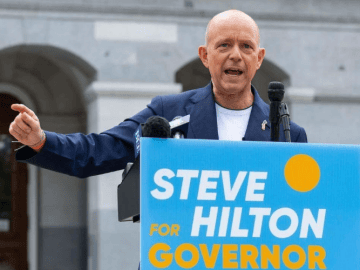
The latest Berkeley Institute of Governmental Studies poll finds Becerra, the Democratic candidate for governor, leading Republican Steve Hilton 57% to 35% among Latino likely voters, with 8% undecided.
Statewide, Becerra leads Hilton by 55% to 37%.
That means Latino voters currently give Becerra a 22-point advantage, four points larger than his statewide lead. But the numbers also show that Hilton has attracted more than one-third of Latino likely voters—making the Latino electorate important to both campaigns as the November election approaches.
The poll was conducted August 3–9 among 4,207 registered voters, including a weighted sample of 2,310 likely voters. The survey was conducted online in English and Spanish.
The most important number for Latino voters is straightforward:
57% Becerra.
35% Hilton.
8% undecided.
That is a strong advantage for Becerra, but it is not the kind of margin that makes the Latino electorate irrelevant to the Republican campaign.
Put differently, more than one in three Latino likely voters in the Berkeley survey currently backs Hilton.
That matters because California’s Latino electorate is large enough to influence statewide outcomes, while the political preferences of Latino voters can vary by age, region, income, immigration experience and other factors.
The Berkeley poll itself does not provide a Latino breakdown by region or by individual issues, so the numbers should not be interpreted as showing that all Latino communities are moving in the same direction.
Instead, the clearest conclusion is narrower: Becerra currently has a substantial advantage among Latino likely voters statewide, but Hilton retains a meaningful Latino constituency.
Parriva has followed this evolution throughout the campaign. In May, our coverage examined Becerra’s earlier surge among Latino voters as immigration and healthcare emerged as important themes in the primary. Xavier Becerra Surges Among Latino Voters as Immigration and Healthcare Drive California Governor Race
The new poll shows that Becerra’s support among Latino voters has continued into the general election—but it also gives us a new question to examine.
Are Latino voters supporting Becerra because he is Latino?
The answer from this poll is surprisingly clear: that is not the main reason Becerra supporters give for supporting him.
Among voters who support Becerra, the two largest reasons were tied at 38% each.
One group said the most important reason was that Becerra supports traditional Democratic policies, including expanding healthcare and protecting LGBTQ+ rights.
Another 38% said the most important reason was that Becerra would aggressively fight Trump administration policies.
Another 13% said simply that he is a Democrat.
Only 1% selected the candidate’s identity as a Latino and son of immigrants as the most important reason for their support.
That does not mean Becerra’s Latino identity has no political significance.
It does mean that the poll does not support the idea that Latino identity, by itself, is the principal explanation for his support.
That distinction is important in a state where Becerra could become the first Latino governor elected in modern California history.
Parriva previously explored that historical context in Before Xavier Becerra, There Was Romualdo Pacheco, examining why Becerra’s candidacy carries significance beyond the immediate election. Before Xavier Becerra, There Was Romualdo Pacheco
Representation matters. But this poll suggests voters supporting Becerra are more likely to describe their choice in terms of political values and the direction of government than ethnic identity.
The 38% who cited Becerra’s willingness to fight Trump administration policies deserve particular attention.
Combined with the 38% who cited traditional Democratic policies, those two motivations account for 76% of Becerra supporters’ primary reasons for backing him.
That gives the Democratic campaign a relatively clear political message: voters who support Becerra are largely responding to the policies he represents and the broader conflict between California Democrats and the Trump administration.
The finding also fits the candidate’s political history.
As California attorney general, Becerra became one of the most aggressive Democratic legal opponents of the Trump administration’s first term. That history is now part of the contrast between the two candidates.
But voters supporting Hilton are receiving a very different message.
Hilton’s Latino support points to a different political coalition
Among Hilton’s supporters, 55% said the most important reason for their support was that he backs traditional Republican policies such as lower taxes and reduced government regulations.
Another 28% said they support him because he is not part of the California political establishment.
Only 7% selected “a Republican,” while 4% cited his endorsement by President Trump.
That distinction matters.
Hilton’s Latino support cannot simply be described as evidence that Latino voters are becoming Republican. The poll does not establish that.
Instead, it shows that a significant share of Latino voters currently supporting Hilton are responding to economic and anti-establishment arguments.
That could give the Republican campaign an opening if it can persuade additional Latino voters who are dissatisfied with California’s cost of living, taxes, regulations or government performance.
There is another finding California Latino voters should watch closely—but it comes from the broader regional data, not the Latino cross-tab.
Becerra is far ahead in Los Angeles County:
Becerra 60% — Hilton 31%.
But the Inland Empire is essentially a toss-up:
Hilton 48% — Becerra 46%.
The poll does not tell us how Latino voters specifically break down in the Inland Empire, so it would be misleading to assume the region’s overall result represents its Latino electorate.
Still, the regional contrast is important for a Latino-focused newsroom because the Inland Empire contains large and politically significant Latino communities.
It also suggests that California’s 2026 governor race cannot be understood solely through statewide averages.
The political environment in Los Angeles looks dramatically different from the political environment just east of Los Angeles.
The Berkeley poll gives Becerra a comfortable statewide lead:
55% to 37%.
Becerra also leads among voters with no party preference or other affiliations, 58% to 30%, and among every age group measured in the survey. Among voters ages 18 to 29, his advantage is particularly large: 69% to 17%, although 14% in that age group remain undecided.
Hilton therefore faces a larger challenge than simply increasing Republican turnout.
He needs to persuade voters who currently lean toward Becerra or remain undecided.
His favorability numbers make that task more difficult.
Becerra is viewed favorably by 49% of likely voters and unfavorably by 43%.
Hilton is viewed favorably by 39% and unfavorably by 50%.
And Hilton’s image has moved in an unfavorable direction as more voters have become familiar with him. In late May, 31% had a favorable opinion of Hilton, 38% unfavorable and 31% had no opinion. In the August poll, his favorable rating rose to 39%, but his unfavorable rating climbed to 50%, while the share with no opinion dropped to 11%.
In other words, Hilton is becoming better known—but greater recognition has not yet translated into a better overall image.
The latest numbers establish that Becerra has a meaningful advantage among Latino likely voters.
They do not establish that Latino voters have already decided the election.
They also do not show that Latino voters are supporting Becerra primarily because he is Latino.
Instead, the poll points toward a more complicated electorate—one in which Democratic policy preferences, opposition to the Trump administration, economic concerns and political identity all play a role.
That is why the next round of polling will matter.
For Latino voters, some of the most important questions will be whether Becerra can maintain his current 22-point advantage, whether Hilton can expand beyond his current 35% Latino support, and whether the issues that matter most to Latino households—healthcare, affordability, housing, jobs and immigration—become more important as the general election campaign intensifies.
Becerra currently has the advantage among Latino voters, but the new Berkeley poll suggests the story is less about identity than it may appear at first glance. Latino voters are helping power Becerra’s statewide lead, yet a substantial minority backs Hilton—and the reasons voters give for their choices could become more important than either candidate’s biography as the campaign enters its final months.