A growing number of young Latino voters in Los Angeles are breaking sharply from older generations ahead of the Bass vs. Raman mayoral runoff.
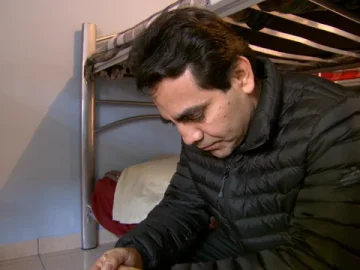
If Geyker Santos ran into Mayor Karen Bass face to face, he would tell her he’s disappointed that he thinks she let the city of Los Angeles down.
Santos voted for her in 2022; her progressive agenda and track record convinced him to cast his vote for Bass instead of Caruso. In 2026, he won’t be voting for her, but for her opponent, Councilmember Nithya Raman, for whom he is actively volunteering and attending rallies.
Geyker, 27, is living out a divide that shows up clearly in the numbers. A Berkeley IGS/Los Angeles Times poll released October 2 found that among Latino voters 50 and older, Bass leads Raman 36 percent to 26 percent. But among Latino voters ages 18 to 49, that advantage flips entirely: Raman leads Bass 60 percent to 9 percent.
“Four years ago I watched Bass’s political career, progressive, endorsed by Bernie Sanders and Obama. And I saw that her platform talked about fixing issues that were hurting the Latino community. But she failed; there are more apologies in her campaign now for missteps and disconnection from the problems of the city and of Latinos than anything else. I think she’s living off her past victories now; she’s really struggling to digest this anti-her movement. But young Latinos are living in survival mode, worried about and immersed in a lot of problems; we need someone who answers us, we are looking for answers, the kind we haven’t seen from Bass,” says this young North Hollywood resident.
The most striking shift shows up among young Latinos specifically. In the June 2 primary, Bass won 35 of the city’s 43 Latino majority neighborhoods, compared with just seven for Raman, and finished with 34 percent of the vote against Raman’s 29 percent among the general electorate, according to the Los Angeles Times. Now, that same paper’s Berkeley IGS poll shows Latino voters splitting sharply by age, with the youngest half of that electorate having moved almost entirely toward Raman since then.
Younger Latinos are simply looking for something different.
For many of them, Los Angeles has become increasingly unaffordable. Housing costs have made it harder to rent, buy a home, start a family, or imagine staying in the city long term. At the same time, immigration has become an increasingly personal political issue, particularly as federal enforcement has become more visible and aggressive.
These voters are experiencing the problems directly. They are not debating housing affordability as an abstract policy question. They are living with it.
And they aren’t necessarily looking for a politician who promises City Hall can solve everything. They may be looking for someone who appears willing to fight.
That is where Raman comes in.
“I’m 27 years old, I live with my parents, I have two siblings, one of them has a disability. We have a lot of responsibilities and few prospects, unique challenges, the economy, affordability, ICE, name it. I and a lot of young Latinos feel that Nithya understands us, that she speaks the same language and is pushing for the changes we want. We believe she’ll work for us, for our communities. We’re living through critical times,” he says.
Raman cannot control federal immigration policy. Neither can Bass. Neither can Newsom. The mayor of Los Angeles cannot stop federal deportations or determine who enters the country.
But a mayor can resist. A mayor can refuse to cooperate with certain federal actions, use the power of the city to protect immigrant communities and publicly confront the federal government.
That symbolic dimension may matter enormously to younger Latino voters.
They may understand the limits of local power. But they may also be asking a simpler question: Who is willing to fight?
Raman offers a different political style. She presents herself as a challenge to the status quo, rather than simply another representative of it. For younger voters who feel that the existing political system has failed to make Los Angeles affordable or secure enough for their generation, that message can be powerful.
Call it generational impatience.
“Bass has voiced opposition to ICE. I don’t believe it. When the MacArthur Park thing happened, she wasn’t actually opposing ICE’s presence; she was just talking to the press, I don’t know, we don’t believe her rhetoric. She spent several years in Congress; she was deeply disconnected by the time she got to Los Angeles. We need a government that works for us, that solves our problems,” he adds.
Santos mentions that young Latinos are also split between those who are deeply committed to politics as a way to change things and those who simply don’t care.
“I have neighbors, friends; a lot of them would rather not talk about politics or get involved, and it’s not because they don’t care. They have a lot on their plate. ICE, paying their household expenses, affordability, transportation- they struggle to get through each day. They’re desperate, but they don’t want one more thing piled on top; they’re too worried about just surviving. But we’re making progress; more young Latinos are getting involved now. We’re more active; little by little we’re seeing changes. We can’t stay apathetic. That’s exactly how they’d love for us to be: uninvolved. I have a lot of hope that things can get better. It’s rough out there; we’ve survived two Trump administrations, we can survive more, but that’s not what we want; we want a government that actually responds to us,” he adds.
According to UCLA political scientist Matt Barreto, Latino voter participation in California’s 2026 primary reached record levels, with young Latino voters showing the biggest increase in turnout compared with the 2022 primary. Barreto said much of that surge came in the final three to four days before the election, helping drive a late increase in support for Xavier Becerra. The mobilization was particularly significant in Los Angeles, where Latino voters played a key role in Becerra’s first-place finish in the Democratic primary for governor.
For Santos, one essential part of the challenger candidate is keeping close communication with the community and not losing sight of her campaign platform.
“We need more affordable housing, more legal tools to defend ourselves against ICE, a lot of people are losing their parents, more tools to help people understand how to navigate the system, translators, more mental health services, economic support for small businesses, affordability, with everything that comes with it, there are so many things that are necessary that haven’t been done these past few years,” he says.
“Nithya has given me more hope; we can’t give up. My grandparents are very happy with my activism; they tell me: ‘Mijito chulo, échele ganas.'”