Bass asks voters to continue work already underway. Raman argues Los Angeles needs a different approach. Here’s how to weigh those appeals against the evidence.
Karen Bass is asking Los Angeles voters to trust the work she has started and give her another term. Her campaign presents the alternative as replacing action with more studies and promises.
For readers who grew up hearing a parent or grandparent say, “Más vale malo conocido que bueno por conocer,” that appeal may sound familiar. The proverb counsels sticking with what you know, faults and all, rather than taking a chance on something that might be better.
The saying is a way to understand the appeal, not a description of either candidate as good or bad. Bass’s campaign language echoes its caution about change. Raman’s campaign challenges that caution: what if continuing with familiar leadership means accepting results that should be better?
For families facing high rents, neighbors worried about safety and people waiting for help from City Hall, that is a practical choice. Familiarity can reassure. It also gives voters a record to examine.
Bass’s case: Keep the work going
On her campaign homepage, Bass asks whether voters want to keep moving forward or replace action with “more studies, reports, and empty promises.”
Her explanation for seeking reelection describes a foundation already laid and a second term devoted to building on it. She points to housing, homelessness, public safety and neighborhood infrastructure as reasons to continue.
That is more than an appeal to name recognition. Bass is asking voters to believe that her experience in office has put Los Angeles on a better course and that changing leadership could interrupt it.
But her message also includes change. She portrays herself as the mayor taking on problems previous leaders avoided. The choice she offers is between continuing her changes and replacing them with an approach she questions.
Raman answers with a different promise. Her campaign platform centers on affordability, functioning services and a City Hall that responds to residents. She points to her council district’s homelessness results as evidence that another approach is possible.
Parriva’s earlier examination of both candidates’ visions for Los Angeles explored those broader goals. The question here is how voters can judge the case for staying the course.
What the numbers can tell voters
Homelessness shows why a familiar record still needs careful scrutiny.
In its July 2026 homeless-count release, the Los Angeles Homeless Services Authority estimated 45,194 people experiencing homelessness in the city, an increase of 3.4% from 2025. LAHSA said that change was not statistically significant.
The agency identified reduced access to rental subsidies as a major bottleneck. With fewer people moving into permanent housing, temporary beds stayed occupied and the system had less room for people coming off the streets.
That finding is important when candidates claim credit or assign blame. It points to funding and movement through a shared housing system, beyond the actions of any one elected official.
Raman’s campaign highlights a 49% decline in unsheltered homelessness in her district. That is her argument for expanding her approach citywide. The campaign’s claim of credit, however, does not establish that she alone produced the decline or that the same result would follow across Los Angeles.
Voters should also distinguish total homelessness from unsheltered homelessness. They measure different things. A comparison needs the same timeframe, geography and definition.
Parriva’s Bass–Raman debate fact-check offers further context on reading campaign claims.
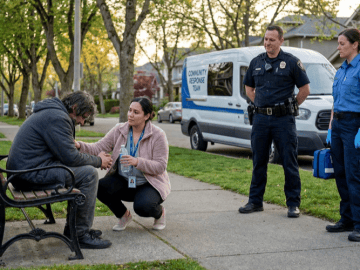
Public safety also shows where the candidates’ work overlaps. On October 23, Bass issued a directive to bring the dispatch systems for the city’s two civilian crisis-response programs, CIRCLE and UMCR, together. Full operation is targeted for July 1, 2027, rather than an integrated service already being available.
As Parriva’s reporting on the planned unified crisis-response center explains, the effort also builds on Council work. Raman introduced a March 2025 consolidation motion seeking a path toward one citywide unarmed-response program.
Bass is now advancing implementation of reforms Raman and other council members helped develop. That gives voters a more concrete comparison than campaign promises alone. For a family calling about someone in crisis, the test will be whether the changes bring the right help sooner.
What voters can check before deciding
Start with the service you need and ask what each candidate would deliver.
For homelessness, look beyond encampment removals to whether people reach permanent housing and remain there. For safety, ask about response times, who answers a crisis call and how residents can hold the system accountable.
Then separate an accomplishment, a proposal and a prediction. Ask who controls the money, what requires cooperation from other agencies and how progress will be measured.
The familiar proverb captures a real hesitation about change. Bass’s campaign gives voters a clear reason to stay with her: the work has begun and deserves another term. Raman asks them to demand a different approach.
The useful test is whether each candidate can connect that appeal to better, measurable results in people’s daily lives.