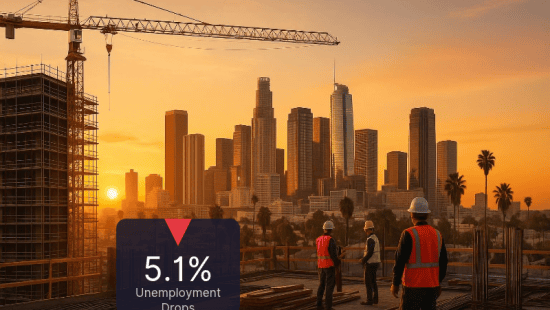
Los Angeles has a striking real-estate contradiction: large amounts of office space are sitting unused while renters continue to face high housing costs.
According to Cushman & Wakefield, overall office vacancy in Los Angeles reached 23.4% in the second quarter of 2026. In other words, nearly one-quarter of the market’s office space was vacant.
At the same time, housing remains expensive and difficult to afford. UCLA’s Latino Policy and Politics Institute found that 58% of Latino renter households in California are housing-cost burdened, including 29% who spend more than half their income on housing.
So why can’t Los Angeles simply turn empty offices into apartments?
The answer is that a vacant office is not automatically a usable home.
Office buildings were designed for a different purpose.
Converting them into apartments can require major changes to plumbing, electrical systems, fire and life-safety features, elevators, windows, layouts and other building systems. Construction costs and financing can also determine whether a conversion makes economic sense.
That means a building can be physically empty while still being difficult or expensive to transform into housing.
The distinction matters because Los Angeles doesn’t simply have a shortage of buildings. It has a shortage of housing that people can afford and access.
Parriva has previously examined the pressure facing Latino Angelenos and the broader housing challenges confronting renters. That coverage helps put the office-conversion debate into context: unused commercial space is only useful to renters if it can actually become housing that people can afford.
The city has now changed the rules governing adaptive reuse.
Los Angeles’ Citywide Adaptive Reuse Ordinance took effect in 2026, expanding opportunities to convert eligible commercial buildings into housing and streamlining aspects of the process. The Los Angeles Department of City Planning’s adaptive-reuse materials explain the new framework.
The idea is straightforward: instead of building every new home from the ground up, Los Angeles can sometimes use buildings that already exist.
That approach also fits into the broader housing-reform conversation in California. Parriva, has in another article, explained what California’s housing reforms mean for renters, including why changes in housing policy do not necessarily translate immediately into lower rents.
But one conversion or even thousands of potential units — does not mean every vacant office can become housing, or that adaptive reuse alone can solve Los Angeles’ affordability problem.
Housing Pressure Hits Latino Renters Hard
The need for additional housing is especially relevant for Latino renters.
UCLA’s 2026 research found that 58% of Latino renter households in California are cost-burdened, meaning they spend at least 30% of household income on housing. Nearly one-third are severely burdened, spending more than half their income on housing.
Earlier UCLA research focused specifically on Los Angeles County found that 55% of Latino renters were cost-burdened, including 28% who faced severe cost burdens.
For renters facing those pressures, converting an office building matters only if the resulting homes are actually affordable and available to the people who need them.
That is why the question goes beyond whether Los Angeles can create more housing. It also concerns what kind of housing gets created, where it is located and who can afford it.
Another Kind of Vacancy Is Hitting Latino Business Corridors
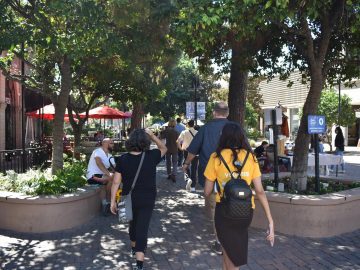
The commercial-space problem looks different in some Latino neighborhoods.
A 2026 UCLA Latino Policy and Politics Institute study conducted with Inclusive Action for the City examined the economic effects of the June 2025 immigration-enforcement surge on Latino business corridors across Los Angeles County.
Researchers found 46,000 fewer visits to businesses near nine enforcement sites during the first two weeks, with estimated losses of about $3.16 million during that period.
That is a different phenomenon from office vacancy.
Office buildings are largely dealing with changes in demand for traditional workplace space. The UCLA research describes a decline in customer activity associated with an enforcement-related chilling effect on particular commercial corridors.
Both can produce empty-looking spaces, but they have different causes and require different responses.
The numbers point to three separate challenges facing Los Angeles:
Office vacancy: A large amount of commercial space is underused as companies require less traditional office space.
Housing affordability: Renters face substantial housing-cost burdens, with Latino renters particularly exposed to high costs.
Commercial-corridor disruption: Some Latino businesses have experienced significant declines in customer traffic following immigration-enforcement activity.
The problems overlap geographically and economically, but the evidence does not establish that one causes the others.
That distinction is important. Converting offices into housing could increase the supply of homes, but it does not automatically make those homes affordable. It also does not restore customers to businesses affected by a separate economic shock.
Parriva’s broader reporting on California’s housing affordability challenges, including the state’s affordable-housing budget and its implications for renters, provides another piece of the picture: housing supply, affordability and access are related, but they are not interchangeable problems.
Los Angeles does not have one vacancy problem or one housing problem.
It has different kinds of underused space and different kinds of unmet demand.
The city’s expanded adaptive-reuse rules create a new pathway for turning some underused commercial buildings into homes. But whether that translates into meaningful housing relief will depend on which buildings can be converted, how quickly projects move forward, what they cost and who ultimately can afford the resulting units.
The larger challenge is not simply filling empty buildings.
It is figuring out how to turn some of Los Angeles’ underused space into the kinds of places people actually need, at prices they can afford, while addressing the separate forces affecting the neighborhoods and businesses around them.