Downtown Los Angeles is adding residents and showing signs of recovery, but roughly 30% of retail space remains vacant. The contrast reveals why bringing people back downtown has not automatically brought businesses back with them.
Just a few blocks from Los Angeles City Hall, one of Downtown Los Angeles’ biggest contradictions is visible from the sidewalk.
People live in the apartment buildings.
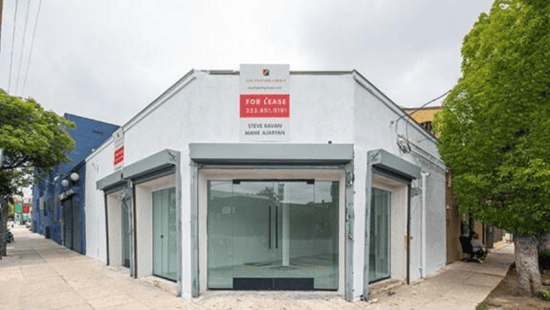
But some of the storefronts underneath them remain empty.
That contrast is particularly clear in the Historic Core, where residential buildings have been converted, renovated or restored while ground-floor retail has struggled to find new tenants.
At The Metropolitan, a landmarked apartment building at Broadway and Fifth Street, the residential portion was reported to be 91% rented while its ground-floor retail spaces remained unoccupied. Downtown LA Market Report — DTLA Alliance
The building offers a simple picture of a much more complicated downtown problem:
Housing can bring people back to downtown. It does not automatically bring the businesses back with them.
The empty storefronts are not just something pedestrians notice.
About 30% of Downtown Los Angeles retail space occupied by stores and restaurants is vacant, according to CBRE data. Nearly 40% of office space in the Financial District is also described as functionally empty.
Nearly 1,000 businesses left Downtown Los Angeles in 2024, with closures concentrated in areas including the Historic Core, Central City, the Fashion District and South Park. Downtown LA Reports & Research — DTLA Alliance
Those numbers do not mean Downtown LA is empty.
They show something different:
The recovery is not even.
Parriva has previously examined the connection between Downtown Los Angeles’ office vacancy and housing shortage, a problem that has become increasingly important as Los Angeles considers how to reuse underused commercial space.
Downtown Los Angeles still has thousands of residents.
Apartment buildings, hotels, restaurants, cultural institutions and government offices continue to operate.
That makes the empty storefronts particularly important.
In a conventional neighborhood, more residents can create a larger customer base for nearby businesses. But a business needs more than people living nearby.
A restaurant or retailer also depends on people walking past its door, workers coming into the area, visitors, customers willing to spend money, rents that make sense for the business and operating costs that can be sustained.
Downtown’s post-pandemic changes have disrupted several of those pieces at the same time.
The result is a downtown where one building can be full of residents while the commercial space below it remains unused.
Restaurants are among the most visible examples.
Cole’s, the historic French dip restaurant on Sixth Street, closed permanently in March 2026 after 118 years.
Clifton’s, the enormous historic restaurant and entertainment complex on Broadway, has also remained shuttered after its former operator abandoned plans to reopen.
One or two restaurant closures cannot establish what is happening to every restaurant downtown.
But they illustrate the pressures facing businesses that depend on a steady flow of customers.
When a restaurant closes, the effect is also visible from the sidewalk: a darkened dining room, a locked door and another stretch of inactive street frontage.
It is tempting to look at an empty storefront and conclude that the building itself is the problem.
But vacancy can have many explanations.
A landlord may be looking for a tenant.
A potential tenant may be negotiating a lease.
A restaurant may have closed while its space is being prepared for another operator.
A property can be largely occupied while its retail component remains vacant.
That is why the overall vacancy numbers are more useful than simply counting empty doors around City Hall.
They show that commercial vacancy is a measurable downtown condition, while individual storefronts require more context.
Then there is the vacant lot across from City Hall
The contradiction becomes even more visible at First Street and Broadway.
The approximately 1.96-acre property sits directly across from City Hall. Los Angeles acquired the site in 2013 with plans for a civic park. The city’s Bureau of Engineering describes the proposed project as a 1.96-acre park with public gathering space and other improvements.
For years, the site remained fenced and largely unused.
In 2026, it was temporarily activated as El Corazón Art Park, a project involving AltaMed that includes art and cultural programming, trees and a health center.
The temporary activation changes what pedestrians see when they pass the property.
But the site’s history also illustrates another downtown challenge: valuable land can remain underused even in one of the most prominent locations in Los Angeles.
Could more housing help?
Los Angeles is betting, in part, that underused commercial buildings can have another life.
The city’s Citywide Adaptive Reuse Ordinance creates zoning incentives and streamlined procedures for converting qualifying older commercial buildings into housing. The ordinance applies to eligible buildings at least 15 years old across Los Angeles, not just downtown.
City Planning says the policy is intended to transform underused commercial buildings into housing while helping reactivate vacant space and commercial corridors.
That could help address office vacancy while adding more residents to downtown and other parts of the city.
But there is an important limitation.
More residents do not automatically mean more occupied storefronts.
If empty offices become apartments, the number of people living downtown could increase.
Whether those residents translate into enough customers to support new retailers, restaurants and neighborhood services depends on what happens next: where people work, how they move through downtown, how much they spend locally and whether businesses can afford to operate there.
That is the difference between residential recovery and commercial recovery.
Parriva’s coverage of California’s push to build more housing and improve affordability provides broader context for why converting existing commercial space into housing has become part of the state’s and city’s housing strategy.
Downtown LA isn’t empty
The most accurate description of Downtown Los Angeles in 2026 is not that it has become a ghost town.
It hasn’t.
People live there.
Businesses operate there.
Restaurants remain open.
Hotels receive visitors.
Cultural institutions continue to draw audiences.
Government offices continue to bring workers into the area.
Some blocks are busy.
Others are not.
The challenge is the unevenness.
An apartment building can be nearly full while its ground-floor retail spaces are empty.
A busy restaurant can sit next to a vacant storefront.
A historic property can remain shuttered while another nearby building is being renovated.
And across from City Hall, a large parcel that was intended to become a civic gathering place spent years behind a fence before receiving a temporary new use.
The more important question is what happens between the residential and commercial parts of downtown.
Can new residents create enough sustained demand to support local businesses?
Can vacant offices be converted to housing without leaving the ground floors disconnected from the neighborhoods around them?
Can restaurants and retailers find locations where rents, labor, insurance and customer demand make the numbers work?
And can the city create the conditions for private investment without assuming that every vacant space has the same problem?
Those questions matter to more than property owners.
They matter to small-business owners deciding whether Downtown LA is a viable place to open or expand.
They matter to residents who want everyday services within walking distance.
And they matter to Los Angeles as it tries to reshape a downtown whose economy was fundamentally changed by the pandemic, remote work and the disruption of the entertainment industry.
For now, the clearest picture may still be the simplest one.
Look upstairs.
There are people living in many of Downtown LA’s apartment buildings.
Then look downstairs.
In too many places, the storefronts are still waiting for them.