A federal judge blocked several ICE construction-site tactics in Alabama. Here’s what the ruling means and why California’s construction workforce is watching.
Leo Garcia Venegas was born in Florida. He’s spent six years working in construction in Alabama. He’s also been detained by immigration agents three separate times, despite being a U.S. citizen.
On September 21, a federal judge sided with him. U.S. District Judge Jeffrey Beaverstock blocked three tactics the Department of Homeland Security has been using at construction sites nationwide: entering private worksites without a warrant, detaining workers without any individualized reason to suspect they’re undocumented, and continuing to hold people even after they show valid proof of citizenship. “The nature of the worksite does not open the floodgates to warrantless government intrusion,” Beaverstock wrote, rejecting the government’s argument that construction sites don’t carry the same Fourth Amendment protections as other private property. Jared McClain, the Institute for Justice attorney who argued the case, called it “a huge blow to DHS’s lawless enforcement practices.”
That ruling only covers Alabama’s southern federal district for now. But it lands squarely on the industry where California has the most riding on this fight. Nearly 42 percent of California’s construction workforce is foreign-born, more than 521,000 people, the highest share of any state in the country. Nationally, Hispanic workers now make up almost a third of the entire construction labor force, and California alone accounts for roughly 775,000 of them. Construction isn’t just one job among many for Latino workers here; it’s the single biggest concentration of Latino and immigrant labor in the state’s economy. One in three Hispanic workers entering the U.S. labor force for the first time takes a construction job.
That’s what makes a policy built around unannounced entry and preemptive detention at construction sites so disproportionately consequential in California specifically. A crew on a job site here is statistically more likely to be Latino and foreign-born than almost anywhere else in the country, which means the exact scenario Venegas went through, three detentions despite valid citizenship, is baked into the math of how these operations play out at scale.
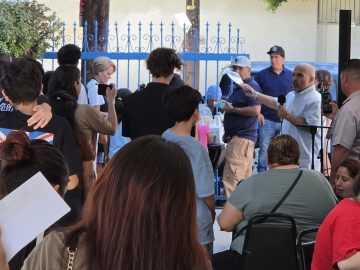
This isn’t the first time a court has pushed back on similar tactics closer to home. Earlier this month, a federal court blocked what the ACLU of Southern California called DHS’s “unlawful, warrantless immigration arrests” across the region, in a case brought by the Coalition for Humane Immigrant Rights. CHIRLA’s executive director, Angelica Salas, said the ruling gave people “breathing room to go about their daily lives, providing for their families while continuing to demonstrate such incredible resilience.”
Neither ruling settles anything permanently. Alabama’s is a temporary stay tied to one federal district, still working through litigation. The Southern California case remains active too. DHS spokesperson Tricia McLaughlin has rejected any suggestion these tactics amount to racial profiling, calling the accusation “disgusting, reckless, and categorically FALSE” and insisting enforcement runs on “reasonable suspicion,” not race.
Still, two federal courts in two different states have now, independently, reached the same conclusion about the same enforcement playbook. For a workforce where roughly two in five construction workers in California were born somewhere else, that legal reasoning, if it holds, could end up shaping something as basic as whether people can safely show up to a job site tomorrow morning.