former presidents unity message highlights growing concern about division in the U.S. and why civic participation matters more than ever for Latino communities and the country’s future.
At a moment when public trust is fragile and national optimism is slipping, four former U.S. presidents stepped onto the same stage with a shared message: the country’s future still depends on unity, civic responsibility, and belief in democracy.
In a rare joint appearance tied to the upcoming 250th anniversary of the United States, Joe Biden, Barack Obama, George W. Bush, and Bill Clinton reflected on the state of the nation during an interview connected to a History Talks event in Philadelphia.
Their message was not about policy. It was about direction.
Each leader approached the conversation from a different political legacy, yet their tone converged around a central idea: democracy only works if people stay engaged.
Clinton pointed to the country’s long democratic experiment as proof of resilience, urging Americans not to give up on a system that has endured for nearly two and a half centuries. Obama emphasized citizenship as the core of American identity, arguing that democracy is sustained not by leaders alone but by everyday participation.
Bush focused on service and responsibility, calling on Americans to remain active in their communities. Biden reinforced the idea that opportunity and fairness remain foundational promises, even as political divisions dominate headlines.
Their remarks arrive at a time when confidence in national direction is weakening. According to Gallup, about 60 percent of Americans say the country is on the wrong track, and long-term optimism has fallen to one of its lowest levels in decades. Data from Pew Research Center shows similar concern, with large majorities citing deep political division and dissatisfaction with how democracy is functioning.
While immigration policy was not directly debated, the conversation repeatedly returned to diversity as a defining American advantage.
Clinton described diversity as a strength rooted in the country’s founding ideals. Obama framed storytelling and shared identity as tools that bridge cultural differences. Biden echoed the nation’s founding principle that all people are created equal, linking it to economic and social mobility.
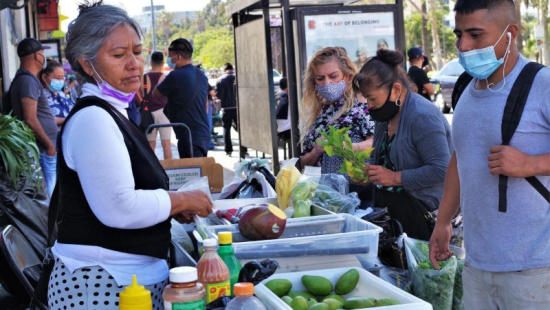
That framing carries particular weight for Latino communities, which now represent a growing share of the U.S. population and electorate. The emphasis on inclusion and participation aligns with long-standing calls from Latino civic leaders to expand access to voting, representation, and economic opportunity.
The appearance stood in quiet contrast to the sharper tone of current national debates. Donald Trump, now back in office, has focused heavily on immigration enforcement and rolling back diversity initiatives, signaling a different vision for the country’s direction.
The former presidents avoided direct criticism. Instead, they leaned into a broader message about democratic responsibility and national identity.
Why this moment matters
The significance of the moment is not just symbolic. It reflects a growing concern among political leaders, researchers, and community advocates that civic disengagement and polarization are weakening democratic institutions.
For Latino communities, the stakes are especially high. Participation rates continue to rise, but gaps remain in representation, access to information, and economic opportunity. The call for active citizenship is not theoretical. It is tied to real outcomes in education, housing, healthcare, and small business growth.
As the country approaches its 250th anniversary, the question raised by the former presidents is simple but consequential: can a divided nation still act like a shared one?
Their answer was cautious but clear. The system only works if people choose to believe in it and take part in shaping it.