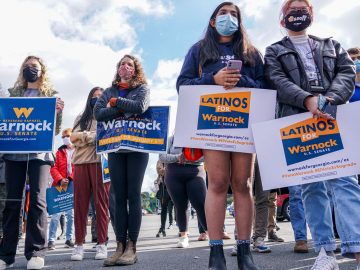
Washington’s Latino eligible-voter population has grown 224% since 2000, offering a glimpse of how Latino political and economic communities are expanding beyond the states traditionally at the center of the conversation.
For years, the map of Latino political power in the United States seemed fairly easy to understand.
California. Texas. Florida. New York. Arizona.
Those states still matter enormously. But they no longer tell the whole story.
A new look at Washington state offers a glimpse of how the Latino electorate is changing; not just by getting larger, but by becoming more important in places that have not traditionally been at the center of conversations about Latino voters.
According to a new analysis from the UCLA Latino Policy and Politics Institute, Washington’s Latino eligible-voter population grew from about 159,000 in 2000 to 516,000 in 2024. That’s a 224% increase.
Latinos now make up 9.2% of Washington’s eligible voters, making them the state’s second-largest eligible-voter group.
The change is especially striking among younger voters. Nearly one in five Washington eligible voters ages 18 to 24 is Latino.
That is more than a demographic statistic.
It is a sign that the political map is changing.
Washington is not California or Texas. Its Latino population is smaller, and its political history is different.
But that is exactly what makes the state useful as a case study.
The growth of the Latino eligible-voter population means candidates, elected officials, civic organizations and public institutions are increasingly dealing with communities that have their own needs, experiences and political priorities.
And those communities are not simply arriving at the ballot box.
They are already part of the state’s economy.
UCLA found that Washington Latino eligible voters have a 74% labor-force participation rate, the highest among the state’s major racial and ethnic groups. Latino workers are represented across industries including health and education services, construction, agriculture, retail and hospitality.
But the same research shows a more complicated reality.
The median hourly wage for Latino eligible voters in Washington is $23, compared with $30 for eligible voters overall and $32 for non-Hispanic white eligible voters.
Latino households also face higher housing-cost burdens, lower homeownership and higher rates of being uninsured. Fifteen percent lack broadband access.
In other words, a growing electorate does not automatically mean a community’s economic challenges have disappeared.
Washington is one example of a broader national shift.
Pew Research Center’s analysis of Latino eligible voters estimated that 36.2 million Latinos were eligible to vote in 2024, up from 14.3 million in 2000. Latinos represented 14.7% of the nation’s eligible electorate in 2024.
California remains the largest Latino electorate in the country.
Pew’s 2024 data show California with about 8.7 million Latino eligible voters, followed by Texas with 6.7 million, Florida with 3.8 million, New York with 2.2 million and Arizona with 1.4 million.
So the old map has not disappeared.
It has expanded.
California and Texas still contain enormous Latino electorates. But Washington and other states show why looking only at the traditional centers can miss where the electorate is growing and what those communities look like.
we have also reported on the record number of Latino potential voters nationally, providing additional context for how dramatically the Latino electorate has grown over the past two decades.
There is another mistake worth avoiding.
A larger Latino electorate does not mean Latino voters will all vote the same way.
Latino voters differ by age, state, generation, country of origin, income, education, religion and political preference. The issues that matter most in Washington do not necessarily mirror those in California or Texas.
Another interesting article that we published on changing political preferences among Latino voters, is an important reminder that the size of an electorate and the political choices within it are two different questions.
Even within one state, Latino voters are not a single political constituency.
That makes the growth of the electorate more complicated and more important.
The number of eligible voters tells us about potential political participation. It does not tell us who will register, who will vote, which issues will matter most or which candidates voters will support.
Those are separate questions.
Washington’s numbers illustrate why the Latino electorate cannot be understood only through election statistics.
The people appearing in voter data are also workers, renters, homeowners, parents, students and consumers.
In Washington, Latino eligible voters have one of the state’s highest levels of workforce participation while also facing significant gaps in wages, housing, health coverage and internet access.
Those conditions are meaningful because political participation does not happen in a vacuum.
A community’s experience with housing costs, wages, health care, schools or access to information can shape the issues that matter to voters and the questions they bring to public officials.
That does not tell us how anyone will vote.
It tells us why the numbers deserve a closer look.
What Happens When the Map Gets Bigger?
For decades, national conversations about Latino political power could focus heavily on a relatively small number of states.
That is becoming less sufficient.
The growth in Washington does not mean Washington will become another California. It means the state has its own growing Latino electorate that deserves to be understood on its own terms.
The same principle applies elsewhere.
The important question is not simply where the Latino population is growing. It is where Latino communities are becoming large enough and established enough to become part of the everyday political, economic and civic conversation.
For California readers, there is an important lesson here.
California has not become less important. Its Latino electorate remains the largest in the country.
But California is no longer the whole map.
The Latino electorate is becoming harder to describe with a handful of familiar states.
And Washington offers a clear example of what that change looks like: a young, growing electorate that is already deeply connected to the state’s workforce and communities, while still facing significant economic and social gaps.
The numbers show a bigger Latino electorate.
They do not tell us exactly what that electorate will do.
The more revealing question is what happens when more states begin to understand Latino communities not as a future constituency, but as part of their political and economic reality right now.