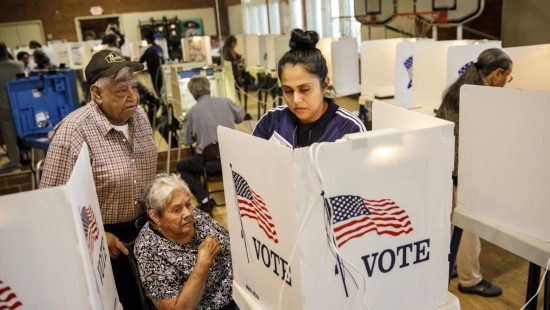
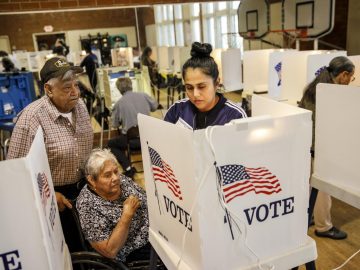
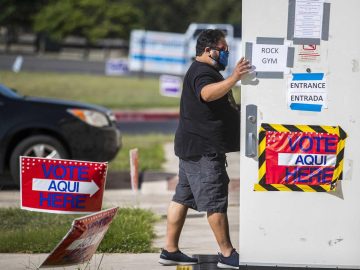
With California’s November election less than 10 weeks away, voters are sharply divided over whether they trust the state’s elections.
A recent UC Berkeley Institute of Governmental Studies poll found that Californians express confidence in the state’s election process by nearly a two to one margin. But beneath that overall number is a striking partisan divide. Nearly nine in ten Democrats say they are confident elections will be conducted fairly and accurately. Among Republicans, only about two in ten say the same.
The numbers reflect a national political divide that has grown particularly pronounced since the 2020 election.
But there is another question worth asking in California.
Where do Latino voters fit?
California’s Latino electorate is large, politically important and increasingly difficult to describe as a single political bloc. While Latinos continue to lean Democratic overall, recent elections and polling have shown movement among Latino voters, including support for Republican candidates and concerns that do not always align with either party.
That makes election confidence an especially interesting question.
Are Latino voters as confident in California’s elections as Democrats generally? Are Latino Republicans as skeptical as Republicans overall? And what about Latino independents?
The Berkeley poll offers a detailed picture of the partisan divide, but publicly available results do not provide a comparable Latino breakdown. That leaves an important piece of the picture unresolved.
The distinction matters because a lack of confidence in an election system does not necessarily mean a voter believes an election was stolen.
A voter can support stricter identification requirements, greater verification of voter registrations or faster reporting of results while still believing election officials are honestly counting legitimate votes.
The opposite is also true. Someone who says they have concerns about election integrity is not necessarily saying that widespread fraud has occurred.
California’s vote counting process can contribute to that confusion.
Election Night results are not final. Counties continue processing ballots after polls close, including eligible vote by mail ballots that arrive after Election Day, provisional ballots and ballots requiring additional verification. Officials verify signatures and conduct other procedures before results are certified.
California law allows certain vote by mail ballots postmarked by Election Day to arrive later and still be counted. Counties generally have up to 30 days to complete the official canvass.
For voters accustomed to seeing most election results finalized on Election Night, that process can be difficult to understand.
It has also become a political flashpoint.
Following California’s June primary, Republican House Majority Leader Steve Scalise criticized the state for continuing to update its results days and weeks after Election Day.
“For days and weeks later, they just keep finding ballots and finding ballots until the election results change,” Scalise said.
But ballots being counted after Election Day does not mean election officials are discovering fraudulent votes. It means some legally cast ballots have not yet completed the verification and counting process.
That distinction may be particularly important when talking with Latino voters.
Recent polling suggests California Latinos remain more Democratic leaning overall, but there is significant political diversity within the electorate. A UnidosUS survey this year found that 59 percent of California Latino voters preferred a Democratic candidate for Congress, compared with 22 percent who preferred a Republican. Nineteen percent were undecided.
At the same time, Latino voters ranked economic concerns such as the cost of living, wages, health care and housing among their most important issues.
The numbers suggest that Latino voters should not be treated simply as an extension of either party’s national narrative.
That makes their views on election confidence worth exploring directly.
A Latino Democrat may say they have complete confidence in local election officials.
A Latino Republican may believe California needs stronger safeguards.
A Latino independent may trust that votes are counted honestly while still wondering why the numbers continue changing days after Election Day.
Those positions are not contradictory.
They reflect a distinction that is often lost in the political debate: you can believe an election system should be improved without believing that the election itself is fraudulent.
That may be the most important question to explore as California approaches November.
Is political party the main factor determining whether voters trust the election system?
Or do Latino voters evaluate election administration through a different lens?
The answer could tell us more than simply who Latino voters intend to support.
It could reveal whether election confidence itself is becoming another partisan fault line in California, or whether Latino voters occupy a middle ground between the two increasingly polarized views of election integrity.
With millions of Californians preparing to vote and results likely to continue changing after Election Night, understanding that distinction could be critical to understanding how voters interpret the results themselves.