As Santa Monica moves toward a city-controlled homelessness system, Los Angeles is preparing to rethink its relationship with LAHSA. The debate raises a larger question: can local control improve accountability and results in the region’s homelessness response?
On the same week that the Los Angeles City Council voted to spend $450,000 on a consultant to help chart a path away from the region’s troubled homelessness authority, the City Council here approved something Los Angeles has yet to build: a homelessness system it runs itself.
The plan, called the Housing Focused System of Care, gives Santa Monica direct authority over homeless services, from street outreach to permanent housing. Mayor Caroline Torosis framed the shift as a rejection of dependency on outside coordination. “Santa Monica is choosing instead to build a system we control,” she said.
The approval came after 14 community meetings held between April and July, and years of groundwork. The result is already measurable: the city’s 2026 count of homeless residents found unsheltered homelessness down nearly 19 percent from the year before, with the overall number falling to 718 people — even as the count rose slightly across the rest of Los Angeles County.
“Get Me Off This Merry-Go-Round”
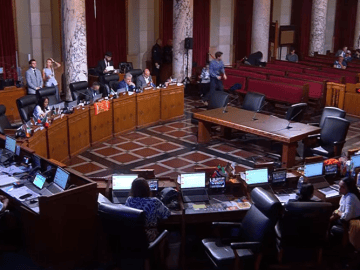
In Los Angeles, the path forward remains unresolved — and some council members are running out of patience with their own process. On Tuesday, the council authorized funds to hire a consultant to help design a new homelessness structure, to eventually break from the Los Angeles Homeless Services Authority, or LAHSA. The vote was 14 to 0.
It was not the city’s first attempt to reach this point. In April, the council’s homelessness committee had already voted to bring on an outside consultant for a similar analysis, setting a July 1 deadline. That deadline passed without anyone hired for the role, pushing the target completion date to December 2027.
Councilwoman Nithya Raman, who leads the homelessness committee and is challenging Mayor Karen Bass in next year’s mayoral race, did not hide her frustration at a tense committee meeting in March. “Get me off this merry-go-round from hell,” she said. Afterward, she told reporters she would push to speed the process up. “Preparing for the next step is urgent given the circumstances,” she said.
Not every council member has supported the continued spending. Councilwoman Monica Rodriguez, who represents parts of the San Fernando Valley and has long pushed for the city to break from LAHSA, voted against the related homeless funding transfer approved the same day. She has been blunt about her assessment of the system as a whole. “We’re hemorrhaging money on a homelessness system that was never designed to succeed — and no one is being held accountable for the failure,” Rodriguez said earlier this year, after a city analysis found roughly $418 million had gone toward homelessness programs with little to show for it.
Even LAHSA’s own interim leadership has urged caution rather than speed. Gita O’Neill, serving as the agency’s chief executive during a leave from her post at the city attorney’s office, asked council members in the spring not to rush the transition. “I would just ask this committee to take their time to look at the issues,” she said. “Sometimes when things are rushed and hurried, unfortunately our unhoused folks fall through the cracks.”
A Federal Judge’s Warning
The frustration extends beyond City Hall. U.S. District Court Judge David O. Carter, who has overseen a long-running homelessness case against the city, sharply criticized officials for what he described as years of financial mismanagement, calling the situation a “slow train wreck” during a hearing with Bass and Council President Marqueece Harris-Dawson. Carter pointed to an audit showing the city could not account for more than $2 billion in spending because LAHSA had failed to collect accurate data or hold contractors accountable — and warned he might appoint an outside receiver to take control of the city’s homelessness funds if transparency does not improve.
Homelessness watchdog John Alle, who has tracked the city’s spending for years, offered a blunter assessment of the broader approach. “Services are a band-aid,” he said. “The numbers never go down.”
Two Cities, Two Timelines
The contrast has not gone unnoticed by officials who track both systems. Santa Monica, a city of roughly 90,000 people, built a full strategic plan, secured community buy-in, and began showing results within about four years of commissioning its first outside assessment. Los Angeles, a city of nearly four million, has spent a comparable stretch of time still deciding who to pay to tell it how to begin — missing its own deadlines along the way.
For now, the $450,000 hire in Los Angeles is meant only to produce a plan, not to implement one. City officials have not set a firm date for when residents might see the kind of measurable change Santa Monica now points to as evidence its approach is working.