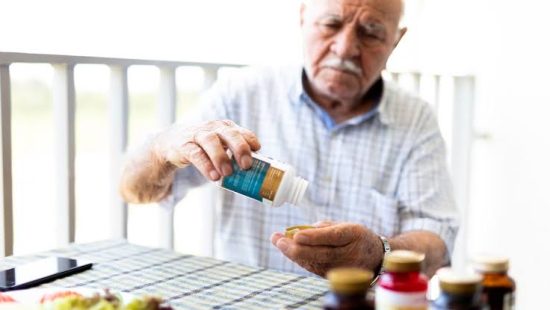
A new Pew survey finds 73% of Hispanic adults currently take at least one supplement. The bigger health question is what information is shaping those choices and what consumers should know before adding supplements to their routines.
Nearly three out of four Hispanic adults in the United States say they currently take at least one dietary supplement for their health.
A new Pew Research Center survey of 3,554 U.S. adults, conducted July 6–12, 2026, found that 78% of U.S. adults currently take at least one supplement. Among Hispanic adults, the figure was 73%.
But that number alone does not explain why people take supplements or where they learned about the products they use.
That raises a more useful question for consumers:
If supplements are already part of everyday health routines for nearly three-quarters of Hispanic adults, where are people getting the information that shapes those choices?
The Pew survey shows that supplement use among Hispanic adults is not concentrated in just one category.
Among Hispanic adults:
- 58% say they currently take vitamins or minerals.
- 32% take protein supplements.
- 27% take omega oil supplements.
- 22% take herbal supplements.
- 32% take other supplements included in the survey.
For comparison, 67% of U.S. adults overall report taking vitamins or minerals, 31% take protein supplements, 25% take omega oils and 19% take herbals.
The numbers also vary among other racial and ethnic groups. For example, 24% of Black adults report taking herbal supplements, compared with 22% of Hispanic adults. Forty percent of Asian adults report taking omega oils.
Pew defines Hispanic adults as people of any race. The survey’s White, Black and Asian categories include people who identify as that single race and are not Hispanic.
The survey is useful for showing what people report taking. It is much less useful for explaining why they take it.
The survey does not establish that culture, family traditions, income, education, social media or any other single factor causes Hispanic adults to choose particular supplements.
It also does not tell us whether the supplements people take are medically necessary, whether they improve their health or whether the products they use are appropriate for their individual circumstances.
In other words, 73% is a measure of reported behavior, not an explanation of that behavior.
That is where the question of health information becomes important.
Health Information Is Moving Beyond the Doctor’s Office
A separate Pew analysis of health information and social media offers an important piece of context.
Pew found that 49% of Hispanic adults say they get health information from social media at least sometimes. That includes 19% who say they do so often or extremely often and 30% who say sometimes. Among U.S. adults overall, 36% say they get health information from social media at least sometimes.
Pew’s research does not say that social media is responsible for supplement use among Hispanic adults. The two findings come from different surveys and should not be treated as evidence of cause and effect.
But they point to a broader reality: health information increasingly reaches people through multiple channels, including social media, health and wellness influencers and other sources outside traditional medical settings.
Among Hispanic adults who get health information from influencers, Pew found that learning about things they do not want to ask their doctor about is a major or minor reason for around half or more of those who use these sources.
That makes the quality of the information especially important.
Pew also asked Americans what they value in the people they get health information from.
Among Hispanic adults, 71% say medical training is extremely or very important when evaluating a health-information source. An identical 71% say transparency about conflicts of interest is extremely or very important.
Those findings offer a useful standard for evaluating health claims online.
Who is providing the information?
Do they have relevant medical training?
Are they clear about whether they are being paid to promote a product?
Are they identifying evidence behind the claim?
And are they explaining the limits of what is known?
Those questions can matter even more when the information involves products that people can purchase without a prescription.
Supplements Are Not Automatically Risk-Free
Dietary supplements can include vitamins and minerals, but also botanicals, amino acids, protein products and other ingredients that can have significant effects in the body.
The U.S. Food and Drug Administration’s guidance on mixing medications and dietary supplements warns that some supplements can change how medications are absorbed, metabolized or eliminated from the body. That can affect how well a medication works and, in some cases, create serious health risks.
The FDA also warns consumers not to assume that a product is safe simply because it is labeled “natural.”
This does not mean supplements are inherently harmful. It means the safety of a particular supplement depends on the product, its ingredients, the amount being taken and the person using it — including other medications or supplements that person may be taking.
The FDA regulates dietary supplements as food, not drugs, and says manufacturers and distributors are responsible for ensuring their products are safe before they are marketed. The agency also warns that some supplements can interact with medications or medical conditions and that products containing hidden drugs have sometimes been falsely marketed as dietary supplements.
That makes the source of information about a supplement an important part of the consumer decision.
Before Adding a Supplement to Your Routine
The FDA advises consumers to talk with a doctor, pharmacist or other health professional before taking dietary supplements.
Consumers should consider:
Check the ingredients.
Read the Supplement Facts label and know what the product contains and how much you are taking.
Check for interactions.
Tell your doctor or pharmacist about every supplement and medication you take. Some combinations can change how medicines work.
Don’t assume “natural” means safe.
Herbal and other natural products can still have powerful effects or interact with medications.
Be careful with combinations.
Taking several supplements at the same time can increase exposure to certain ingredients and create additional risks. The FDA specifically warns about combining supplements, mixing supplements with medicines and taking excessive amounts.
Look beyond the marketing claim.
Ask who is making the claim, what evidence supports it and whether the person or company has a financial interest in the product.
Use reliable sources.
The NIH Office of Dietary Supplements’ collection of supplement fact sheets provides information about vitamins, minerals, herbs, botanicals, probiotics and other supplements. Many of its consumer resources are available in both English and Spanish.
For Spanish-speaking consumers, NIH also provides a dedicated Spanish-language supplement information resource with information on how to evaluate health information online and individual supplement ingredients.
The Pew survey tells us something important: supplement use is already a routine part of health behavior for a large share of Hispanic adults.
It also shows that the pattern is not identical across supplement categories.
But the survey does not tell us what led an individual person to choose a vitamin, protein powder, omega oil or herbal product.
That makes the information question worth asking.
When nearly three-quarters of Hispanic adults report taking supplements, understanding what people take is only part of the health story.
The next question is where the information behind those choices comes from — and whether consumers have the tools to distinguish evidence-based health information from unsupported claims.
For more reporting and practical health information, readers can also explore Parriva’s Health coverage.
For anyone considering a supplement, that may be the most useful question of all:
Before asking whether a supplement is right for you, ask where the information telling you to take it came from.