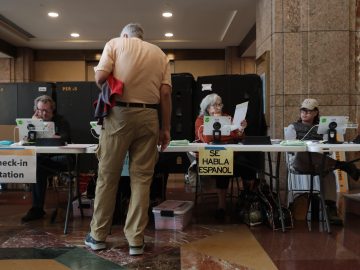
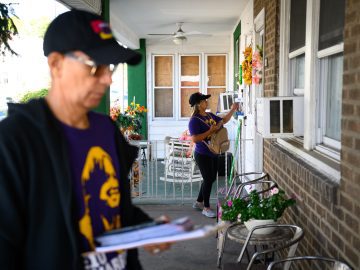
New research finds Latino voters report different levels of comfort discussing politics, while concerns about political violence are shaping how some communities experience the 2026 election environment.
Political participation does not always happen in public.
As the 2026 midterm elections approach, new research suggests some Latino voters are becoming more selective about where and how they express political opinions whether online, in person, at work or within their communities.
The findings do not show that Latino voters are abandoning politics. Instead, they point to a more complicated question: what happens when people remain interested in politics but become less comfortable talking about it openly?
A My Code Intelligence Center survey found a substantial partisan difference among Hispanic voters in how safe they felt discussing politics compared with the previous election.
Among Latino Republicans, 52% said they felt safer discussing politics online, while 53% said they felt safer discussing politics in person.
Among Latino Democrats, those numbers were 39% online and 41% in person.
That represents a 13-percentage-point gap online and a 12-point gap in person.
The pattern was not unique to Latino voters. Among voters overall, 31% of Democrats said they felt safer discussing politics online and 34% said they felt safer doing so in public, compared with 39% and 41%, respectively, among Republicans.
The numbers therefore show a partisan difference in perceived safety. They do not, by themselves, show that Latino Democrats are less likely to vote or participate politically.
The research also found that political expression among younger Latino voters does not follow a simple withdrawal pattern.
Among Hispanic Gen Z respondents, 49% said discussing politics online felt safer than it had at the end of 2025. That compared with 43% of multicultural Gen Z respondents overall and 28% of non-multicultural Gen Z respondents.
That finding matters because it suggests that political expression can depend on the setting.
For some younger Latino voters, online spaces may provide a lower-risk way to engage. For others, public or workplace conversations may feel more exposed.
The result is not one uniform story of young people becoming disengaged.
The qualitative portion of the My Code research offers another piece of the picture.
Participants in its Cultural Collective described limiting political expression to protect their jobs, relationships, personal safety and peace of mind.
Some of the concerns involve what might happen after someone expresses an opinion publicly: workplace conflict, judgment, retaliation, being targeted or having comments misunderstood.
That can change the calculation around political participation.
A person may still follow an election, vote, donate, talk with family members or research candidates while deciding not to display political support publicly or debate politics with coworkers.
That distinction is important.
Silence in one setting is not necessarily disengagement from politics.
A newer My Code political tracker released in September adds another layer to the story.
The Wave 15 research surveyed 3,219 eligible voters and found that Hispanic respondents who were concerned about political violence were particularly likely to believe their own communities faced greater risk than other communities.
The finding does not establish that political violence caused the partisan differences in political expression. But it does show that concerns about safety are part of the political environment experienced by many Hispanic voters.
That concern is also visible in California.
A 2025 UnidosUS survey of California Latino voters found that 50% were very or extremely concerned that they or someone close to them could become a victim of political violence.
The concern was higher among California Latino Democrats than Republicans in that survey: 55% versus 42%.
The same survey found that 60% of California Latino voters said their rights and freedoms felt less secure.
These findings come from a different survey, conducted in October 2025, so they should not be treated as a direct explanation for the newer My Code results. Together, however, they show that concerns about political safety are not limited to one national survey or one partisan group.
The evidence points to an important distinction as the midterms approach.
Political expression and political participation are not the same thing.
Someone can avoid political arguments at work while voting.
Someone can stop posting political opinions online while remaining highly informed.
Someone can avoid public displays of political support while discussing candidates privately with family or trusted friends.
And someone who feels uncomfortable talking about politics may still have strong opinions about housing, healthcare, immigration, jobs, education or the cost of living.
Parriva’s previous reporting has documented how those everyday issues connect directly to Latino political participation in California. Latino voter turnout in California and Los Angeles
That makes the central question for 2026 less about whether Latino voters are simply becoming “silent.”
It is whether the places where people feel comfortable participating in politics are changing.
What the research can and cannot tell us
The available research can tell us that Latino voters report different levels of comfort discussing politics and that concerns about political violence and personal consequences are part of how some voters describe the political environment.
It cannot tell us whether Latino Democrats will vote at lower rates, whether Latino Republicans will participate at higher rates, or whether these reported differences will affect election results.
It also cannot establish that political violence caused the partisan gap in perceived safety.
Those questions require separate evidence on voter turnout, actual participation and behavior.
For now, the research points to a narrower but important finding: some Latino voters may be changing how they participate politically, even when they have not stopped participating.
As the 2026 midterms approach, that distinction could matter for anyone trying to understand how Latino communities are experiencing the political environment—not simply how they intend to vote.
The question may not be whether Latino voters have something to say. It may be where they feel safe enough to say it.