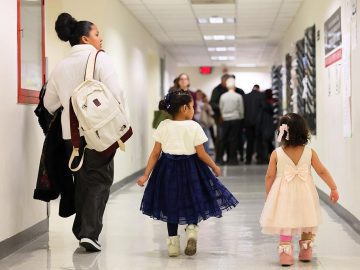
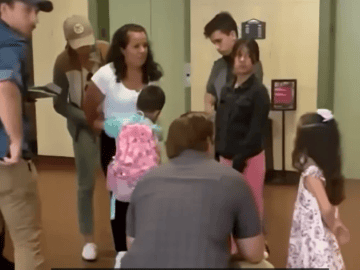
Families visiting people detained at California City must currently meet through glass. A new “Hugs Beyond Bars” campaign is demanding contact visits.
For families visiting loved ones detained at California’s largest Immigration and Customs Enforcement facility, a visit does not include a hug.
It does not include holding hands, sharing a meal or even sitting beside each other.
Instead, visitors sit on the other side of a thick pane of glass, speaking through a telephone to the person they came hundreds of miles to see.
The California City detention facility, operated by the private prison company CoreCivic, has prohibited contact visits since it began holding ICE detainees in 2025. The facility houses roughly 1,600 people in the desert north of Los Angeles.
For families, the policy has turned what should be a moment of connection into another form of separation.
“I want to hold my son”
Teresa Reyes drove about 300 miles in May to visit her son, Guillermo, on his 32nd birthday.
She brought herself to the facility hoping to spend time with him. Instead, she had to sit behind glass.
She could not give him a hug.
She could not share a meal with him.
She could not even touch him.
“I want to hold my son, I want to touch him, I want to assure him everything is going to be OK, but I can’t,” Reyes said, according to reporting on the facility.
Her experience is shared by families of people detained at California City, where physical contact during visits is prohibited.
The restriction is particularly painful for people who do not know how long their loved ones will remain in detention or whether they will have another chance to see them before being deported.
A campaign called “Hugs Beyond Bars”
The people detained inside California City have begun pushing back.
In April, detainees organized letters demanding that officials allow regular contact visits. Some had previously been held at other ICE facilities where families were allowed physical contact, making the restrictions at California City especially difficult to understand.
With help from the California Collaborative for Immigrant Justice, detainees and advocates launched a campaign called “Hugs Beyond Bars.”
The campaign asks the facility to allow families to embrace their loved ones during visits.
For detainees, the issue is not simply about comfort.
It is about maintaining a connection to the people they may eventually have to leave behind.
Gustavo Guevara, one of the detainees involved in organizing the campaign, said people inside were particularly worried about never getting the chance to say goodbye if they were deported.
One of his friends was deported to Mexico in June. Guevara said he never got the chance to hug him goodbye.
A question of security and dignity
Officials have cited security concerns around detention facilities, including the possibility of contraband entering through contact visits.
But immigration advocates question whether a complete prohibition is necessary.
A California Department of Justice review of the facility reportedly found that the visitation policy provided by CoreCivic called for opportunities for physical contact, while allowing restrictions when security concerns existed. The review also found that the facility has a room that appears capable of accommodating contact visits.
That has raised a basic question for families and advocates: Why can’t contact visits be permitted under controlled conditions?
The issue is especially significant because people held in immigration detention are not necessarily serving criminal sentences. They are being held while their immigration cases proceed.
Yet advocates say the visitation restrictions can make the experience feel increasingly like incarceration.
“We feel isolated in here”
Allen Tayson, a father of two from Gilroy, has been detained at California City since February, when ICE detained him during a green card interview.
He said the inability to physically embrace his wife and children makes the detention harder to endure.
“We feel isolated in here,” Tayson said. He described a hug from his family as something that could briefly take him away from the environment of detention.
For families, meanwhile, the trip to California City can itself be a burden.
The facility is located in a remote desert region, requiring some visitors to drive for hours. After making that journey, they may still be separated from their loved ones by a sheet of glass.
The result is a visit without physical contact, a family reunion in which the family cannot actually touch.
Families are asking for something simple
The campaign at California City is not asking for unrestricted access.
Detainees and advocates are asking for the opportunity to hug their relatives.
They argue that physical contact can be managed safely while giving parents, spouses and children something that a phone call cannot provide: the reassurance of human touch.
The campaign has gained support from advocates and the office of U.S. Sen. Alex Padilla, but the policy remains in place. CoreCivic and the facility’s warden had not responded to the campaign’s demands in the reporting published this week.
For Teresa Reyes and other families, the question is painfully simple.
When someone has driven hundreds of miles to see a loved one behind bars, should they at least be allowed to hug them?
At California City, the answer is currently no.
And families are fighting to change it.