A technology that rebuilt damaged enamel in laboratory testing has entered a human clinical trial. It could eventually change how some tooth damage is treated, but it is not a treatment patients can get yet.
A technology designed to rebuild damaged tooth enamel has moved from laboratory research into human testing, giving researchers a chance to determine whether the approach works in an actual mouth.
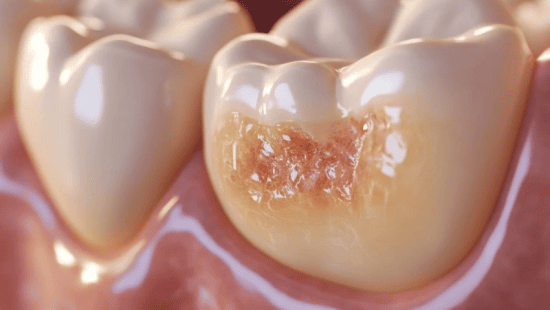
The technology, called Epinamel, is being tested in a small clinical investigation involving people with white-spot lesions; early areas of enamel damage that can develop after orthodontic treatment.
The study began in 2026 and is expected to involve about 20 participants. Researchers are comparing Epinamel with another enamel-repair treatment and measuring changes in the affected teeth.
The results are not available yet.
From laboratory to human testing
The technology grew out of research published in Nature Communications in 2025.
University of Nottingham researchers developed a protein-based matrix designed to imitate the biological environment involved in natural enamel formation. In laboratory experiments, the material helped organize calcium and phosphate from saliva into enamel-like mineral structures on damaged teeth.
Researchers reported that the reconstructed material restored several mechanical properties associated with natural enamel.
But those experiments were conducted outside living patients.
The researchers said additional testing in living systems was necessary.
The 2026 clinical investigation is the next step.
This is where the research becomes relevant to everyday life.
Enamel is the hard outer layer protecting a tooth. Once significant enamel is lost, the body cannot simply grow it back.
Enamel erosion can expose the underlying dentin and contribute to sensitivity. But tooth pain, especially pain when chewing, is not proof that enamel damage is the cause. Cavities, cracks, infection and other dental problems can also cause pain.
Anyone experiencing persistent or significant tooth pain should have the tooth evaluated rather than waiting for an experimental treatment.
Today, fluoride and other established dental treatments can help protect teeth and manage sensitivity. But those approaches are different from actually rebuilding substantial amounts of lost enamel.
That is what makes the Epinamel research potentially significant.
What the new trial does and doesn’t prove
The current human study is focused on white-spot lesions following orthodontic treatment. It does not establish that Epinamel can repair every type of damaged or eroded tooth.
And because the trial is small and still underway, there is not yet evidence showing how well the treatment works over the long term.
There is also no established price, insurance coverage or timeline for widespread patient availability.
So this is not a new cavity treatment available at the dentist today.
It is a technology being tested to determine whether damaged enamel can actually be rebuilt in people.
If enamel regeneration eventually becomes an effective dental treatment, another question will become important:
Who will be able to afford it?
Dental care can already be difficult to afford for families without adequate coverage. Parriva has reported on the growing use of cross-border dental care as Americans seek lower-cost treatment, as well as broader health-coverage challenges affecting California Latino communities.
Parriva: Dental Care and Cross-Border Healthcare
Parriva: California Latino Health Coverage
If Epinamel ultimately succeeds, its impact will depend on more than whether it works. Cost, insurance coverage and access will determine who can actually benefit from it.
The important development in 2026 is not that scientists have discovered a way to “regrow teeth.”
It is that an experimental technology designed to rebuild damaged enamel has entered human testing.
That is a significant step beyond laboratory research, but it is still only a step.
The clinical results are still pending.
For people with painful or sensitive teeth today, established dental care remains the option. But if this technology proves effective, it could eventually give dentists something they have never had before:
a way to rebuild some of the tooth structure that has been lost.