For some young voters, the biggest barrier may not be whether they care about voting, but whether they feel ready to face their first ballot.
For years, I thought about voting the way some people think about a college final they didn’t study for.
Heavy. Overwhelming. Something I knew I was supposed to do, but didn’t feel ready to do.
I didn’t cast my first vote until I was in my late 30s.
Part of it was simple: I didn’t give voting much importance. I wasn’t following politics. I wasn’t reading about candidates or government. It just wasn’t something I made time for.
But there was another part.
I didn’t know what I was doing.
The thought of going to vote without knowing enough about the candidates or propositions made the whole thing intimidating. It felt easier to avoid it than to walk into something I hadn’t prepared for.
Then I finally voted.
And the fear disappeared.
Now I see something similar with my own children. I have three voting-age kids, and none of them spends much time following politics.
So when our ballots arrive, I don’t tell them how to vote.
When we’re all together, I take the ballots out. We sit down and go through them. We talk about the candidates and propositions. Everyone makes their own choices.
It usually takes about 30 minutes.
Then we’re done.
That experience made me wonder:
Could part of the reason some young people don’t vote be less about not caring and more about not knowing where to start?
The research suggests that question deserves a closer look.
Young Latino voters can face a different starting point
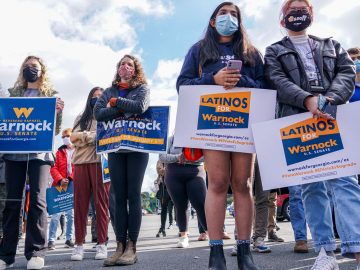
Young people generally vote at lower rates than older Americans. But young Black and Latino voters faced particularly low turnout in the 2024 election, according to research from CIRCLE at Tufts University. The researchers also found that young voters faced barriers ranging from not having enough information or support to feeling that voting was not important.
That’s important because telling someone to “go vote” assumes the hardest part is motivation.
It may not be.
For some first-time voters, the harder question could be:
What am I supposed to do when this ballot actually shows up?
Information helps. But information can also feel like homework.
California already has plenty of election information.
The state’s official voter guide includes information about statewide propositions, including arguments for and against the measures.
But there is a difference between having information and feeling prepared to vote.
That distinction may be especially important for someone facing a ballot for the first time.
If the ballot feels like a final exam, handing someone a pile of study material may not solve the problem.
Maybe they need someone to show them where to start.
That is one reason we created a dedicated California 2026 propositions guide, and a sumary California Voter Guide 2026: What the 14 State Propositions Could Mean for Housing, Schools, Taxes and Latino Communities where readers can work through the statewide measures without having to become political experts.
And for readers looking for a broader starting point, Parriva’s trusted California voter guides and election information brings together additional resources for understanding the voting process.
Maybe the first vote is the hardest one
There is something about doing something for the first time that can make it feel bigger than it really is.
Voting can be like that.
You have to figure out the ballot. You have to understand what the offices are. You may see propositions you have never heard of. You may worry about making the wrong choice.
And if nobody around you talks about voting, the whole thing can feel like something you are expected to figure out on your own.
That doesn’t mean information is the answer to everything. People choose not to vote for many reasons.
But research from CIRCLE shows that information and support are real barriers for some young nonvoters.
Could families help?
This is where my own experience gets interesting.
I don’t think parents should tell their adult children how to vote.
That’s not the point.
The parent doesn’t have to become the answer key.
The parent can simply say:
“Let’s figure this out together.”
Maybe that happens around the kitchen table. Maybe it’s with friends. Maybe it’s a conversation between siblings.
The point is to make the first ballot feel less like a test you’re walking into unprepared and more like something you can actually figure out.
There is no evidence that my family’s 30-minute approach will make every young person vote. That would be too big a conclusion.
But it raises a question worth exploring:
Could the people closest to a young voter help make the first step feel normal instead of intimidating?
The ballots are arriving
California county elections officials are scheduled to begin mailing ballots by Oct. 5 for the Nov. 3, 2026, general election. The voter registration deadline is Oct. 19, although conditional same-day registration is available from Oct. 20 through Election Day. California Secretary of State: November 3, 2026 General Election
That means a lot of first-time voters may soon be holding that envelope in their hands.
Maybe the answer isn’t another message telling them:
“Go vote.”
Maybe it starts with something simpler:
“You don’t have to know everything. Let’s figure out how this works.”
For a first-time voter, that may be enough to make the ballot feel a little less like a final exam.
And maybe becoming a regular voter starts with something very ordinary:
Someone sitting beside you for 30 minutes.