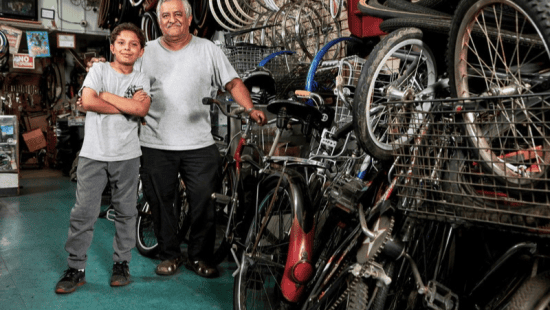
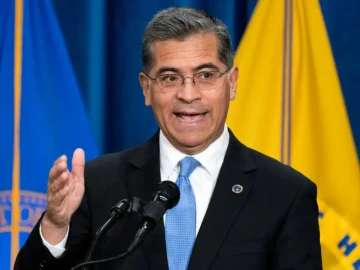
“My father taught me to be a strong person and never to take advantage of others. He showed me the profound value of my ancestors and Indigenous communities. Having him by my side meant so much to me. The humanity he instilled in me shaped who I am; it was important to understand people and fight for their dignity.”
At first glance, or even after hearing him speak, the image Estuardo Mazariegos gives off is exactly what you’d expect: an activist, someone who breathes activism, with words like justice, equality and compassion surfacing in every answer. It’s easy to picture him, in cinematic terms, as an old-school tough guy, no gun, of course, but with a shovel and a hoe, maybe a sickle and a rake, someone who uses his hands as much as his voice. And he does use them: for debate, he relies on words, arguments built up over a lifetime, the lessons of his parents and his community, and his university studies in labor issues.
But that image disappears the moment a little girl’s voice comes through the phone, approaching him. His voice softens, filled with tenderness and love; he pauses for a moment; his daughter Camila is by his side. When the brief exchange ends, Estuardo apologizes: “I’m sorry; she just got back from school; it’s her first day of class. It’s very important to me. My girls have changed my life; they’ve taught me so much, given me a real experience of the world. My job with them is to teach them to use their voice; for example, she just came over to show me what she did today. With them, I’ve reaffirmed that the world is harder for women; they have to fight against so many ideas that exist against them. I say they’re my campaign managers; they go everywhere with me.”
For this, and many other reasons, he’s fully committed to the campaign to become the next District 9 councilmember this November.
“It’s not acceptable to live in a district where 37% of children live in poverty,” he says bluntly.
Mazariegos knows something about that.
He was born in a humble community called La Limonada, in Guatemala. Like thousands of his countrymen, migration to the United States intensified in the 1980s because of the abuses caused by the civil war. “More than immigrants, we were refugees. We’re a community that’s hurting, battered, with a deep social and justice consciousness.”
Estuardo was very young, just three years old, when he crossed Mexico with his parents to reach this country. Often, wounds take root when you’re barely taking your first steps through life.
“A lot of people say you’re not from here or from there; I see it differently. That experience didn’t let me spend more time with the people from my community in Guatemala, but I found another town, other people, a new community I grew up in. But I was also shaped by the values that made us leave our country: the need to defend freedom of expression, our future, to fight for justice, to fight injustice… What I do now is a product of my history; it’s honoring that testimony of our community,” he says, reflective.
That was the upbringing he received as he grew up. His father, always watchful, would ask him to be an example for his younger brother; if he ever hurt him, his father would immediately ask, “How do you feel? Your job is to understand him and protect him.”
Growing up, he had to learn to defend himself; living in tough neighborhoods wasn’t like going to the beach. He had to learn to stand his ground, or “they’d eat me alive.”
“What’s always mattered most to me is seeking knowledge, learning, understanding, knowing how to navigate this society. I had the best teacher, my father, César Mazariegos; he read a book a week; I’ve never known anyone more educated. I come from a tough neighborhood, with a lot of need, a community marginalized for being poor and having dark skin; we live in a society that criminalizes people for that. My father taught me to be a strong person, to never take advantage of others; he showed me the full value of my ancestors, of Indigenous communities. Having him by my side mattered so much. The humanity he passed down shaped me; it was important to understand people, to fight for their dignity; without dignity, there’s nothing. Despite our differences, we always have to stay united.”
Estuardo Mazariegos has spent nearly two decades as a community organizer in South Los Angeles, first at the Los Angeles Alliance for a New Economy (LAANE) and currently as co-director of the Alliance of Californians for Community Empowerment (ACCE) in Los Angeles. Through his work, he has pushed for the Tenant Harassment Ordinance and the Resident Protection Ordinance, and helped secure passage of Measure ULA, among many other efforts.
“Having so many children living in poverty should be a source of shame, having a community that’s been hit this hard, with no green spaces, no community support programs… All that hope we carry has to be turned into strength, into power, to get the resources we need.”
South Los Angeles
“I believe fighting for justice is what I’ve done. I can learn and to fight, always with compassion. For me, this election is a continuation of the work I’ve been doing; it’s a new chapter, bringing together the power of the community. South Los Angeles, South Central, is a marginalized community, first populated mostly by African Americans, then by refugees, Latinos… That’s why unity matters so much, fighting the injustices this community has lived through: the high cost of housing, of family expenses… South Central has the highest level of overcrowding in this area; that shouldn’t be possible… Having so many children living in poverty should be a source of shame, having a community that’s been hit this hard, with no green spaces, no community support programs… All that hope we carry has to be turned into strength, into power, to get the resources we need,” he adds.
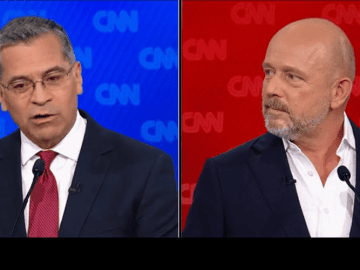
Mazariegos respects his opponent, José Ugarte, but sees a clear distinction between the two of them.
“The difference between him and me is that I’ve worked at the root of the problem. José has been working alongside those in power. I ask myself, what did he do to prevent all these problems we have now?” he says pointedly.
In the primary election, Ugarte finished in first place, roughly 15 percentage points ahead of Mazariegos. But heading into the general election, this candidate reads the results differently.
“To me, most voters rejected the establishment; they want change. I don’t see José as having won over the majority of the district. I’m working with all those people who didn’t vote for him, who are the majority, so they can join this movement for change… We’re at a point where the same political direction can’t continue; we need to transform South Los Angeles. I have a lot of long-standing relationships on the City Council; I’m known in Los Angeles political circles; most importantly, I have credibility; I know how to run a political project,” he emphasizes.
“Young people want change; there are volunteers on my campaign I’ve known since they were kids, I tell them: ‘Come see how we can change things.’ My door is open to young people.”
Young People, the Black Community, the DSA, and the Future of District 9
A third of District 9’s population is young people, one of the biggest challenges for anyone looking to transform a segment of the community that lacks opportunity and where gangs and crime show up everywhere.
“Young people want change; there are volunteers on my campaign I’ve known since they were kids, I tell them: ‘Come see how we can change things.’ My door is open to young people, just as it is to the Black community. I’ve always worked with them; we’ve worked for the people. There’s a segment of this community that isn’t happy with the Black leadership that’s governed the city. My movement is about justice, but I want to emphasize that racial justice is my priority. Making sure there’s a future,” he underscores.
Mazariegos is backed by the DSA movement, which has supported major Democratic candidates positioning themselves across the country.
“Their support is practical; they don’t ask for anything. They believe in my worldview, in the importance of justice; they’re part of a fairly broad coalition backing me. I know this election is going to be close, but I want to make clear that the most important thing about my campaign is that we’re going to raise that sign, high and big: ‘South LA It’s Not For Sale.'”