California added 47,100 jobs overall in October, but construction employment fell. Labor shortages and immigration enforcement raise questions about the workforce needed to rebuild Los Angeles.
California’s economy added thousands of jobs in October, but one industry moved in the opposite direction: construction.
The state lost 4,800 construction payroll jobs even as it gained 47,100 jobs overall, according to the Employment Development Department’s November 20 report.
The loses in construction are inportant for Los Angeles, where rebuilding homes destroyed by the Palisades and Eaton fires will require thousands of skilled workers. It also raises questions about an industry that relies heavily on immigrant labor while facing intensified immigration enforcement.
The October figures do not establish that immigration policies caused the job losses. But separate research documents workforce pressures that could complicate rebuilding.
Why did California lose construction jobs in October?
Construction recorded the largest monthly decline among California’s 11 major industry sectors.
EDD attributed part of the loss to wet weather across portions of the state. Employment also declined among utility-system construction companies, foundation and building-exterior contractors, and building-equipment contractors.
The longer-term picture is less dramatic.
California had approximately 880,600 construction payroll jobs in October, just 200 fewer than in October 2025.
A one-month decline does not necessarily indicate a sustained contraction. Statewide figures also do not reveal how many jobs were lost specifically in Los Angeles or wildfire rebuilding.
Meanwhile, private education and health services added 15,200 jobs, professional and business services gained 11,600, and leisure and hospitality added 8,100. California’s unemployment rate declined to 5.0%.
The figures show an economy growing unevenly.
How many workers will Los Angeles need to rebuild?
The workforce challenge extends beyond October’s employment report.
In its Blueprint for Rebuilding, Los Angeles County estimated that reconstruction across the Palisades and Eaton fire areas could require as many as 45,000 workers at peak activity.
That is a projected workforce requirement, not a count of current vacancies.
The county warned that construction labor shortages could undermine rebuilding schedules while the region also needs workers for housing production, infrastructure and other projects.
A June 2026 county economic update reported growing demand for recovery-related occupations, including construction managers, even as local hiring activity remained below pre-fire levels.
Los Angeles needs substantial construction capacity, but securing enough qualified workers may not be straightforward.
What role does immigration enforcement play?
Immigrant workers are central to Los Angeles construction.
A February 2026 economic assessment commissioned by LA County estimated that undocumented workers accounted for 28.7% of the county’s construction workforce.
That estimate describes workforce composition, not how many workers have left jobs because of enforcement.
Still, there is evidence of disruption.
A September 2026 national survey by Associated General Contractors of America found that 29% of responding contractors reported at least one direct or indirect enforcement-related impact during the preceding six months.
Twelve percent said workers had left or failed to appear because of actual or rumored immigration actions. Sixteen percent reported subcontractors losing workers.
In the western United States, 22% reported an enforcement-related impact.
The survey also found that 42% of responding contractors experienced project delays because of workforce shortages.
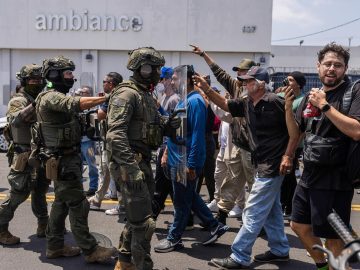
Parriva previously reported on construction workers frightened by an immigration operation in Montebello. Their contractor said some workers were afraid to return.
These accounts document concerns, not the cause of October’s statewide losses or verified rebuilding delays.
LA County’s blueprint also warned that immigration enforcement could discourage workers from participating in recovery.
What does this mean for Latino workers and housing?
For Latino construction workers, the situation presents competing pressures.
Rebuilding creates labor demand. At the same time, immigration enforcement can introduce uncertainty for workers, contractors and families dependent on construction employment.
The county’s assessment identified construction as particularly exposed to enforcement-related disruptions.
But Latino, immigrant and undocumented workers are not interchangeable categories. The statewide report does not identify how many October construction job losses affected Latino employees.
For homeowners rebuilding after the fires, the concern is whether contractors can assemble crews, retain skilled workers and complete projects on schedule.
For California’s housing shortage, workforce constraints could make an already difficult construction environment more challenging.
Financing, insurance, permits, materials and construction demand also influence rebuilding.
Is Los Angeles preparing for the workforce it needs?
LA County’s blueprint calls for expanding training and apprenticeships, coordinating with unions and colleges, and helping qualified workers enter construction careers.
Parriva has also examined growing interest in skilled trades and challenges facing Latino construction workers.
What remains unclear is how quickly these efforts can produce enough workers, whether employers face measurable staffing problems on individual rebuilding projects, and how immigration enforcement is affecting that work locally.
October’s employment report cannot answer those questions.
California added 47,100 jobs while construction lost 4,800. The industry was nearly unchanged from a year earlier, but Los Angeles faces rebuilding demands extending well beyond one month’s figures.
The larger question is whether the region can maintain and expand the workforce needed to rebuild homes while meeting its broader housing needs.