An investigation documents more than two dozen incidents involving federal immigration agents and vehicles, while collisions in Houston and Long Beach raise questions about force, safety and accountability.
An investigation documented more than two dozen incidents in which federal immigration agents allegedly used vehicles against immigrants and activists. A recent collision in Southern California has brought the controversy closer to Los Angeles.
A Mexican immigrant fleeing federal immigration agents in Houston was struck by an unmarked government SUV. In Long Beach, a former city employee riding a bicycle was hit by an unmarked ICE vehicle traveling the wrong way down a one-way street.
The incidents happened hundreds of miles apart, but both raise the same question: Are vehicles becoming another weapon in the aggressive tactics used by federal immigration agents?
The question gained new urgency after The Intercept published an investigation on November 2 documenting more than two dozen incidents in which Immigration and Customs Enforcement agents allegedly used government vehicles against immigrants and people monitoring federal operations.
The reported tactics included ramming vehicles, driving into civilians, and using sudden braking maneuvers against people following immigration enforcement operations. Some victims were hospitalized, and the investigation included cases involving serious injuries and deaths.
The report describes these practices as offensive driving techniques, a term that captures a troubling shift in how vehicles can be used during immigration enforcement. Cars and SUVs are no longer simply transportation for agents conducting arrests. In some encounters, they have allegedly become instruments of physical force.
A Mexican immigrant struck while running from ICE
One of the cases drawing particular attention involves Miguel Parra Hernandez, a Mexican national who was fleeing ICE agents in Houston on October 10.
According to prosecutors, Parra Hernandez ran into a parking lot as an unmarked government SUV followed him. The vehicle crossed a median and struck him, leaving him with a broken leg and requiring rehabilitation.
A Harris County grand jury indicted ICE officer Mario Alberto Morales on a charge of aggravated assault with a deadly weapon. The alleged weapon was the vehicle he was driving.
Morales turned himself in and was released on bond. His attorney has said his client committed no crime.
The Department of Homeland Security disputed the allegations, claiming Parra Hernandez ran in front of the vehicle. However, prosecutors say surveillance footage contradicts that account and shows the SUV striking him as he attempted to escape.
The case is significant because it moves the debate beyond accusations that immigrants use vehicles to threaten federal officers. It raises the possibility that agents themselves have used vehicles in ways that prosecutors consider criminal.
A collision in Long Beach brings the controversy to Southern California
The issue has also reached Los Angeles County.
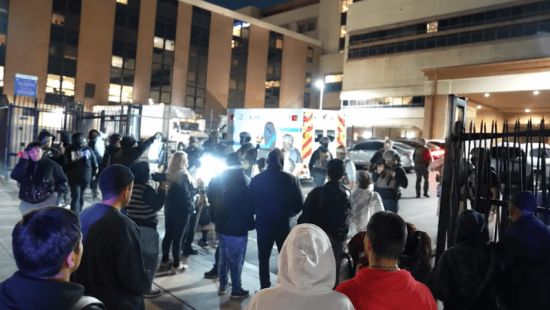
On October 17, an unmarked ICE vehicle traveling the wrong way down a one-way street in Long Beach struck Ricardo Gonzalez, a bicyclist whose family says he is a U.S. citizen.
Video of the encounter, reported by The New York Times and reviewed by other news organizations, appears to show the SUV swerving into Gonzalez’s bicycle. The agent then got out and pointed a gun at him.
Gonzalez was hospitalized with injuries. His family said he was also shocked with a Taser and suffered a broken arm during the encounter.
ICE disputed that its vehicle struck him. The agency said the incident involved a person who damaged a government vehicle and was arrested. Long Beach Mayor Rex Richardson called for an independent investigation and demanded answers from the Department of Homeland Security.
The incident is especially relevant to immigrant communities because it demonstrates how confrontations surrounding federal operations can affect people who are not necessarily the targets of an immigration arrest.
The broader climate in Los Angeles has also intensified. In October, Los Angeles City Council District 13 reported an increase in federal immigration enforcement activity across Hollywood, East Hollywood and Koreatown. The district said the operations were affecting longtime residents, workers and families.
Local reporting by LA Public Press documented additional ICE sightings and reported arrests across Los Angeles County between November 1 and 5, including activity near the Twin Towers jail, in Glendale, East Los Angeles, Koreatown and other communities. The publication cautioned that its reporting relied on rapid response groups, witnesses and local sources rather than official real time arrest data from DHS.
More recently, video from an October 30 immigration operation in North Hollywood showed a masked federal agent pointing a handgun at a bystander who was walking his dogs. The incident did not involve a vehicle striking a civilian, but it added to the growing scrutiny of federal agents’ conduct during operations in the Los Angeles area.
The double standard over vehicles
The controversy is particularly sensitive because the Trump administration has repeatedly accused immigrants and protesters of using their cars as weapons against federal agents.
A July investigation by The Guardian examined 26 cases that DHS had promoted as examples of vehicle attacks against immigration officers. The newspaper found that most allegations had been disproven, dismissed or had not resulted in criminal charges. Only one of the 26 cases had resulted in an assault conviction at the time of publication.
The findings raised questions about how federal authorities describe vehicle encounters and how those descriptions are used to justify arrests and the use of force.
The American Civil Liberties Union also documented vehicle-related incidents in its report on federal immigration enforcement. Its review identified 82 incidents involving agents using cars, including boxing in vehicles, ramming cars, and hitting people. The organization said agents rammed vehicles into other cars 14 times and hit people with cars six times among the incidents it reviewed.
These findings do not establish that every collision involving an ICE vehicle was intentional or unlawful. But they provide additional context for the cases now under scrutiny.
ICE faces questions about its vehicle policies
The agency has already issued new guidance on vehicle stops. An October memo obtained by The Associated Press prohibits ICE officers from pursuing vehicles that fail to stop and requires specific training for officers conducting vehicle stops. It also requires body cameras to be activated and vehicles used in stops to have operational lights and sirens.
The guidance still permits trained officers to use vehicle pinning techniques and tire deflation devices under specified circumstances.
ICE has described the new instructions as a reminder of existing safety requirements. DHS has also said the agency is introducing additional training in crowd control, high-risk vehicle stops, officer safety and medical response.
But the new rules do not resolve the central question raised by the recent incidents: who is accountable when a federal agent uses a government vehicle in a way that injures a civilian?
For Mexican immigrants and Latino families in Los Angeles, the Houston case and the Long Beach collision are more than isolated headlines. They are reminders that immigration enforcement operations can create risks that extend beyond the people agents intend to arrest.
As federal operations continue across Southern California, the public will be watching not only who is detained, but also how agents use their vehicles, what evidence is recorded and whether independent investigations can establish what happened when those encounters turn violent.