Police unions, construction workers, Airbnb-linked groups and a hedge fund manager helped finance the outside advertising battle. Here’s who spent the money and what was at stake.
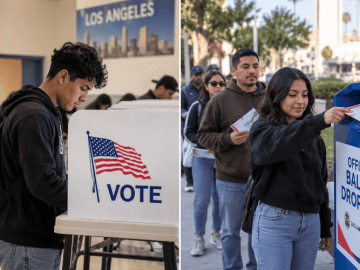
The 2026 Los Angeles mayoral runoff between incumbent Mayor Karen Bass and City Councilmember Nithya Raman became a multimillion-dollar battle involving some of the city’s most powerful business interests, labor organizations, wealthy individuals, and political advocacy groups.
Outside groups spent approximately $24.5 million on advertising in the runoff after the June primary, according to an analysis of filings with the Los Angeles City Ethics Commission published by The Basin and Rews on November 1. Of that amount, approximately $21.4 million went toward advertisements with readable text.
The spending significantly expanded the financial influence surrounding the contest, raising questions about who financed the competing political messages, what interests those organizations represent, and how much influence outside money can have over the city’s political conversation.
The money came from organizations with different priorities, including policing, housing, construction, transportation, labor relations, and the regulation of short-term rentals.
Two candidates, two financial coalitions
Behind Bass and Raman were different networks of donors and political organizations seeking to shape the election.
On Raman’s side, some of the largest financial backers included hedge fund manager Aaron Sosnick and the Western States Regional Council of Carpenters, a major construction workers’ organization.
On Bass’ side, major financial supporters included the Los Angeles Police Protective League, Airbnb-linked political spending groups and organized labor organizations representing city workers and other employees.
These organizations were not simply contributing to candidates’ campaign accounts. Much of the money flowed through independent expenditure committees, which can raise unlimited contributions and finance political advertising, provided they operate independently of the candidates’ campaigns.
That distinction is important because direct contributions to Los Angeles mayoral candidates are subject to strict limits, while independent committees can accept substantially larger contributions.
Raman’s financial network: Hedge fund wealth and construction unions
One of the most prominent financial supporters of Raman was Aaron Sosnick, a hedge fund manager who runs A.R.T. Advisors.
According to the report, Sosnick contributed $3 million to Estamos Con Nithya for Mayor 2026, an independent expenditure committee sponsored by the Western States Regional Council of Carpenters. He contributed another $1 million to a separate pro-Raman committee sponsored by Streets for All.
The combined $4 million made him one of the largest individual financial contributors in the mayoral contest.
Sosnick has also supported transportation initiatives in Los Angeles, particularly efforts to expand bicycle lanes, improve pedestrian infrastructure and redesign streets to accommodate alternative forms of transportation.
His involvement connects the mayoral contest to a broader debate about how Los Angeles should invest in its transportation infrastructure and reshape its streets.
The other major contributor to Estamos Con Nithya was the Western States Regional Council of Carpenters, which also put $3 million into the committee.
The union represents construction workers throughout the western United States and has significant interests in housing construction, development projects, infrastructure investment and labor standards.
Its support for Raman followed a political shift. The organization had supported Bass in her 2022 mayoral campaign but changed its endorsement to Raman in August 2026.
LAist reported that the union’s disagreement with Bass included her affordable housing directive, ED1, which does not require union wages.
The relationship raises questions about the importance of labor standards, prevailing wages and union participation in the city’s future housing and construction projects.
The important reporting question is how these donors’ financial and policy interests intersect with decisions about housing, transportation, development and construction in Los Angeles.
Bass’ financial network: Police, business and organized labor
Bass also received substantial outside support from organizations with significant interests in city government.
One of the most prominent was the Los Angeles Police Protective League, the organization representing rank-and-file LAPD officers.
The union financed political advertising supporting Bass and opposing Raman, making public safety one of the central themes of the outside advertising campaign.
A November 1 analysis of outside advertising found that 54% of spending supporting Bass involved advertisements containing the word “safer.” Half involved the word “school,” while 33% included the word “police.”
Several advertisements focused on Raman’s opposition to certain restrictions on homeless encampments near schools and daycare facilities.
The political debate reflects the union’s interest in policing policy, public safety funding and the role of law enforcement in addressing homelessness.
Another major source of financial support for Bass was Airbnb.
The report show that Airbnb had contributed more than $4 million to political groups supporting Bass and three other city candidates. That money should not be attributed entirely to the mayoral contest.
The company’s political involvement is particularly relevant because it has sought changes to Los Angeles regulations governing short-term rentals.
Bass advanced a proposal backed by the company that would allow hosts to rent out second homes and investment properties through 2028.
The city also has an ongoing legal dispute involving Airbnb over alleged price gouging following the January 2025 fires. The company’s interests in city regulation make its political spending an important subject for further examination.
Organized labor also played a role in Bass’ financial network.
SEIU Local 721, which represents thousands of Los Angeles city employees, contributed $150,000 to Unidos Con Karen Bass, an independent expenditure committee supporting the mayor.
The union has a direct interest in city employment contracts, wages, staffing and public-sector labor policy.
These relationships illustrate how political spending can bring together organizations with different priorities, from policing and business regulation to public-sector employment.
The advertising battle: Homelessness versus public safety
The millions spent by outside groups were also reflected in the language of their political advertisements.
The Basin examined the text of advertisements filed with the city and found that the two sides emphasized substantially different issues.
On the Raman side, 78% of outside advertising spending went toward ads containing the word “homelessness.” The word “rent” appeared in advertisements representing 56% of that spending.
Other frequently used terms included “leadership,” “crisis,” and “fire.”
On the Bass side, the most prominent word was “safer,” appearing in advertisements representing 54% of outside spending. Other frequently used terms included “school,” “kids,” “police,” and “tents.”
The findings suggest that the competing financial coalitions were investing in different political narratives: one emphasizing homelessness, housing and leadership, and the other focusing on public safety, schools and policing.
The question for voters was not simply which candidate had the larger advertising operation, but which claims were supported by evidence about the city’s actual challenges.
Questions about campaign finance transparency
The scale of outside spending also raised questions about the independence of political committees.
In October, the Los Angeles Times reported that election-law experts questioned whether Unidos Con Karen Bass was operating independently after Solomon Rivera, a former adviser to the mayor, became involved in running the committee.
Under campaign finance rules, independent expenditure committees cannot coordinate their activities with the candidates they support.
A lawyer representing Unidos disputed the allegations, saying Rivera had not communicated with Bass or her campaign about the committee’s advertising.
The allegations were not established violations, but the episode illustrates the challenges of enforcing independence requirements when former campaign or government officials become involved in outside political organizations.
Another complication is that money can move through several committees before being spent on advertising, making it difficult for voters to identify the original source of political funding.
Following the money beyond Election Day
The approximately $24.5 million spent by outside groups on advertising provides a starting point for understanding the financial forces surrounding the Los Angeles mayoral election.
But contributions alone do not establish that donors received political favors or that candidates changed their positions because of financial support.
The next step is examining lobbying records, city contracts, development approvals, policy decisions and the public positions of the organizations involved.
For Angelenos, the central issue extends beyond how much money was spent supporting Bass or Raman.
It is about understanding who financed the political conversation, what interests those organizations represent, and how their priorities intersect with the decisions that will shape Los Angeles.
The election may be over, but the financial relationships behind it deserve continued scrutiny.