Federal agents brought a detained person for treatment. Here’s what California law protects and what families should know.
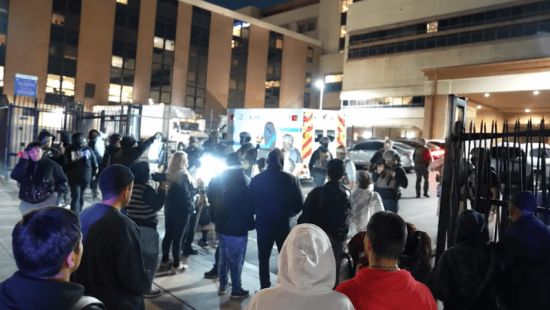
For families in Boyle Heights, the sight of federal immigration agents outside Adventist Health White Memorial Medical Center on November 6 raised an unsettling question: Is it safe to go to the hospital?
The agents had brought someone already in federal custody to receive medical treatment. Available reporting does not establish that they were conducting a raid to arrest hospital patients.
But their presence led to confrontations, and hospital officials said agents blocked an ambulance entrance without authorization.
California has laws protecting patients, and federal law requires most emergency departments to provide emergency care regardless of immigration status. Understanding those protections is particularly important as new UCLA research documents how immigration concerns are associated with families avoiding public assistance and delaying medical treatment.
What happened at White Memorial?
ICE agents brought a person in their custody to the hospital’s emergency department Friday evening.
White Memorial said agents subsequently blocked ambulance access, requiring ambulances to be diverted for approximately two hours.
Hospital President Daniel Fontoura told ABC7 that staff refused a request for agents to be present during a physician-patient consultation.
The hospital said it does not participate in immigration enforcement and remains committed to treating patients regardless of immigration status.
ICE stated that it does not target hospitals, schools or churches.
Community members protested, and advocates reported detentions outside the hospital. The circumstances of those reported detentions remain separate questions requiring verification.
The initial reason for the agents’ hospital visit is confirmed. Whether their subsequent actions violated hospital protocols or patient protections requires further review.
What protections does California law provide?
California’s Senate Bill 81 restricts immigration enforcement access to designated nonpublic areas where patients receive treatment or discuss protected health information.
The California Attorney General’s guidance explains that covered facilities generally cannot voluntarily permit immigration enforcement into those areas without appropriate legal authorization.
But the law allows agents to accompany someone already in custody who needs medical care.
That exception does not authorize unrestricted access to other patients or private treatment areas for immigration enforcement.
Parriva previously explained what California law allows ICE agents to do inside hospitals, including the difference between public areas and restricted treatment spaces.
California also enacted SB 1323 in September 2026. Beginning January 1, 2027, the law adds requirements involving hospital visitor procedures, notices explaining restrictions on access to nonpublic areas, and staff guidance when people in immigration custody seek to notify family members or designated support persons.
Those additional requirements were not yet in effect during the White Memorial incident.
Los Angeles County has also taken steps to strengthen procedures at county-operated health facilities. Parriva reported on the county’s hospital protection initiative earlier this year. Those county measures should not be confused with policies governing White Memorial, which is not a county-operated hospital.
Hospital treatment areas have legal protections, but federal agents are not categorically prohibited from entering medical facilities.
Can someone receive emergency treatment without immigration documents?
Yes. The federal Emergency Medical Treatment and Labor Act, or EMTALA, requires most hospital emergency departments to provide an appropriate medical screening examination to anyone seeking emergency care.
If someone has an emergency medical condition, the hospital must offer stabilizing treatment or arrange an appropriate transfer.
These rights apply regardless of citizenship, immigration status, insurance or ability to pay, as explained by the Centers for Medicare & Medicaid Services.
Hospitals may ask about insurance, but that cannot delay the required emergency examination or treatment. Medical information is also protected by privacy laws, subject to legal exceptions.
These protections do not guarantee that immigration enforcement will never occur near a hospital. They do mean that a person does not need proof of lawful immigration status to receive the emergency screening and stabilizing care required by federal law.
For a medical emergency, call 911 or seek emergency care promptly.
Why does UCLA’s new research matter?
Just one day before the White Memorial incident, the UCLA Center for Health Policy Research published findings from the 2025 California Health Interview Survey.
Researchers found that 15% of low-income immigrant adults avoided public programs because of concerns about immigration consequences, up from 11% in 2024.
Among those avoiding programs, 26% reported delaying needed medical care, compared with 12% among those who did not avoid programs.
The study does not establish that avoiding assistance caused those delays. It also predates White Memorial and cannot tell us whether the incident changed anyone’s willingness to seek care.
Still, it documents a serious existing concern: immigration-related fears are associated with people going without assistance and experiencing greater difficulty obtaining health care.
Parriva previously examined how fear of ICE is changing decisions about hospitals, schools and emergency assistance. UCLA’s new findings add California-specific evidence about avoiding public programs.
Emergency treatment and public-benefits enrollment are different matters. California’s updated public-charge guidance explains that immigration consequences depend on individual circumstances. Families should seek qualified legal advice before changing Medi-Cal, CalFresh or other benefits.
What should families know now?
White Memorial says it remains committed to treating patients regardless of immigration status. Federal law protects access to emergency screening and stabilizing treatment, and California law limits immigration enforcement access to private patient-care areas.
Questions about the ambulance diversions and the conduct of agents outside the hospital still deserve answers.
But the reported purpose of the initial visit was to obtain medical treatment for someone already detained; not to conduct a raid on hospital patients.
Families should have accurate information about both their rights and the limits of those protections. No one should delay urgently needed medical treatment because of an inaccurate understanding of what happened at White Memorial.