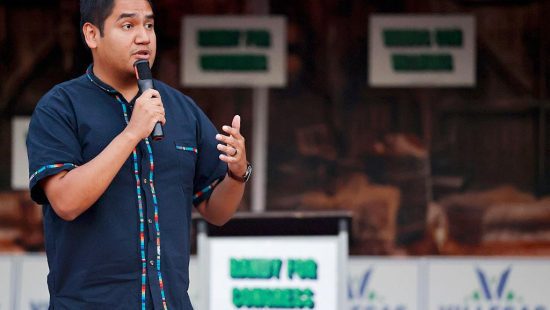
Randy Villegas, a progressive educator and son of Mexican immigrants, was projected to defeat the six-term Republican after October immigration raids put Valadao’s response to federal enforcement under scrutiny in a district that is about 73 percent Latino.
Rep. David Valadao’s failure to publicly challenge immigration enforcement operations targeting farmworker communities became a central issue in his re-election campaign, as Democrat Randy Villegas was projected to defeat the six-term Republican in California’s 22nd Congressional District.
Early returns showed Villegas leading by roughly two to one, with slightly more than half of the expected vote counted, according to NBC News. The results remain unofficial, as California continues counting ballots for weeks after Election Day.
The district, which includes Bakersfield and surrounding agricultural communities, is about 73 percent Latino, according to Reuters. The race was rated a toss-up before Election Day and was among the contests Democrats hoped to win as they sought to take control of the House.
The campaign unfolded against a backdrop of October ICE raids across the Central Valley, where immigration agents made arrests near homes, businesses and intersections in agricultural communities including Bakersfield and Wasco, Reuters reported. The operations spread fear among farmworker families, many of whom worried that going to work, shopping or simply moving through their communities could expose them to immigration enforcement.
Rather than forcefully criticize the operations or demand greater accountability from the Department of Homeland Security, Valadao largely defended the agency’s stated rationale. In a statement, he said DHS had told his office that enforcement operations focused on people with active warrants and known criminal histories.
In an interview with the Sacramento Bee, Valadao acknowledged that ICE had gone too far in some cases but declined to identify specific examples or detail what he had done to address them.
His response at an early October debate was even more revealing. Asked about the raids, Valadao said, “It is what it is,” a remark Villegas repeatedly invoked to challenge the congressman’s willingness to stand up for the communities he represented.
Villegas, a Visalia school board member and son of Mexican immigrants, characterized the arrests as a “very clear attempt to try and intimidate our communities.” He argued that the enforcement operations were terrorizing families across the Valley and made clear that Valadao’s response was inadequate.
The United Farm Workers union said it knew of hundreds of California farmworkers detained in recent weeks. For residents in a district where agriculture is central to the local economy, the raids were not an abstract debate over immigration policy. They were affecting workers, families and entire communities.
Valadao’s position left an important question unanswered: If federal immigration agents were going too far in the communities he represented, what was he prepared to do about it?
Villegas’s campaign also criticized Valadao’s vote for President Trump’s 2025 tax and spending law, arguing that it tripled ICE’s budget without adequate oversight. The legislation also reduced projected Medicaid spending, an issue with particular significance in a district with one of California’s highest Medi-Cal enrollment rates, according to a Dropsite News guide to rural congressional races.
The debate over immigration enforcement also extended to the criminal records of those arrested. A study by researchers at the University of Colorado Boulder and the University of California, Berkeley, published in the Proceedings of the National Academy of Sciences, found that just 34 percent of people arrested by ICE during Trump’s second term had criminal convictions, a near-historic low.
The study counted convictions, not pending charges. A DHS official, meanwhile, has said that 70 percent of those arrested had criminal convictions or pending charges, a broader measure.
For some voters, the raids became a test of Valadao’s willingness to challenge the administration. Raul Castro, 53, a Fresno County probation officer, told The Intercept he was upset that the congressman had not stood up to Trump over the enforcement operations.
Villegas finished second to Valadao in the June primary, receiving 32.4 percent of the vote to Valadao’s 40.7 percent. Assemblywoman Jasmeet Bains, another Democrat, finished third with 26.9 percent. Villegas went on to win the November matchup, according to the projection. Valadao was first elected to the House in 2012.