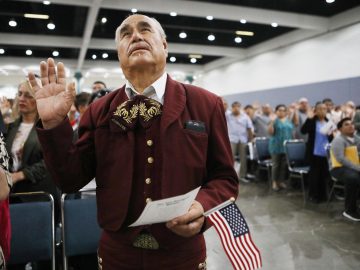
The 2026 midterms weakened Trump’s power and revealed growing Latino dissatisfaction with his presidency. Now both parties face a question: Have they underestimated these voters?
Latino voters have sent a clear message.
After nearly two years of President Donald Trump’s second administration, many Latinos have grown frustrated with policies they believe have harmed their families, communities and economic opportunities.
They know the issues. Immigration enforcement, health care, the cost of living and restrictions affecting immigrant families have shaped their lives and conversations.
Now that frustration is visible in the numbers and in an election that has changed the balance of power in Washington.
Democrats won control of both chambers of Congress on Tuesday, dealing Trump a major political setback. Early election reporting also points to renewed Democratic support among Latino voters, particularly in Texas, where Republicans had celebrated major gains just two years earlier.
For Latinos who have opposed the administration’s policies, the results may bring relief. But the election raises a bigger question: Could this be a turning point in how both parties understand Latino voters?
The numbers tell the story
The warning signs for Republicans were visible before Election Day.
An October Pew Research Center survey found that Trump’s approval among Latino registered voters had fallen to 24%, down from 38% in February 2025.
Seventy percent said his administration’s policies had harmed Hispanics. More than half—55%—said they viewed their congressional vote as a vote against Trump.
Even among Latinos who voted for Trump in 2024, his approval fell from 93% at the beginning of his second term to 57%.
The dissatisfaction went beyond immigration. Pew found that 74% of Latino registered voters believed Trump’s economic policies had made conditions worse.
These figures are from a pre-election survey, not the final vote count. But they reveal how much attitudes had changed before voters went to the polls.
The election results added another dimension.
In Texas, where Republicans made substantial gains among Latino voters in 2024, Democrat Gina Hinojosa defeated Gov. Greg Abbott, becoming the state’s first elected Latina governor. Democrat James Talarico also won the U.S. Senate race.
In California, Xavier Becerra won the governorship, becoming the state’s first Latino governor in more than 150 years.
These victories are significant, but the two states tell different stories. Texas ended more than three decades of Republican control of the governor’s office. California was already strongly Democratic.
The results also cannot tell us exactly how many Latino voters switched parties or whether different turnout patterns drove the changes. That requires more detailed postelection data.
What is clear is that Republican gains among Latino voters in 2024 did not guarantee continued support two years later.
What Trump’s weakened presidency means
Trump remains president until January 2029. But losing both chambers of Congress makes it much harder for him to pass major legislation.
The term lame duck describes an elected official nearing the end of a term, often with declining political influence.
Trump cannot be elected to another presidential term. Beginning in January 2027, Democrats will have greater power to block legislation, investigate federal agencies, examine spending and question administration officials.
But that does not mean Trump’s presidency is over.
He retains executive authority, including the power to direct federal agencies within legal limits and veto legislation. Congressional opposition does not automatically reverse existing policies.
For Latino communities concerned about immigration enforcement, health coverage and other federal decisions, that distinction matters.
The administration will face stronger oversight. Whether that produces meaningful changes for families remains to be seen.
Will both parties stop taking Latino voters for granted?
For years, political campaigns have treated Latino voters as a group whose support could be predicted from one election to the next.
The past two elections offer a reason to reconsider that assumption.
Trump made substantial gains among Latino voters in 2024. Two years later, his approval has fallen sharply, while Democrats have regained political ground.
But that does not mean Latino voters have permanently returned to the Democratic Party.
Pew found that 65% of Latino voters who supported Trump in 2024 still intended to vote Republican in their 2026 congressional races.
And Democratic support does not necessarily mean satisfaction with the Democratic Party.
In a separate Pew analysis of Latino attitudes toward the parties, only 42% of Latino Democratic congressional candidate supporters said the party cared about people like them a great deal or quite a bit.
That finding deserves attention.
Republicans cannot assume support gained in one election will survive dissatisfaction with government policies. Democrats cannot assume opposition to Trump will translate into lasting trust in their leadership.
Latino voters differ in their political beliefs, priorities and experiences. They do not speak with one voice, and no single election can capture all their views.
But their concerns are familiar: affordable housing, decent wages, health care, education, family stability and opportunities to get ahead.
Those expectations do not disappear when the votes are counted.
The 2026 midterms have changed the balance of power in Washington. They have also provided new evidence of the influence Latino voters can exercise—and the consequences when political support changes.
The next test belongs to the parties and the officials elected to serve.
Latino voters have made their dissatisfaction visible. Whether this becomes a lasting turning point will depend on what both parties learn from the election and whether they respond with results that earn voters’ trust.
For more political knowledge visit our political section.