District 9’s historic 2026 election could be the beginning of something larger: a South Los Angeles political movement capable of turning demographic strength into lasting influence at City Hall and beyond.
South Los Angeles has already undergone a remarkable transformation.
A region once known primarily as the historic center of Black political and cultural life in Los Angeles is now home to one of the city’s largest Latino populations.
In the middle of that transformation sits Los Angeles City Council District 9.
The district is approximately 78% Latino, according to the city’s 2021 redistricting data. Even more significant politically, Latinos make up nearly 65% of the district’s citizen voting-age population.
Now, for the first time in more than six decades, District 9 is poised to have a Latino councilmember.
The two candidates advancing to the general election, José Ugarte and Estuardo Mazariegos, are both Latino and have deep connections to South Los Angeles.
That makes the 2026 election historic.
But it also raises a bigger question:
Could South Los Angeles become one of the most influential Latino political regions in Los Angeles?
The answer will not be determined by one election.
Population creates potential.
Political organization turns that potential into power.
South L.A. Has the Demographic Foundation
The first ingredient is already there.
According to the latest Los Angeles Department of City Planning South Los Angeles Demographic Profile, based on 2020–2024 American Community Survey data, about 64% of residents in the city’s South Los Angeles planning area are Hispanic or Latino, compared with 22.6% who are Black.
District 9 is even more heavily Latino.
The city’s 2021 City Council redistricting demographic data put District 9 at 78.2% Latino overall and 64.9% Latino among citizens of voting age.
Those numbers give South Los Angeles something political communities cannot easily manufacture:
a large, geographically concentrated population.
But population alone does not determine political influence.
A Census count does not elect a councilmember.
Voters do.
And voters need organizations, candidates, information and reasons to participate.
Political Power Has Several Layers
One way to understand South Los Angeles’ political potential is to think of influence as a ladder.
Population
↓
Citizen voting-age population
↓
Voter registration
↓
Election turnout
↓
Political organization
↓
Candidates
↓
Coalitions
↓
Policy influence
South Los Angeles has already climbed several of those steps.
The District 9 election is evidence of that.
But the question is whether the community can continue climbing.
If Latino residents register and vote at higher rates, more candidates emerge from the community, organizations become more coordinated and elected officials build stronger coalitions, demographic strength can become something much more consequential.
It can become political power.
District 9 Could Be a Launching Point
District 9 matters because the councilmember represents more than a demographic statistic.
The Los Angeles City Council is the city’s governing legislative body. It enacts ordinances, authorizes public improvements and contracts, adopts or modifies the city budget, levies taxes and makes other decisions affecting residents across Los Angeles.
That gives every council district a direct connection to some of the city’s most important policy decisions.
District 9 also sits in an area of enormous economic importance.
The district includes much of South Los Angeles and the western portion of Downtown Los Angeles, according to the City of Los Angeles Department of Cultural Affairs’ District 9 profile.
At the same time, the district faces significant economic challenges.
That combination creates something important:
A large Latino constituency connected to some of the city’s most consequential economic, housing, transportation and development decisions.
A councilmember who can organize that constituency effectively could have influence far beyond the district itself.
The Real Question Is What Happens After the Historic Election
There is a danger in treating the election of the first Latino councilmember as the end of the story.
It may actually be the beginning.
One elected official does not create a political movement.
For South Los Angeles to become a major center of Latino political influence, the community would need to develop deeper political infrastructure.
That could include:
- Higher voter registration and turnout
- More Latino candidates running for office
- Stronger neighborhood organizations
- More civic participation among young voters
- Greater participation from Latino small-business owners
- Stronger relationships between community organizations and government
- Effective Black-Latino coalitions
- A sustained policy agenda that reaches beyond one election
Those developments would matter more than simply counting the number of Latino elected officials.
The Next Generation May Be the Most Important
South Los Angeles’ demographic transformation is no longer primarily an immigration story.
It is increasingly a generational story.
Many Latino residents were born in Los Angeles or have lived in South L.A. for decades.
They went to local schools.
They built businesses.
They bought homes.
They raised children.
They became teachers, organizers, entrepreneurs and community leaders.
That matters because political participation often grows when residents develop a long-term stake in a place.
The young Latino population that grew up during South Los Angeles’ demographic transformation is now entering adulthood.
Some are becoming voters.
Some are becoming organizers.
Some are running for office.
The District 9 race is an early indication of what that generation could mean for the region’s political future.
But South L.A.’s Future Cannot Be Built Without Black-Latino Cooperation
Any serious discussion about Latino political influence in South Los Angeles has to recognize the community’s Black political history.
Black Angelenos built many of the institutions that made South Los Angeles politically powerful in the first place.
Churches, neighborhood organizations, labor networks, businesses and civic leaders created a political infrastructure that helped produce generations of elected officials.
That history cannot simply be replaced.
And politically, it would be a mistake to try.
The most consequential future for South Los Angeles may not be one in which Latino political power replaces Black political power.
It may be one in which Black and Latino political power becomes increasingly interconnected.
That possibility is already visible in the District 9 race.
In Parriva’s interview with José Ugarte about his campaign and the future of South Los Angeles, Ugarte described his candidacy not as a rejection of District 9’s Black political history, but as an attempt to build on it while bringing Latino and Oaxacan representation to a district that is now overwhelmingly Latino.
He also pointed to shared priorities between Black and Latino residents, including public safety, schools, neighborhood conditions and economic opportunity.
That perspective is significant because it illustrates what a future South Los Angeles political coalition could look like: not replacement, but expansion of the political table.
South L.A. Has Something Other Latino Political Centers Do Not
Los Angeles already has powerful Latino political communities.
East Los Angeles has a long history of Latino civic activism.
Boyle Heights has produced generations of organizers and elected officials.
The San Fernando Valley has become an important center of Latino political participation.
South Los Angeles is different.
Its political identity was built through a different historical experience.
It became Latino-majority while retaining one of the city’s strongest Black political traditions.
That creates both a challenge and an opportunity.
If South Los Angeles can build a political coalition that connects its growing Latino population with its historic Black institutions, it could develop a political model that is unusually powerful in a city where demographic diversity is increasingly the norm.
That is also why Parriva’s earlier examination of how South Los Angeles became majority Latino is essential context for understanding this moment.
The demographic transformation came first.
The political transformation may be coming next.
The Business Community Could Become Part of the Equation
Political influence also extends beyond elections.
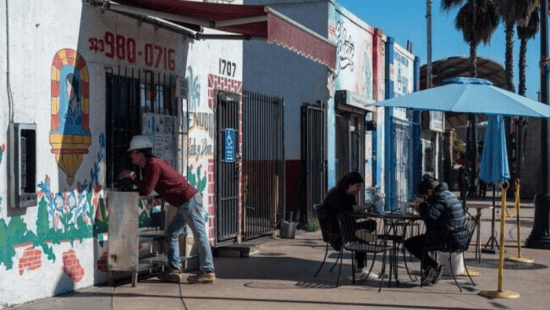
South Los Angeles has a large network of Latino-owned businesses, street vendors, entrepreneurs and working-class commercial corridors.
Small businesses are directly affected by city decisions involving permits, zoning, public safety, transportation, sanitation, development and enforcement.
If those businesses become more politically organized, they could become another source of influence.
That could matter particularly on issues where economic development intersects with neighborhood needs.
The political question is no longer simply:
Who represents South Los Angeles?
It is also:
Who is organized enough to influence what that representative does?
Influence Should Be Measured by Results
Ultimately, the number of Latino elected officials is not the best measure of political power.
A better test is what happens to policy.
Does South Los Angeles receive greater investment in infrastructure?
Do residents gain more access to affordable housing?
Do small businesses have a stronger voice?
Do transportation projects reflect neighborhood priorities?
Are city services more accessible in Spanish?
Does the community have greater influence over development?
Are more residents participating in elections?
Are young people becoming politically engaged?
And can leaders from South Los Angeles influence citywide decisions rather than focusing only on their individual district?
Those are the measurements that will tell us whether the region has developed real political influence.
The District 9 Election Could Be the First Visible Milestone
The 2026 election guarantees one historic outcome.
District 9 is poised to have its first Latino councilmember.
But the larger political significance remains uncertain.
It could be a one-time milestone.
Or it could become the first visible sign of a much broader transformation.
That depends on what happens next.
If Latino voter participation continues to grow, if more candidates emerge, if community institutions become stronger and if Black and Latino leaders develop durable coalitions, South Los Angeles could become an increasingly important political force in Los Angeles.
And if that happens, the impact could extend well beyond District 9.
It could affect citywide elections.
It could influence the direction of the City Council.
It could create a stronger pipeline of candidates for Sacramento and Washington.
It could change how political campaigns organize in South Los Angeles.
And it could demonstrate something larger about Los Angeles itself:
Demographic change does not have to remain demographic. It can eventually become political.
South Los Angeles Is Standing at the Beginning of the Question
The numbers suggest the potential is real.
The historic District 9 election suggests something is changing.
A new generation of Latino leaders is emerging.
But political influence is not inherited from population statistics.
It is built through participation.
It is built through organization.
It is built through coalition.
And it is ultimately measured by results.
That means the most important question for South Los Angeles may not be whether it can elect a Latino councilmember.
It is whether the community can turn that historic first step into lasting political power.
If it can, South Los Angeles may not simply become one of Los Angeles’ largest Latino communities. It could become one of the city’s most consequential Latino political regions.
And the 2026 District 9 election may be remembered as the moment when that possibility first became impossible to ignore.