Democrats’ congressional victory has sparked a fight over party leadership, with progressives challenging established leaders and Latino lawmakers demanding a stronger role in shaping the agenda.
Democrats have barely celebrated their sweeping November victories, but a new political battle is already developing inside the party: Who should lead the Democratic Party now that it controls both chambers of Congress?
The election delivered Democrats control of the House and Senate, giving them an opportunity to challenge President Donald Trump’s agenda during the final two years of his presidency. But the victory has also intensified questions about whether the party’s traditional leadership can respond to voters demanding a different direction.
Senate Democratic Leader Chuck Schumer and House Democratic Leader Hakeem Jeffries are both facing pressure from progressives who want a more confrontational approach toward Republicans and a new generation of leadership.
The criticism has been particularly direct toward Schumer. Several incoming Democratic senators have announced they will not support him in the next Senate leadership election.
Among them is Michigan Senator-elect Abdul El-Sayed, who has called for leadership focused on economic issues and reducing the influence of money in politics.
“I’ve been clear: I want new leadership, and I want leadership that is focused on getting money out of politics, putting money in your pocket, passing Medicare for All,” El-Sayed said in an interview with The Bulwark.
Other incoming senators, including Peggy Flanagan of Minnesota, Troy Jackson of Maine, Juliana Stratton of Illinois and Adam Hamilton of Kansas, have also expressed opposition to Schumer or declined to support his reelection.
Texas Senator-elect James Talarico has also refused to commit to backing Schumer, arguing that Democrats should be able to govern when they win a majority.
“I believe that the majority has the right to govern in this country,” Talarico said, criticizing the Senate filibuster as a source of legislative gridlock.
Schumer, however, has shown little interest in stepping aside.
Asked about incoming senators who have said they would not support him, he responded: “The issue is not me. I’ll be reelected as majority leader.”
The debate is not limited to the Senate. Jeffries, who is expected to become the first Black speaker of the House, is also facing pressure from progressive activists who argue that Democrats need a more forceful approach to confronting Trump.
An online petition calling on Democrats to reject Jeffries as speaker attracted more than one million signatures, reflecting dissatisfaction among some progressive voters. The petition, however, does not represent a formal challenge from Democratic lawmakers.
Latino lawmakers want a stronger voice
For Latino Democrats, the leadership debate comes at a moment of historic growth in congressional representation.
The Congressional Hispanic Caucus announced November 4 that more than 50 incoming members would join its ranks, making it the largest caucus in its history as it approaches its 50th anniversary.
The caucus said Latino voters demonstrated their political influence in the election and warned that their communities cannot be treated as an afterthought.
“Our numbers are growing. Our voices are growing. And our commitment to defending our communities and delivering for the people we represent has never been stronger,” the organization said in its post-election statement.
The caucus identified several priorities, including defending immigrant families, fighting deportations, advancing immigration reform, lowering costs, and protecting civil rights.
Although the organization has not called for Schumer or Jeffries to be replaced, its statement reflects the expectations facing Democratic leadership as Latino representation expands.
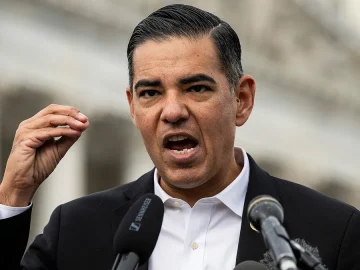
California Rep. Robert Garcia, who is expected to lead the House Oversight Committee, is among the Latino lawmakers preparing to use the new Democratic majority to challenge the Trump administration.
Garcia has promised investigations into immigration enforcement, alleged government abuses, corporate corruption and the handling of the Jeffrey Epstein files.
His message following the election was direct: “LAWYER UP,” he wrote on social media, signaling the investigations he intends to pursue.
In subsequent comments, Garcia made clear that Democrats intend to take a more aggressive approach.
“The days of us not fighting back are over,” he said.
Garcia’s position illustrates another challenge for the incoming leadership: Democrats must demonstrate that their congressional majority can hold the administration accountable while delivering on economic promises.
A different Democratic Party?
The election has created an unusual political moment. Democrats have regained control of Congress, but the party is entering the new session with disagreements over leadership, priorities, and how aggressively to confront the president.
Jeffries has emphasized affordability, promising to address the cost of housing, groceries, gasoline, and healthcare. He has also pledged investigations into alleged corruption and abuses of power.
Schumer has similarly promised to make lowering costs a priority.
But progressive Democrats argue that winning elections is not enough. They want leaders willing to challenge the influence of wealthy donors, advance healthcare reform and use congressional power more aggressively.
For Latino lawmakers, the challenge is also about ensuring that the communities that helped shape the election have a meaningful role in setting the legislative agenda.
The growing Hispanic Caucus, combined with the arrival of new progressive lawmakers, could change the internal balance of power in Washington.
Whether that translates into a leadership change remains uncertain. Schumer is defending his position, while Jeffries is preparing to become speaker.
But the message emerging from the election is clear: Democrats have won control of Congress, and their own voters are already demanding that the party show what it intends to do with that power.