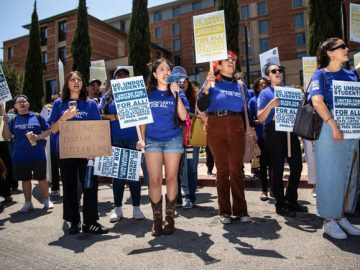
The California Teachers Association is suing the state over billions of dollars in public-school funding, arguing that California violated the constitutional school-funding guarantee created by Proposition 98.
The lawsuit, filed Sept. 15, asks a court to determine whether the state can delay about $3.9 billion in Proposition 98 funding for the 2025–26 school year. CTA also is challenging a separate $1.9 billion obligation from the previous year.
The dispute can sound like a fight between a teachers union and Gov. Gavin Newsom. But the larger issue is more basic: How does California’s constitutional school-funding guarantee work, and when does the state have to provide the money?
What is Proposition 98?
Proposition 98, approved by California voters in 1988, established a constitutional minimum funding guarantee for K-12 schools and community colleges.
The amount is not simply a fixed dollar figure. It is calculated each year using formulas tied in part to state revenues, enrollment and other economic factors.
That means the amount California expects to owe schools can change as its revenue estimates change.
The nonpartisan Legislative Analyst’s Office has warned that these estimates can be particularly difficult because California’s tax revenues can fluctuate significantly, including because of volatile capital-gains income.
So what is the $3.9 billion?
The state has calculated that the Proposition 98 guarantee for 2025–26 is higher than the amount currently being provided through the budget.
The 2026–27 budget leaves about $3.9 billion unpaid as a Proposition 98 obligation.
That does not mean the money has disappeared or that schools have permanently lost $3.9 billion.
It means the state has not provided the full amount now, creating an obligation that can be settled later as California gets a clearer picture of its actual revenues.
This process is commonly called a “settle-up.”
There is also a separate $1.9 billion Proposition 98 obligation from the prior fiscal year. CTA is challenging both amounts, describing the combined dispute as nearly $6 billion.
Why is California delaying the money?
The state’s argument centers on uncertainty.
California’s budget is based partly on forecasts of how much tax revenue the state will collect. Those forecasts can change substantially.
If the state commits too much money to Proposition 98 based on an optimistic revenue estimate and actual revenues later come in lower, California can face a new budget problem.
The Legislative Analyst’s Office has documented the underlying volatility in Proposition 98 calculations and the significant changes that can occur when revenue estimates are revised.
The state’s position is therefore that delaying some funding provides protection against committing money that might ultimately not be available.
Why is CTA suing?
CTA argues that the state has gone beyond prudent budgeting and violated the constitutional Proposition 98 guarantee.
The union’s lawsuit asks the courts to intervene and require California to honor what CTA says is money constitutionally owed to public schools.
That is an allegation, not a court ruling.
The lawsuit does not establish that California has violated the Constitution. The courts will have to consider the union’s legal arguments and the state’s response.
Why does the timing matter to schools?
School districts have to make financial decisions before every budget question is resolved.
That can affect decisions about staffing, programs and other services.
CTA says the funding uncertainty contributed to roughly 1,000 educator layoffs and argues that withholding the money has real consequences for schools and students.
That claim should be understood as CTA’s position; the lawsuit itself does not establish that every reported layoff was caused by the $3.9 billion dispute.
For districts, however, the underlying problem is straightforward: planning is harder when a large amount of expected funding is uncertain or delayed.
What happens to the money next?
The lawsuit does not automatically send the $3.9 billion to schools.
The court will first have to consider CTA’s claims and the state’s defense.
Separately, California will continue updating its revenue and Proposition 98 calculations.
That means the eventual amount and timing of any payment can depend on both the legal dispute and the state’s fiscal picture.
What does this mean for California families?
For parents and students, the immediate question is not simply whether California “has” $3.9 billion.
The more important questions are when schools will receive the money, how much will ultimately be owed and whether the state’s method of delaying payment is constitutional.
Those answers are not yet known.
The lawsuit also does not mean every school district will suddenly receive a check if CTA prevails. How any court decision would be implemented would depend on the ruling, subsequent state budget actions and the final Proposition 98 calculations.
What Latino families should know
California’s public schools serve millions of Latino students and families, making statewide education funding an important community issue. California 2026 Voter Guide / California propositions explained
But there is no basis for assuming that Latino voters, parents or educators have a single position on the lawsuit.
The practical issue for families is the same regardless of political affiliation: whether changes in state education funding affect the schools, programs and services available to their children.
The court case will determine whether California’s treatment of the Proposition 98 obligations complies with the state Constitution.
At the same time, state officials will continue monitoring tax collections and updating the estimates used to calculate the education funding guarantee.
For readers, the key numbers to watch are the $3.9 billion current obligation and the $1.9 billion prior obligation — and whether either amount changes as California’s fiscal picture becomes clearer.
The bottom line
This is not fundamentally a story about whether readers should side with CTA or Newsom.
It is a dispute over how California’s constitutional school-funding guarantee works, when the state must provide money calculated under that guarantee, and how much flexibility California has when its revenue forecasts are uncertain.
CTA says the state has crossed a constitutional line.
California says fiscal caution is necessary when billions of dollars depend on volatile revenue forecasts.
The courts will now have to decide where that line is.