Massive food giveaway lines in Los Angeles are exposing growing economic strain as California prepares for major CalFresh eligibility changes in 2026. Latino households, who make up most CalFresh recipients in L.A. County, could face increased hardship from stricter work requirements and inflation.
The various food giveaway efforts organized by community groups and government agencies are no longer enough to address the economic hardships facing a large portion of Los Angeles residents.
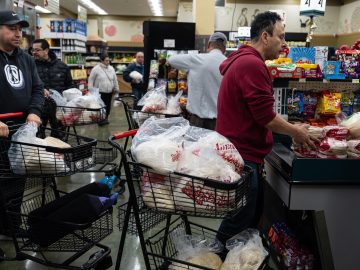
This week, an event organized by Supervisor Hilda Solis was overwhelmed by massive lines of people who began arriving as early as 5 a.m. hoping to receive food assistance. Cars lined up bumper-to-bumper for hours until supplies ran out. Around 2,000 families received food boxes before the distribution ended.
There are few signs that the situation is improving.
With new laws affecting people who receive CalFresh benefits, many residents are expected to face even greater financial and food insecurity in the coming months.
“To know that people are lining up as early as 5 o’clock in the morning, because it’s that important to them, tells me that the need is just so great,” said L.A. County Supervisor Hilda Solis. “And it’s unfortunate that we don’t have enough for everybody.”
Solis’ office organized Wednesday’s drive-through food distribution through a partnership launched last month with the Los Angeles Regional Food Bank to address growing food insecurity in her district.
Although food insecurity has long been a problem in Los Angeles County, inflation has made the crisis far more urgent.
One in four households in Los Angeles County reported struggling to afford enough food in 2025, according to a study by the USC Dornsife College of Letters, Arts and Sciences.
“We were hoping that in 2026 demand would ease off a little bit after everything that happened in 2025, but we’re not seeing it,” said Michael Flood, president and CEO of the Los Angeles Regional Food Bank. “Demand remains extremely strong.”
The latest increases in food and energy prices are putting additional pressure on already strained household budgets, especially among working-class families, seniors living on Social Security, and people relying on disability payments.
“It does feel like the pot is continuing to boil and slowly boiling over,” Flood said.
This month marks CalFresh Awareness Month, an initiative dedicated to increasing public awareness about CalFresh. State agencies, counties, and community organizations are working to inform residents, dispel myths, and assist families with applications.
However, the latest policy changes are raising concerns.
New rules implemented in April and additional changes scheduled for June will make it harder for many residents to qualify for assistance through the government program.
Latino communities are expected to be among the hardest hit.
Approximately 3,048,000 Latinos receive CalFresh benefits in California, accounting for 55% of all program participants statewide.
In Los Angeles County, dependence on the program is even greater. Latinos make up 62% of all CalFresh recipients among the county’s roughly 1.5 million beneficiaries.
“I depend completely on the assistance I receive for my daughter. Without it, I wouldn’t know what to do,” Ofelia told Parriva.
So far, officials have not released estimates on how many Latinos could lose benefits under the new rules.
On Tuesday, the U.S. government announced that inflation reached a three-year high in April as the war with Iran drove up energy prices.
Gas prices have increased by more than $1.50 nationwide in just over two months, reaching a national average of $4.50 per gallon and $6.15 per gallon in California, according to the American Automobile Association.
Grocery prices rose 0.7% in April, marking the largest monthly increase in nearly four years. Meat, dairy, and produce all saw significant price increases, according to the Bureau of Labor Statistics.
Overall, 24% of households in Los Angeles County experienced food insecurity during the past year.
Among low-income households earning less than 300% of the federal poverty line, 35% reported food insecurity, down from 41% in 2024. Nutrition insecurity also declined from 29% in 2024 to 21% in 2025.
CalFresh Changes in April 2026
Beginning April 1, eligibility for CalFresh was restricted for certain noncitizen groups, including refugees, asylees, and other humanitarian populations who had previously qualified for benefits.
The change is expected to affect tens of thousands of Californians and increase the risk of food insecurity among vulnerable communities.
Changes Coming in June 2026
Beginning June 1, 2026, one of the most significant CalFresh policy changes in recent years will begin taking effect.
Under the updated rules, certain adults between the ages of 18 and 64 without dependent children will need to meet new work requirements to continue receiving CalFresh benefits beyond three months within a 36-month period.
To remain eligible, individuals must:
Work, volunteer, or participate in approved education or training programs for at least 20 hours per week
Or earn at least $217.50 per week
Because eligibility reviews occur during applications, renewals, and recertifications, participants may experience these changes at different times over the next 12 months.
Key changes include:
Fewer exemptions. Veterans, people experiencing homelessness, and former foster youth will no longer automatically qualify for exemptions.
Stricter rules for parents. Exemptions will now apply only to parents with children under age 14, reduced from the previous age limit of 18.
Beginning in October 2026, another major change will affect how CalFresh is funded and administered.
Under the new federal policy, the federal government’s share of CalFresh administrative costs will decrease from 50% to 25%, shifting a much larger financial burden to states and counties.
These administrative expenses include staffing, EBT card issuance, customer service, and technology systems.
In addition, while CalFresh benefits have historically been fully funded by the federal government, a new cost-sharing structure tied to each state’s Payment Error Rate will require states with higher error rates to cover up to 15% of benefit costs.
Based on California’s most recent federal error rate, which is just under 11% and close to the national average, the state could face an estimated $2 billion in additional annual CalFresh costs beginning in 2027–2028 if the error rate remains above 10%.