
With $130.9 million allocated to planning and stabilization, community advocates want stronger enforcement of affordable housing and other redevelopment commitments.
After years of helping shape the future of Los Angeles County’s historic General Hospital, community organizations are asking the county to clarify how it will enforce the benefits they helped negotiate.
The Eastside LEADS Coalition supports the Community Benefits Agreement Framework signed in October. But in a November 23 letter to the Board of Supervisors, the coalition expressed concern about the lack of specific enforcement procedures and deadlines for addressing violations.
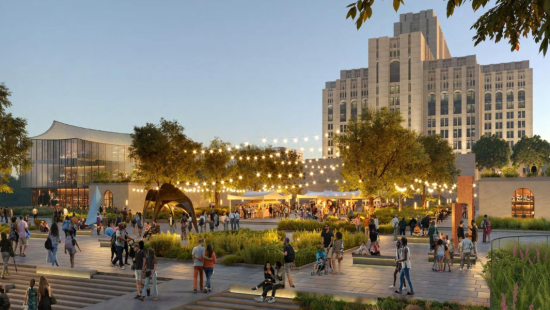
The following day, supervisors approved measures advancing the redevelopment of approximately 30 acres of public property, including the historic hospital and West Campus.
The November 24 Board action moves the county toward a development agreement with Centennial Partners for a mixed-use community known as the Healthy Village.
Final adoption of the enabling ordinance and execution of the development agreement have not yet been confirmed. The community benefits framework is intended to take effect upon execution of that agreement.
How much housing is guaranteed to be affordable?
Under the community benefits framework, at least 35% of the development’s residential units must be income-restricted affordable housing.
Those apartments would serve households earning up to 80% of area median income (AMI), a regional income benchmark used to determine housing eligibility and affordability limits based on household size.
The developer must also make commercially reasonable efforts to achieve a cumulative average affordability level of 40% of AMI or below across the affordable units. That does not mean every affordable apartment would be reserved for households at that income level.
Another 20% could become affordable housing if financing allows. Otherwise, those apartments would generally target moderate-income households earning between 80% and 120% of AMI, without mandatory long-term affordability covenants.
For lower-income Boyle Heights families, that distinction is important. The framework establishes a path toward 55% affordable housing, but only 35% represents the baseline income-restricted commitment.
The number of apartments available to extremely low-income households, their rents and application dates remain undetermined.
Who will enforce the community benefits?
The framework establishes a Governance Committee to monitor the developer’s performance and participate in negotiating commitments for individual development phases.
The developer must meet with the committee quarterly and submit annual reports. Missed performance targets require explanations and corrective action plans.
Formal enforcement, however, remains the county’s responsibility.
Eastside LEADS, whose members participated in nine months of negotiations, wants the future Master Option Agreement to more clearly define enforcement procedures, dispute resolution and the committee’s responsibilities.
The coalition’s concerns do not amount to opposition to the redevelopment.
The Los Angeles Conservancy also submitted a letter supporting the project, highlighting its potential to preserve a historic public asset while providing housing, jobs and community services.
Before the November 24 vote, Supervisor Hilda Solis acknowledged the contributions of community advocates and expressed confidence that county departments would be held to higher standards of accountability and transparency.
Who controls future development decisions?
The November 17 Board letter outlines a system under which the county’s Department of Economic Opportunity could approve qualifying development phases and ground leases without returning to the Board for every individual decision.
Projects outside the permitted development framework would require further Board approval.
Each development phase must also have a completed community benefits agreement before its corresponding ground lease is executed.
The framework calls for public notice when phase-specific community benefits negotiations begin and public access to high-level summaries of the resulting agreements.
Those safeguards provide opportunities for community oversight. However, access to summaries is not the same as guaranteed public access to complete agreements, compliance reports and enforcement decisions.
Healthcare facilities are not the same as funded services
The framework requires the redevelopment to provide a permanent home for The Wellness Center, including clinical and office space.
However, the developer is not required to finance or operate its healthcare and wellness programs.
For families seeking affordable medical and behavioral health services, securing space is an important step. Securing the resources necessary to provide those services is a separate challenge.
The redevelopment is intended to complement the neighboring operating medical center, not reopen the historic building as a full-service hospital.
A public investment spanning generations
The county estimates that approximately $130.9 million has been allocated to campus planning and stabilization, including funding from a $50 million state grant.
Centennial Partners estimates that the complete redevelopment could cost between $1.5 billion and $2 billion and take approximately 25 years.
That estimate is not a county funding commitment. Additional county financial participation would require separate Board approval.
The proposed development agreement is intended to move the project forward while preserving public ownership of the land.
For the communities surrounding General Hospital, the next important milestone will be the signing of that agreement.
After years of community participation, the challenge is no longer simply securing commitments. It is ensuring that future generations have access to the information, oversight and enforcement mechanisms necessary to hold both the county and the developer accountable for fulfilling them.