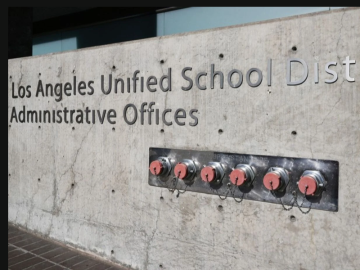
Declining enrollment, rising personnel expenses and expired pandemic assistance help explain why LAUSD faces financial pressure despite California’s relatively high education spending.
California spends approximately $3,500 more per public school student than the average in the rest of the country. Yet its largest school district is struggling to bring its expenses in line with its revenue.
The contradiction reveals an important distinction between how much California spends on education and what individual school districts can afford.
On November 19, the Los Angeles County Office of Education (LACOE) issued a fiscal oversight letter requiring Los Angeles Unified School District to demonstrate its progress toward financial stability, including how much money it has actually saved.
California spends more, but its money must cover higher costs
According to October research from the Public Policy Institute of California, California spent $22,321 per student on school operations in 2023–24, compared with $18,864 elsewhere in the country, expressed in 2026 dollars.
California ranked 17th nationally in per-student spending but fell to 26th after adjusting for differences in labor costs.
Employee compensation accounts for approximately 80% of current school expenditures statewide. Salaries, health insurance and retirement benefits consequently influence what schools can afford.
Between 2020–21 and 2025–26, state education funding increased by 24.2%, roughly matching inflation.
Meanwhile, combined federal, state and local funding declined from an estimated $144.2 billion in 2024–25 to $142.8 billion in 2025–26.
Substantial education spending does not necessarily translate into substantially greater purchasing power.
Why fewer students can create bigger financial problems
California distributes much of its school funding according to average daily attendance. Declining enrollment can reduce district revenue, although state funding protections can delay some losses.
Statewide spending per student can increase as education resources are distributed across a smaller student population.
Individual districts face a different challenge: losing students does not automatically reduce their expenses proportionately.
A school with fewer students may still need administrators, maintenance workers, utilities and specialized teachers.
LAUSD’s enrollment pressures are also exceeding recent expectations. According to the November 19 county letter, its fall enrollment count was 375,257 students, approximately 4,488 below its forecast.
County officials now want updated enrollment, attendance and revenue projections.
When temporary money supports ongoing expenses
During the pandemic, LAUSD received billions of dollars in additional resources to help students recover from educational disruptions.
A 2024 district financial disclosure anticipated approximately $5.6 billion in combined state and federal pandemic relief funding. By February 29, 2024, the district had received approximately $4.8 billion.
By June 2025, LAUSD acknowledged that pandemic funding had expired and district expenditures were exceeding revenue.
Personnel expenses had also increased.
According to its 2025–26 adopted budget, General Fund expenditures on certificated salaries, including teachers and administrators, rose from approximately $3.38 billion in 2021–22 to $3.88 billion in 2023–24.
That represents an increase of nearly $500 million before accounting for inflation.
Financial concerns and disagreements over spending
In October, California’s Financial Crisis and Management Assistance Team reported that LAUSD faced a high risk of insolvency, identifying deficit spending, declining enrollment and rising personnel and special education costs among its concerns.
United Teachers Los Angeles disputed aspects of that assessment.
LAist reported that the teachers’ union argued the analysis overstated financial risks and penalized the district for increasing teacher compensation. Union representatives also raised concerns that reducing educational programs could further discourage families from enrolling their children.
The disagreement illustrates a difficult financial challenge. Reducing expenses may improve budget projections, but districts must also consider how those decisions affect educational quality and future enrollment.
How district decisions affect school services
LAUSD’s recent campus supervision funding decision illustrates the choices district leaders face.
On November 10, the school board directed approximately $20 million of a planned $100 million equity-based allocation toward campus supervision across schools for 2027–28. The remaining $80 million would prioritize schools with greater needs, including special education schools.
This reallocates planned resources rather than providing additional funding.
Other anticipated savings depend on future decisions. LAUSD’s stabilization plan includes approximately $100 million in proposed savings associated with labor negotiations, including furloughs and health-insurance cost sharing.
County officials want the district to identify alternatives if those savings cannot be achieved.
Although LACOE approved LAUSD’s current-year budget on November 6, the district continues to face long-term financial challenges.
What LAUSD families should watch next
LAUSD’s next financial report is due December 15.
Families can follow the district’s progress through its public Budget Resource Guide and school board meetings.
The next financial update should help establish whether enrollment forecasts are realistic, promised savings materialize and recurring spending commitments align with expected revenue.
Parents can also ask school administrators which positions and student support programs could be affected by future school budget reductions.
California’s spending advantage matters less to individual school communities than whether their district can sustainably finance the educational services students depend on.