California’s Latino workers are a huge part of the state’s economy. But for many families, working does not mean feeling financially secure. Wages, housing costs, health coverage and immigration-related disruption are putting pressure on household budgets.
For a family trying to make it in California, the economy is not an abstract number.
It is the paycheck that has to stretch through the month.
It is the rent or mortgage. The grocery bill. Gas to get to work. Child care. A doctor’s visit. A car repair. Whether there is anything left over when the bills are paid.
That is why the growing economic concern among California Latino voters deserves more than another look at a poll.
What is actually happening to the economic security of Latino families?
Latinos are working. In fact, they are a central part of California’s workforce. But many Latino workers are concentrated in industries and jobs where wages are lower and economic security can be harder to build.
A 2026 report from the UCLA Latino Policy and Politics Institute estimates that Latinos make up about 39% of California’s workforce; roughly 7.8 million workers. The report also finds persistent gaps in wages, housing stability, health coverage and wealth-building.
Working doesn’t always mean getting ahead
UCLA reports that Latina workers have a median hourly wage of $18, compared with $29 for non-Latina women. Latino men have a median hourly wage of $20, compared with $35 for non-Latino men.
Among Latino workers, noncitizens have a median hourly wage of $17, compared with $20 for Latino citizens.
Those numbers matter because California’s cost of living leaves families with little room for error.
A worker can have a job and still be one unexpected expense away from trouble.
That is where the cost of living and California economy becomes a household issue, not simply an economic statistic.
Housing is one of the clearest pressure points.
UCLA estimates that 58% of Latino renter households in California are housing-cost burdened, meaning they spend at least 30% of their income on housing.
For renter households headed by Latino noncitizens, the share is even higher—62%.
When that much of a paycheck goes to keeping a roof over the family’s head, there is less room for everything else.
California Is Building More Housing. But Is It Becoming More Affordable?
Health care is part of the paycheck, too
Health coverage is another piece of the household budget.
UCLA reports that 12% of Latinos in California are uninsured, compared with 4% of non-Latinos.
Among Latino noncitizens, nearly 30% are uninsured.
For a family already dealing with high housing and everyday costs, an uninsured worker can face another kind of financial risk: what happens when someone gets sick?
The economic picture also depends on the kinds of jobs people have.
Latino workers are heavily represented in construction, agriculture, hospitality, retail and other labor-intensive industries.
That matters because what happens in those industries can quickly reach the kitchen table.
A slowdown in construction can mean fewer hours.
A weak season in hospitality can mean less income.
Changes in agriculture can affect both workers and the businesses that depend on them.
And when a family already has a large share of its income going toward housing, even a temporary reduction in hours can hurt.
Immigration can become an economic issue
This is where the economy and immigration begin to overlap.
The evidence does not show that immigration enforcement is responsible for all of the economic pressure Latino families face.
But Los Angeles provides evidence that enforcement can have economic consequences beyond the people directly affected.
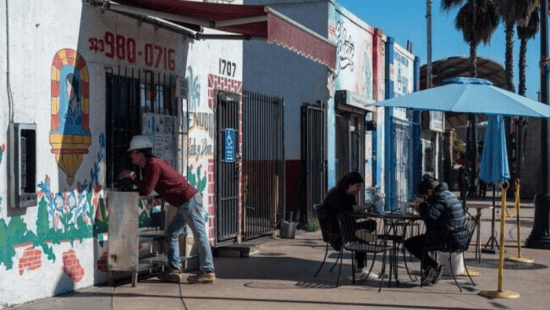
A UCLA study of Latino business corridors across Los Angeles County examined commercial activity around nine immigration-enforcement sites following the June 2025 enforcement surge.
Researchers found 46,000 fewer business visits and an estimated $3.16 million in accumulated losses within two weeks.
In surveys of 75 Latino entrepreneurs, every respondent reported fewer customers and sales following the enforcement activity. UCLA: The Cost of Fear
The study also found that the disruption did not simply disappear after the initial enforcement activity. Many business owners reported continuing financial stress, debt and difficulty recovering.
There are limits to what the research can tell us.
The study focused on nine enforcement sites and surveyed a relatively small group of entrepreneurs. It cannot tell us exactly how much immigration enforcement has affected every Latino business or household in Los Angeles, much less California.
But one thing is for sure, Latino business owners are dealing with several pressures at once, including fewer customers, worker concerns, rising operating costs, immigration enforcement and limited access to affordable financing.
The jobs picture is still moving
There is another reason to keep watching the data.
California added 39,400 nonfarm jobs in August, while the unemployment rate remained at 5.1%. The state’s September employment report is scheduled for release October 16. California EDD: August 2026 employment report
That report will give us a newer look at California’s overall labor market.
But it still will not answer every question about Latino workers.
We need to keep tracking wages, unemployment, labor-force participation, hours, construction, agriculture, hospitality, transportation, small businesses, housing costs and health coverage.
And we need to keep asking what happens when immigration-related disruption enters that picture.
The question voters should be asking
The economic reality is bigger than a campaign slogan.
California’s Latino workers are essential to the state’s economy. But many Latino households are still dealing with lower wages, high housing costs, gaps in health coverage and greater exposure to economic shocks.
That creates a straightforward question for the people asking voters for their support this November:
What specifically will you do to make it easier for working families to earn enough, afford a home, keep their businesses open and build some financial security?
Not just:
How many jobs will you create?
But:
Will those jobs pay enough?
Not just:
How much housing will you build?
But:
Will families be able to afford it?
Not just:
How much will the economy grow?
But:
Will working families actually feel the difference?