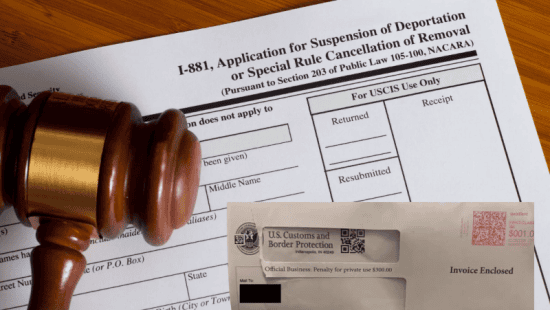
A federal judge has blocked the Trump administration’s process for imposing civil fines of up to $998 a day on immigrants who remain in the United States after certain final removal orders.
The ruling is a major setback for the Department of Homeland Security’s expanded fine program. But it does not erase federal immigration law, cancel every removal order or automatically wipe away every fine.
For someone who received one of these notices, the most important message is simple: don’t ignore it, and don’t assume an old deadline still applies. Get the actual notice reviewed by an immigration lawyer or qualified legal-services provider.
What happened?
On Sept. 30, U.S. District Judge George O’Toole Jr. stayed the administration’s 2025 rule governing civil immigration penalties and blocked enforcement of fines issued under that rule while the lawsuit continues.
The case, Maria L. v. Mullin, was brought by two immigrants and the Immigrant Legal Resource Center.
The lawsuit challenged both the way ICE assessed individual fines and a 2025 rule that made the process faster and harder to challenge.
The judge found that the government likely acted unlawfully. Among other problems, ICE used forms that did not give enough specific information about why an individual’s conduct justified a penalty. The judge also found that the administration failed to follow the required public-comment process when it adopted the new procedure.
The government imposed penalties at a rate of $998 per day. Because the administration applied them retroactively for as much as five years, individual assessments could reach roughly $1.8 million.
DHS said in July that it had issued more than 103,000 fines totaling about $84 billion. Those figures describe penalties assessed by the government. They do not mean DHS collected $84 billion.
The underlying civil-penalty authority comes from federal immigration law passed by Congress. The court did not repeal that law.
Instead, the ruling focuses on how the administration used the authority.
What does the ruling mean for someone who already got a fine?
This is where things get complicated.
The ruling pauses enforcement of fines issued under the challenged 2025 rule while the case moves forward. It does not mean every immigration fine in the country has disappeared.
It also does not erase the underlying removal order.
The government could continue defending the program in court, and the final outcome could change what happens to affected fines.
So if you have a notice, keep it.
Keep the envelope, too. Keep your removal order and any other immigration paperwork. Those documents can help a lawyer determine which process was used and whether the court ruling affects your case.
Under the 2025 rule, people generally had 15 business days to challenge a civil-penalty decision. The rule also eliminated an earlier notice step and changed how appeals were handled.
But that procedure is now part of the court fight.
That means older advice saying, “You have 15 business days or the fine becomes final,” should not be presented as a simple statement of the current law.
If you already received a notice, act quickly anyway. The court ruling does not mean you should sit on your paperwork while lawyers and judges sort out the next steps.
What if the government sent the notice to an old address?
There is a real problem here, but some claims being shared online go too far.
USCIS says most noncitizens must report a change of address within 10 days. It also says changing your address with the Postal Service does not update your USCIS record. USCIS change-of-address information
If you have an immigration-court case, there is a separate address requirement with the immigration court.
The Board of Immigration Appeals’ recent Matter of Diji decision dealt with notice requirements for immigration-court proceedings and in-absentia removal orders. It did not create a blanket rule saying every civil-fine notice mailed to an old address is automatically valid.
So if you missed a notice because you moved, tell your lawyer exactly what happened. Do not assume the fine is automatically valid or automatically invalid.
DHS has also promoted the CBP Home app as a way for some people to leave the country voluntarily.
The administration has said eligible people who self-depart through the program can receive travel assistance and forgiveness of certain failure-to-depart fines. The 2025 federal rule itself described the fine-forgiveness policy as an incentive for people to leave voluntarily.
But leaving the United States can have serious immigration consequences.
Someone with a final removal order, a pending immigration case or a possible path to lawful status should not make that decision based only on the promise of having a fine forgiven.
Get legal advice first.
What should you do if you received a fine?
Keep every document. Don’t throw away the notice.
Update your address. USCIS says USPS forwarding does not update your USCIS address.
Get the case reviewed. An immigration attorney or qualified legal-services organization can determine what notice you received, which rules applied and what the court ruling may mean for you.
Gather your records. That can include medical records, travel-document requests, immigration-court filings, evidence of a pending motion or stay and proof of when you received government notices.
And be careful about making a decision to leave the country simply because the government says a fine can be forgiven.
For Californians trying to understand the larger immigration picture, Parriva is also tracking California’s new immigration laws and what they actually mean for families and the changing rules around ICE arrests in Los Angeles.
The $998-a-day immigration fine system has hit a major legal roadblock.
But the fight is not over.
The court ruling does not erase federal immigration law, cancel every removal order or automatically resolve every fine.
If you received a notice, the safest move is to keep your paperwork, update your address and get your individual case reviewed before making a major decision.