UCLA research shows why reopening does not necessarily mean economic recovery and Boyle Heights offers a current Los Angeles example.
For a small-business owner, reopening the doors after a disaster can feel like the finish line.
The bills, however, do not stop. Customers may not return. Workers may be displaced. Insurance claims can drag on. Revenue can remain below normal even after the lights come back on.
That distinction is at the center of a new UCLA Latino Policy and Politics Institute study of small businesses affected by the 2025 Eaton and Palisades fires.
The report, “Reopened ≠ Recovered,” is based on interviews with 17 business owners and managers. It found that businesses that survived physically could still lose customers, workers and neighborhood activity—and some felt they were overlooked by relief programs because they had not been destroyed.
Reopening, in other words, is a milestone. It is not necessarily recovery.
A business can survive the fire and still lose money
The UCLA research describes a recovery process that continues long after the immediate emergency.
Some businesses faced financial losses, displacement, insurance problems and uncertainty. Others struggled to navigate assistance programs spread across multiple agencies and organizations.
The researchers also found that customer displacement could translate into lost revenue for businesses that remained open.
That matters because physical damage is relatively easy to see.
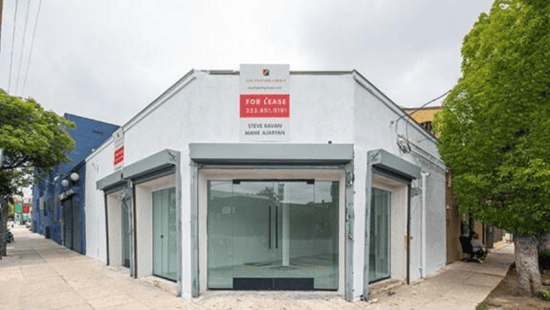
A boarded-up storefront is visible.
A business that opens its doors but loses much of its normal customer base is harder to measure.
The UCLA researchers argue that disaster assistance should account for those indirect economic effects, including revenue losses tied to customer displacement, workforce disruption and reduced commercial activity around disaster zones.
Boyle Heights shows why the question is current
Los Angeles does not have to look back to 2025 to see the problem.
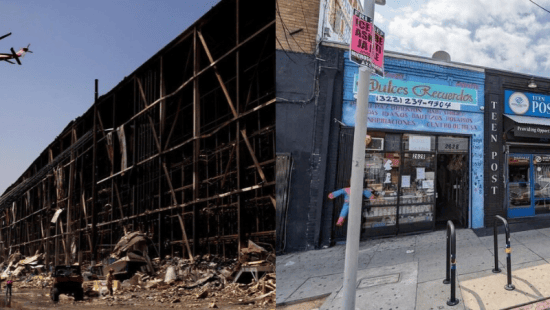
The June 17 Lineage Logistics warehouse fire in Boyle Heights created a separate disaster with its own circumstances and impacts. But it provides a current local example of the same economic question: what happens to neighborhood businesses when normal commercial activity is disrupted?
A Los Angeles County Department of Economic Opportunity survey found that 71 of 88 small businesses in affected commercial corridors reported revenue losses after the fire.
Businesses cited reduced customer traffic, property damage, temporary closures and workforce disruptions.
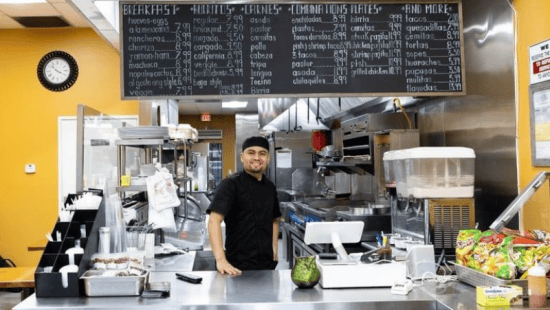
Parriva has also reported directly from Boyle Heights, including the experience of restaurant owner Carlos Ortez, who described declining foot traffic and the difficulty of keeping his business operating after the fire. Parriva’s earlier reporting on the Lineage fire and Boyle Heights businesses documents that experience.
The point is not that the Lineage fire and the Eaton and Palisades fires were the same.
They were not.
The useful connection is what they reveal about economic recovery.
When does recovery actually happen?
A business can be open and still be financially vulnerable.
The questions that matter may include:
- Have customers returned?
- Has revenue returned to something close to its previous level?
- Are workers back?
- Have insurance claims been resolved?
- Have disaster-related debts and expenses been absorbed?
- Can the owner keep paying rent, utilities and payroll?
- Has the surrounding commercial corridor returned to normal?
There is no single number that answers all of those questions.
But the UCLA research suggests that reopening alone is an incomplete measure.
That is especially important for small businesses because they often have fewer financial reserves to absorb a prolonged decline in sales.
UCLA notes that Los Angeles County has more than 1.3 million small businesses, making the health of neighborhood businesses an important part of the region’s broader economy.
Boyle Heights is still in the recovery process
The Lineage response has also moved beyond the initial emergency.
Los Angeles County approved assistance for businesses affected by the fire after its survey documented the reported revenue losses. The city has separately been considering additional recovery assistance for affected workers and businesses.
Parriva has been tracking that transition in its coverage of what Los Angeles City Council is considering for Boyle Heights.
That transition matters because recovery does not end when cleanup crews leave or when a business reopens.
It becomes an economic question.
What small businesses should document
For business owners affected by a disaster, the difference between “open” and “recovered” also has a practical consequence: document the economic loss, not only the physical damage.
That can include records showing:
- sales before and after the disaster;
- days or hours the business was closed;
- reduced customer traffic;
- lost inventory or equipment;
- payroll and workforce disruptions;
- repair and cleanup costs;
- insurance claims and payments;
- disaster-related loans or other expenses.
The UCLA research found that business owners also encountered administrative, language, technology and paperwork barriers when trying to access recovery assistance.
Parriva has previously explained another risk that can emerge during disaster recovery: how to avoid contractor and relief scams after the Boyle Heights warehouse fire.
The bigger lesson
The recovery of a small business is not always visible from the sidewalk.
A storefront can be open while its owner is still trying to replace lost revenue, rebuild a customer base and figure out how to pay the next month’s bills.
That is the lesson emerging from UCLA’s research on Eaton and Palisades businesses and one that Boyle Heights is now giving Los Angeles a chance to examine in real time.
Opening the doors is visible. Recovery is what happens after they open.