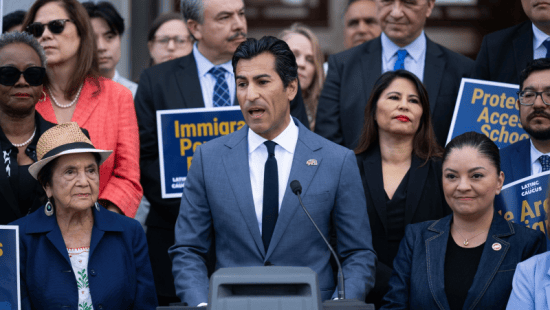
Parriva checks major claims from the September 30 California governor debate between Xavier Becerra and Steve Hilton against government data, official reports and the evidence behind each claim.
The September 30 California governor debate between Xavier Becerra and Steve Hilton produced a familiar political argument: one candidate says the other is getting the facts wrong.
But when we checked the evidence behind some of the biggest claims made during the debate, the picture was more complicated.
Some numbers were real but needed important context. Some claims turned a documented fact into a much broader conclusion the evidence does not establish. Others were campaign projections presented with the certainty of established facts.
Parriva reviewed the major factual disputes in the debate against government data, official reports and other primary sources. You can also read our earlier comparison of Becerra and Hilton’s positions on the issues facing California families for broader campaign context.
Unemployment: the number was real, but the claim needed context
Hilton said California has the highest unemployment rate in America and connected the state’s unemployment problems to high taxes and Democratic policies.
The latest Bureau of Labor Statistics unemployment data available at the time of the debate showed California’s August unemployment rate at 5.1%.
That was tied with Connecticut and Oregon among the 50 states. The District of Columbia, which is not a state, had a higher rate of 5.7%.
So Hilton was pointing to a real unemployment figure, but “highest in America” needed qualification.
The bigger leap came afterward. The unemployment rate itself does not establish that California’s tax policies caused it. Employment is influenced by many factors, including industry conditions, labor markets, economic growth and national trends.
Bottom line: California’s unemployment rate was tied for the highest among states. The broader claim that taxes caused that unemployment rate is not established by the data.
Poverty: California is among the highest, but not currently No. 1
Hilton also said California has the highest poverty rate in the country.
That depends on the measure and time period.
The latest Census Bureau Supplemental Poverty Measure data covering 2023–2025 put California’s rate at 17.8%. Louisiana was higher at 19.0%.
California therefore remains among the states with the highest poverty rates, but the latest data do not support calling it the highest.
An earlier period produced a different result, which may help explain why the formulation continues to appear in political arguments.
Bottom line: The underlying point about California’s high poverty rate is supported. The claim that California currently has the highest rate is outdated.
The 9.3% tax rate is real, but it is a marginal rate
Hilton argued that Californians earning around $70,000 face a 9.3% state income-tax rate.
There is a real number behind that claim. For 2026, California’s 9.3% marginal bracket begins at $72,724 for single filers.
But a marginal rate is not the same as the percentage of a person’s entire income that goes to state income taxes.
The 9.3% rate applies to income within that bracket. It does not mean someone earning around $70,000 simply pays 9.3% of the entire amount in California income tax.
That distinction can materially change how a tax burden sounds when presented in a debate.
Bottom line: The 9.3% figure is a real marginal rate, but presenting it as the effective tax rate on an entire household income would be misleading.
The “40% tax cut” has mathematical support; with an important catch
Becerra repeatedly argued that Hilton’s tax proposal would give millionaires and billionaires a roughly 40% tax cut.
There is a mathematical basis for the figure.
California’s current top individual marginal income-tax rate is 13.3%. Hilton has proposed an 8% state income-tax rate above the first $150,000 of income.
Moving from 13.3% to 8% represents roughly a 39.8% reduction in the marginal rate.
But that is not the same thing as cutting a wealthy taxpayer’s total California tax bill by 40%.
The actual effect would depend on income, deductions, filing status and the details of the proposed tax structure.
So both sides were describing different things: the arithmetic of the marginal rate is real, while describing it as a 40% reduction in the entire tax bill would overstate what that calculation shows.
Hilton’s $11,000 household savings figure is a projection
Hilton also promoted a figure of roughly $11,000 in annual savings for a typical California household under his proposed policies.
That is not an observed result.
It is a campaign estimate based on assumptions about how the proposed policies would affect household taxes and costs. Because the proposal has not been implemented, there is no real-world household data showing that typical California families are actually saving $11,000 under it.
That makes this a prediction, not a measurable current outcome.
The migrant-child claims: real failures, but several claims went much further
The most charged exchange involved unaccompanied migrant children who entered federal custody while Becerra was secretary of Health and Human Services.
Hilton cited a figure of roughly 479,000 children.
That number has a real basis.
An October 1, 2026 HHS memorandum says approximately 479,000 unaccompanied children were referred to the Office of Refugee Resettlement between 2021 and 2024.
The same HHS document describes changes to sponsor-screening procedures and identifies documented cases involving fraud, unsafe situations and abuse.
There is also independent federal oversight documenting problems in the screening and follow-up process. A 2024 HHS Office of Inspector General review found that 16% of sampled case files did not contain documentation of one or more required safety checks. Other files lacked timely documentation of background-check results or follow-up.
Those findings establish that serious problems existed.
They do not establish every claim Hilton made about their scale.
The evidence we reviewed does not establish that hundreds of thousands of children were “missing,” that 100,000 children under age 10 were missing, or that thousands were directly sent to traffickers.
A child who cannot be reached during a follow-up effort is not automatically a missing child. And documented cases of abuse or unsafe placements do not establish a nationwide number of children sent to traffickers.
The distinction is between a documented failure and a much larger claim about how many children were affected and what happened to them.
So were Hilton’s claims simply “made-up facts”?
Becerra repeatedly characterized Hilton’s statements as “made-up facts” or “alternative facts.”
The evidence does not support applying that description to the entire argument.
Some of Hilton’s most dramatic claims were not established. But the underlying issue was not invented: federal watchdog reports have documented problems with sponsor screening, background checks and follow-up involving unaccompanied children.
A more precise reading is that documented failures were combined with additional claims whose scale or causation was not established by the evidence we found.
That difference matters because dismissing the entire argument can obscure the evidence behind the underlying problem.
The HHS fraud claims are another example of a causal leap
Hilton also accused Becerra of dismantling a federal fraud operation and causing hundreds of billions of dollars in losses.
We did not find evidence establishing that Becerra dismantled HHS’s fraud-enforcement machinery.
Federal health-care fraud enforcement continued during and after Becerra’s tenure at HHS. The Department of Justice’s Medicare Fraud Strike Force continued bringing criminal cases and pursuing billions of dollars in investigative recoveries.
There are enormous estimates of fraud across federal health programs. But government-wide fraud estimates cannot simply be attributed to one HHS secretary.
The evidence therefore does not establish either the claimed dismantling of the fraud operation or the claim that Becerra caused hundreds of billions of dollars in losses.
Vaccines: recommendations and requirements are not the same as a universal mandate
Hilton said Becerra forced children to get vaccinated.
Federal health agencies did strongly recommend COVID-19 vaccination for children after vaccines received authorization.
But that is different from saying HHS imposed a universal federal vaccination mandate on every child.
School vaccination requirements are generally governed by states and local jurisdictions, while federal health agencies issued recommendations and requirements in specific settings.
The debate statement therefore compresses several different kinds of government action into the word “forced.”
Measles: the resurgence is real, but the 1960s comparison needs clarification
Becerra said children were dying from measles and described current measles levels as numbers not seen since the 1960s.
The first part is supported.
CDC data showed thousands of confirmed measles cases in the United States during 2026, including measles-related deaths.
But the raw number of cases was nowhere near the hundreds of thousands recorded annually in the early 1960s, before widespread vaccination.
So the statement needs clarification about what exactly is being compared.
A significant measles resurgence can be documented without saying the country has returned to the raw case counts of the early 1960s.
Gas prices: the gap is real, but there is no single-cause explanation
Hilton argued that California gasoline costs roughly $2 more than gasoline elsewhere because of Democratic policies.
The price difference is real.
But the California Energy Commission’s gasoline-price analysis identifies multiple factors that influence California gasoline prices, including crude-oil costs, refinery operations, distribution, marketing, profits, taxes, environmental programs and California’s relatively isolated fuel market.
The commission’s 2026 estimates put the Low Carbon Fuel Standard component at roughly 17 cents per gallon and the cap-and-trade component at roughly 25 cents. California’s state gasoline excise tax was 61.2 cents per gallon.
Those policies and taxes are part of the price.
But the evidence does not establish that Democratic policies alone explain a roughly $2 difference.
The price gap and the causes of that gap are two different factual questions.
Wildfire funding: two different pools of money became part of one debate claim
Becerra argued that the Trump administration was holding roughly $30 billion in wildfire funding hostage over California election laws.
There is a real and substantial dispute over federal wildfire and disaster-recovery funding. California has sought tens of billions of dollars in federal assistance, while the state has also committed its own money to wildfire recovery and prevention.
Newsom’s administration and the Legislature approved a separate $2.5 billion state wildfire package.
Those are different pools of money.
The evidence supports the existence of a major federal funding dispute and billions of dollars in wildfire needs. The more specific claim that the entire $30 billion was being withheld because of California election-law changes requires more documentation than was established in the debate.
Water: Becerra obtained an injunction, but that is not the same as a final win
Becerra also said he had “won the water case” involving the Trump administration.
California did obtain a preliminary injunction in litigation challenging federal water-export rules.
But a preliminary injunction is not the same thing as a final judgment resolving every issue in a case.
That distinction matters when an interim court ruling is summarized as a completed legal victory.
Hilton went further, arguing that Becerra’s water policies had destroyed agriculture.
California agriculture does face serious water constraints, but the evidence does not establish that Becerra’s litigation caused the destruction of California agriculture.
California schools: the score is below the national number, but the difference matters
Hilton said California schools perform below the national average.
That statement has numerical support depending on the test and grade level.
For example, on the 2024 National Assessment of Educational Progress, California fourth-graders scored 212 in reading compared with 214 nationally.
But the difference was not statistically significant.
The number therefore should not be turned into a sweeping conclusion that California students are definitively performing worse than the nation as a whole on the basis of that result alone.
“Worst homelessness” is not a defined statistic
Hilton also described California as having the “worst homelessness” in the country.
California does have by far the largest homeless population in absolute numbers.
But “worst” is not itself a statistical measure.
A comparison could instead examine total homelessness, homelessness per capita, the share of people who are unsheltered, the homelessness rate or housing affordability.
Those measures can produce different comparisons.
Without defining what “worst” means, the statement cannot be evaluated as a precise factual claim.
What the evidence tells us and what it cannot
The debate was not simply a contest between “facts” and “alternative facts.”
The more revealing pattern was:
FACT → CONTEXT → CAUSATION → POLITICAL CONCLUSION.
A number can be real but incomplete.
A true statistic can be presented without enough context to understand what it actually measures.
A documented problem can be used to support a causal claim the evidence does not establish.
And a campaign projection can sound like an established result even though it has never been tested in the real world.
That is why checking a political debate requires more than asking whether a number exists.
The harder questions are: What exactly does the evidence prove? What evidence points in the other direction? And what can the available evidence not tell us?
In this debate, the answers varied claim by claim.
Some statements were supported, with context needed. Some were misleading because an accurate number was used to create a broader impression than the data justified. Some causal claims were not established. And several dramatic claims about migrant children could not be substantiated at the scale stated.
The result is not a simple verdict on either candidate’s overall performance. It is a clearer picture of where the evidence supports the words used onstage and where it stops.