A bigger grocery bill can force a family to make choices that have little to do with food: delay a utility payment, use a credit card, dip into savings or skip something else the household needs.
For millions of Californians, that pressure is continuing even as the state puts more money into food assistance.
California food banks are serving communities facing high demand, higher food costs and changes in federal food supplies. At the same time, California has increased its investment in emergency food assistance.
The result is a food system under pressure and families may feel that pressure when they need help.
About 1 in 4 Californians are facing food insecurity
The scale is larger than the number of people who visit a food bank.
California food banks estimate that about one in four Californians experienced food insecurity in 2025.
That does not necessarily mean a person is going hungry every day. It can mean a household does not have reliable access to enough food or has to make difficult tradeoffs to afford it.
Research from the Public Policy Institute of California found that about one in eight California households lacked the resources to consistently meet their food needs in 2026.
The problem also extends beyond the lowest-income households.
Food prices are no longer rising at the pace seen during the worst of the inflation surge, but groceries remain more expensive than they were several years ago.
The U.S. Department of Agriculture reported that food-at-home prices, the category that includes groceries, were 2.2% higher in August 2026 than a year earlier.
For a household already operating with little financial cushion, even moderate increases can matter.
A family does not need to be officially poor to feel the squeeze. A car repair, higher rent, medical bill or reduced work hours can quickly turn a manageable grocery budget into a problem.
That is one reason food insecurity can show up among working families.
At the same time demand remains high, California’s emergency food system is dealing with changes in federal food assistance.
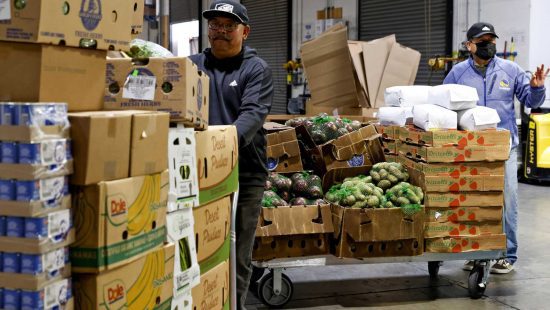
The California Association of Food Banks says federal emergency food commodities are about 38% lower in dollar value than in 2024, representing a loss of more than $100 million.
In a 2026 survey, 92% of responding California food banks said they were serving more people than in the previous quarter, while 55% said they were distributing more food than the previous year.
That does not mean food banks are running out of food.
It does mean the system has less room to absorb additional demand.
Latino families are experiencing higher food insecurity
The burden is also not evenly distributed.
PPIC found that 18% of Latino households experienced food insecurity, compared with 9% of white households.
Households with children also reported elevated levels of food insecurity.
Those differences matter in California, where Latino residents make up a large share of the state’s population.
But food insecurity is not simply a problem affecting one community. It is tied to household income, food prices, housing costs, family size, employment and access to public benefits.
California has responded with additional state funding.
The 2026–27 state budget includes $100 million for general CalFood food distribution, along with $16.5 million for diaper and wipe distribution.
The California Association of Food Banks says recent state investments have brought the total secured for CalFood to about $108 million.
That money helps food banks purchase and distribute food through a network that reaches local community organizations.
But emergency food assistance is only one part of the state’s food safety net.
California is also trying to connect food banks with farmers and food producers.
On September 28, Gov. Gavin Newsom signed SB 881, the Farmer to Food Bank Tax Credit.
The law allows eligible farmers, growers and food producers to receive a tax credit for donating surplus food to food banks.
The goal is straightforward: make it easier for food that might otherwise go unused to reach people who need it.
Food banks and farmers are also testing new approaches to make those connections more reliable, including programs designed to increase the supply of fresh, locally grown food.
For families struggling to afford groceries, a food bank may provide immediate help. But other programs can provide assistance before a household reaches an emergency.
Those include CalFresh, WIC and school meal programs.
PPIC estimates that millions of Californians rely on these programs.
Changes to federal nutrition policy could also affect access. PPIC has reported that recent federal changes could increase administrative costs for California and counties and expand work requirements for some CalFresh recipients.
That makes the broader question bigger than whether a food pantry has enough boxes on a particular day.
It is whether families can consistently afford food in the first place.
What this means for California families
For someone standing in a grocery store deciding what to put back, the larger policy debate can feel very distant.
The immediate question is simpler:
Can I afford enough food this week?
If the answer is no, food banks can provide emergency assistance. Families can also check whether they qualify for CalFresh, WIC or free school meals.
California’s food banks are continuing to distribute food, but they are operating in a system facing both high demand and changing supplies.
For families, that makes knowing where to get help and whether they qualify for other assistance increasingly important.
If you need food assistance: Start with the California Association of Food Banks food bank locator to find a local food bank or food distribution site.
You can also learn more about CalFresh food assistance and California WIC.
Parriva has also reported on California’s continuing food-access problems, including hidden hunger among Latino families in Orange County and what changes to food assistance could mean for Californians in Food Stamps Are Back, But Millions May Lose Access Forever.
The bigger picture is clear: California is investing more in emergency food assistance, but many families are still struggling to make their grocery budgets work.