California is changing how consumers identify healthier food. But in Los Angeles County, hundreds of thousands of households are still dealing with a more basic problem: having enough food to eat.
California just changed the information consumers will have when they buy food.
On September 28, Gov. Gavin Newsom signed legislation creating a voluntary state certification for foods that meet California’s definition of non-ultraprocessed foods. The state also approved new requirements for certain chain restaurants to identify beverages with high added sugar and to offer at least one children’s meal meeting specified nutrition standards. California’s announcement on the new food and nutrition laws
The goal is to make healthier choices easier to identify.
But in Los Angeles County, many families are confronting a different question.
Can they afford enough food in the first place?
About 814,000 Los Angeles County households experienced food insecurity in 2025, according to the county’s October 2025 Food and Nutrition Security report.
That’s about one in four households.
The Los Angeles County’s 2025 Food and Nutrition Security report found that food insecurity has remained around 24% to 25% since 2022, apart from a spike to 30% in 2023.
Food insecurity does not necessarily mean a household goes without food every day. It means the household did not have reliable access to enough food during the period measured.
For a family trying to make a limited grocery budget last through the month, that can make price the first consideration.
A parent may know which food is healthier.
The harder question may be whether there is enough money to buy it.
The problem is especially significant among low-income Latino households
A 2026 UCLA Center for Health Policy Research analysis found that 50.4% of low-income Latinos in Los Angeles County experienced food insecurity.
The analysis also found higher rates among low-income Latino immigrants with lower English proficiency and among those who avoided public programs such as CalFresh because of immigration-related concerns.
That puts California’s new nutrition policies into a more complicated context.
The issue isn’t whether nutrition information matters.
It does.
The issue is whether information creates meaningful choices when a household’s budget is already stretched.
What California’s new laws actually change
AB 2244 creates California’s voluntary Non-Ultraprocessed Certified food standard. The certification system will take time to establish; the law requires the state to accredit certification agents by June 1, 2029.
SB 869 requires qualifying chain restaurants to identify certain high-added-sugar beverages on menus, with the requirements taking effect in 2029.
SB 977 requires qualifying chain restaurants that sell children’s meals to offer at least one meal meeting specified nutrition standards.
These measures change information and food standards.
They do not directly lower grocery prices or expand food assistance.
Food banks see the other side of the problem
The scale of food assistance in Los Angeles offers another measure of the challenge.
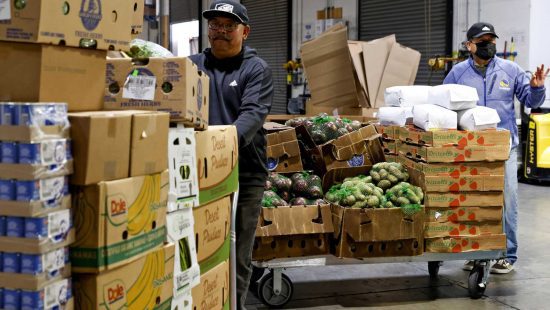
The Los Angeles Regional Food Bank distributed nearly 160 million pounds of food and grocery products in 2025 through a network of more than 600 partner agencies. It reported serving an average of roughly 1.1 million people each month. Los Angeles Regional Food Bank 2025 impact information
The organization has also emphasized nutritious food, including fresh produce, rather than simply providing calories.
That matters because food assistance and nutrition are not separate issues.
But continued demand for food assistance shows that access remains a problem even when communities are trying to improve the nutritional quality of what they provide.
Here is some additioanal information about the broader problem of California food banks and food insecurity and changes affecting CalFresh recipients.
Information is useful. But affordability determines choice.
A household with several affordable grocery options can use a label to compare products.
A household with very little money left for groceries may start somewhere else:
What can I afford?
That does not mean California’s new policies will not help consumers.
It means their effects will depend partly on whether people have realistic alternatives available to them.
That is something the new laws cannot answer yet.
We do not know whether certified foods will cost more or less.
We do not know how many consumers will use the new certification.
We do not know whether restaurant sugar warnings will significantly change purchasing behavior.
And we do not know whether these policies will reduce food insecurity.
Those questions will have to be measured after the policies take effect.
There is nothing contradictory about wanting healthier food and worrying about food affordability.
A family can want nutritious meals for its children while struggling to pay for groceries.
California can make food information clearer while Los Angeles families continue to face high household costs.
And food banks can distribute nutritious food while more than a million people continue seeking assistance each month.
The state’s new policies address one part of the food system.
For many Los Angeles families, however, the first question at the grocery store may remain much simpler:
How much can I spend?
The longer-term test may therefore be bigger than whether consumers can identify healthier food.
It may be whether healthier food becomes a realistic choice for the families with the least room in their budgets.