Los Angeles already supports legacy businesses. Now City Council is considering whether restaurants and other longtime small businesses need additional protections as costs and commercial pressures rise.
For a restaurant that has served the same community for decades, closing can mean more than losing a place to eat. It can mean lost jobs, lost customers and the disappearance of a business that has become part of a neighborhood’s identity. Parriva has explored that human dimension in
That question is increasingly relevant in Los Angeles, where city officials are considering whether existing programs do enough to help longtime restaurants and small businesses remain in operation.
The issue is especially visible on Olvera Street, where multigenerational Mexican-owned businesses have faced declining foot traffic, rising expenses and rent problems. Several businesses have struggled to remain open, according to recent reporting on the historic commercial corridor.
But the policy question facing Los Angeles is broader:
Can the city help longtime businesses survive before financial pressure forces them out?
The city already operates a Legacy Business Program through its Economic and Workforce Development Department.
The program supports businesses that have operated in Los Angeles for at least 20 years. The city says assistance can include technical support, promotional assistance, digital marketing and access to capital and grants.
The program is designed around a straightforward idea: businesses that have remained in their communities for decades can provide economic and neighborhood value that is not easily replaced.
For eligible businesses, the city has also offered Legacy Business Recovery Grants of up to $20,000 for expenses such as payroll, leases, insurance and inventory.
But restaurants are often dealing with pressures that go beyond access to a single grant.
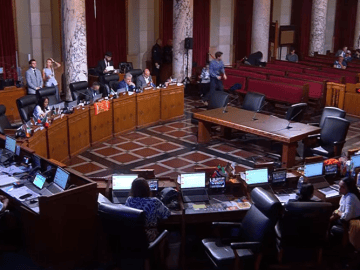
City Council is considering additional restaurant protections
Three City Council files show how the discussion has developed.
Council File 25-1180 would examine expanding the city’s Legacy Business Program to include restaurants and other small businesses that have operated continuously in Los Angeles for at least 10 years, subject to additional eligibility requirements. It also calls for recommendations for a Citywide Restaurant Protection Ordinance.
The proposal identifies potential assistance including education, outreach, technical assistance and expedited processing for qualifying restaurants. It also specifically calls for partnerships with organizations supporting immigrant entrepreneurs and restaurant workers.
As of September 2026, the file remains pending in the Economic Development and Jobs Committee.
A separate proposal, Council File 25-0218, would create a Legacy Restaurant Business Support Program with potential resources and incentives, expedited permits and reduced parking requirements. The item was continued by the Economic Development and Jobs Committee in February and remains pending.
A third measure, Council File 25-0996, has moved further. It directed the city to examine existing regular and emergency assistance available to legacy restaurants and identify additional ways to help restaurants experiencing financial crisis. The City Council adopted the item in February 2026.
These measures are important to distinguish because they are not all at the same stage. Some involve studying or developing possible new programs; another has already directed city staff to examine available assistance.
Restaurants are businesses, but they also depend heavily on the health of the commercial corridors around them.
A restaurant can lose customers when foot traffic falls. At the same time, owners still face rent, labor, food, utilities, maintenance, insurance and permitting costs.
The pressure from commercial costs is not unique to restaurants. We recently looked at how L.A. County is moving to track commercial rents and give small businesses more protection, another example of how commercial real estate costs can affect the ability of small businesses to remain in place.
California employment data also illustrates the scale of restaurant-related work in the Los Angeles region. The state’s Employment Development Department projects more than 60,000 waiter and waitress jobs in the Los Angeles-Long Beach-Glendale metropolitan area by 2032, with more than 125,000 projected openings over the 2022-2032 period.
That does not mean every restaurant is financially vulnerable. It does show why the survival of restaurants can have consequences beyond individual owners.
Olvera Street shows what is at stake
Olvera Street offers a particularly visible example.
The historic corridor is home to multigenerational Mexican-owned businesses, including restaurants whose histories stretch back decades.
That connection between entrepreneurship, cultural identity and business survival also appears throughout our Inspiring Interviews, including stories of immigrant entrepreneurs who have built businesses while serving their communities.
Recent reporting documented businesses dealing with falling sales, reduced foot traffic, rent arrears and expensive building repairs. Some longtime businesses have already closed.
That experience does not prove that every legacy restaurant in Los Angeles faces the same circumstances. It does show what can happen when several pressures accumulate in one commercial corridor.
And it illustrates why the debate is about more than preserving a storefront.
A longtime restaurant can provide jobs, attract customers to neighboring businesses and contribute to the identity of the area where it operates.
The story of Noel García’s Journey: Hard Work, Heritage, and the Making of Santo Fish Restaurant offers another example of how a restaurant can become intertwined with family history, work and cultural heritage.
When that restaurant disappears, another business may eventually occupy the space. But the new business does not necessarily replace decades of relationships, family history and community recognition.
For restaurant owners and residents, the important question is not simply whether Los Angeles supports legacy businesses.
It already does.
The question is whether the city will expand that support and create restaurant-specific tools—and, if so, which businesses would qualify and what assistance they would receive.
For now, the major items to watch are:
Council File 25-1180: potential expansion of the Legacy Business Program and development of a citywide restaurant protection ordinance.
Council File 25-0218: proposed Legacy Restaurant Business Support Program, including possible incentives and regulatory assistance.
Council File 25-0996: city review of regular and emergency assistance for legacy restaurants, already adopted by the Council.
For longtime businesses, timing matters.
A program created after a restaurant has already closed cannot preserve that business.
That is the central challenge behind Los Angeles’ current discussion: whether the city can provide meaningful support while a longtime business is still viable enough to survive.
For communities, the stakes can extend beyond the restaurant itself—to workers, neighboring businesses, commercial corridors and the cultural history attached to them.
Parriva’s Small Business coverage follows the broader economic and policy issues affecting California businesses and entrepreneurs, including the story of Salvadoran entrepreneur Elizabeth Mendoza and other business owners navigating the challenges of building and maintaining a business in California.