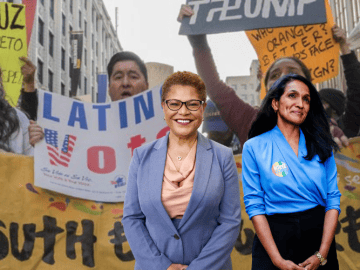
For the first time, two women are competing for mayor in a general election; women hold seven of the 15 City Council seats, and women lead some of the region’s most influential organizations.
Los Angeles will have a woman mayor for the next four years, regardless of who wins the Nov. 3 election. Mayor Karen Bass is seeking reelection against City Councilmember Nithya Raman, setting up a general-election contest between two women for an office the city had never before seen contested by two women in a general election.
The outcome will determine whether Bass remains the first woman elected mayor of Los Angeles or Raman becomes the city’s next leader and potentially its first South Asian woman mayor.
The race marks another milestone in the city’s political history. But women’s presence in leadership raises a broader question: How much representation have they gained, and what does that tell us about political power?
Bass made history when she took office in December 2022 as the first woman elected mayor of Los Angeles. Before becoming mayor, she served in the California State Assembly and the U.S. House of Representatives.
Raman was elected to the City Council in 2020 and represents the 4th District. Her mayoral campaign creates the possibility of another first for the city. The contest also puts two candidates with different backgrounds and approaches to Los Angeles’ challenges, including housing, homelessness, affordability and public safety, before voters.
Although both candidates are Democrats, the municipal election is officially nonpartisan. Their party affiliation does not mean they share the same priorities or solutions.
The City Council offers another measure of women’s representation. The city’s official directory of elected officials, updated Oct. 5, lists seven women among its 15 members: Eunisses Hernandez, Nithya Raman, Katy Yaroslavsky, Monica Rodriguez, Imelda Padilla, Traci Park and Ysabel Jurado.
That is about 47% of the council; substantial representation, but not a majority. The council adopts local ordinances, approves contracts and adopts or modifies the budget proposed by the mayor, according to the city’s description of the council’s responsibilities.
Women also hold all five seats on the Los Angeles County Board of Supervisors: Hilda Solis, Holly Mitchell, Lindsey Horvath, Janice Hahn and Kathryn Barger, according to the county’s official board directory. The county board and the Los Angeles City Council are separate governing bodies with different responsibilities, so their membership should not be treated as one pool of local representatives.
Women also lead influential organizations across the region. Yvonne Wheeler, president of the Los Angeles County Federation of Labor, was unanimously reelected to a second term in March 2026, the federation announced. Its new executive board is led by Chair Xochitl Cobarruvias.
These positions carry influence in different ways. Elected officials make decisions through government institutions; labor, business and community organizations can shape public debate, represent members and seek to influence policy. Leadership in one setting does not automatically translate into decision-making authority in another.
Representation is not the same as power
The mayor’s office carries significant authority, including proposing a city budget, signing or vetoing ordinances and appointing certain officials, subject to applicable procedures. The City Council debates and adopts legislation, approves spending and oversees other municipal decisions.
Who holds these positions matters because those decisions affect residents’ daily lives, from housing and public safety to city services and how public money is spent.
But head counts alone cannot show whether women have equal influence, whether their priorities receive equal attention or whether their presence produces particular policy results. Women do not share one political agenda, and their decisions are shaped by ideology, district needs, personal experience and institutional responsibilities.
To measure changes in political power more fully, representation figures would need to be paired with evidence about decision-making: whose proposals advance, how members vote, which priorities receive funding and what policies ultimately accomplish.
Another milestone on Nov. 3
The mayoral election will decide whether Bass continues in office or Raman takes over. Either way, Los Angeles will retain a woman as mayor.
That is a meaningful change in the city’s political history. It is not, by itself, proof that women have achieved equal influence across local government.
The next question is not simply whether women hold prominent offices, but how they use those positions and how the city’s decisions affect the people they represent.