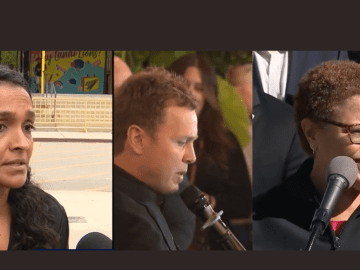
“It’s difficult, but you have to try your hardest. I’ve always been committed to policies grounded in real-life experiences, which is why I’m running again. This time, I’m ready,” she says.
Sara Hernández State Senate District 26 campaign highlights housing, education, and child care priorities while building on a legacy of Latino leadership in California.
Sara Hernández knows that no one will be able to fully fill the role that María Elena Durazo will leave as head of State Senate District 26. Still, she is convinced she has what it takes to lead the seat and the experience to push forward the initiatives needed to benefit the community.
“María Elena Durazo is a leader like no other, with a long and admirable career. What she has accomplished in Sacramento and throughout her political life is remarkable. Her work on behalf of the most vulnerable communities, as well as on immigration and labor issues, is vital. I hope to continue that part of the agenda if I win this election,” says the candidate and President of the Board of Trustees of the Los Angeles Community College District.
Hernández is passionate about housing affordability, economic, labor, and education issues, and her biggest dream is to achieve universal child care for all Californians.
Although she has not held positions on the City Council or in the State Assembly, Sara is clear about the principles that can lead her to success in Sacramento.
“Leading is not about acting alone. We need someone in the Senate with experience in these key issues, and I have it. I can’t say I will solve problems on my own—I would just be one of 40 senators. We need to build the right policy, connect it to what’s happening on the ground, and be a team player,” she says.
Her Story: One of Her Strengths
Sara Hernández grew up in an environment, a city, and a political circle that shaped her life. Salinas, her birthplace, is rooted in a region that fostered one of the most important Latino labor movements in the United States. The fight for farmworkers’ rights is lived, breathed, and fought for there—not only in California but across the country.
“My parents dedicated their work and time to that cause. The idea of social justice was always present at home. It’s what I lived, what I saw in the streets, and what I experienced growing up,” she recalls.
As a child, she also had dreams. She shyly admits she once wanted to be a hairdresser—she enjoyed being around people. She was also an avid reader, and among the many books she read was East of Eden by John Steinbeck, a novel about life in the Salinas Valley that told stories familiar to her.
“I’ve always been interested in education. As a student, I knew it was a tool to move forward in life. Later, I realized that by working in education, we could offer Latino youth opportunities they don’t always have access to,” she says.
For her, the fight for social justice was a natural part of life. She attended the legendary El Teatro Campesino of Luis Valdez and spent time in local taquerías that served as gathering spaces for the community.
Looking back, she reflects on how those early experiences shaped her values. “Salinas was often compared to the Deep South because of the discrimination and struggle. Most of us were Mexican farmworkers with a rich history of resilience.”
“I truly believe people run for office because they care about their communities and want to make a positive impact. For me, this has been one of the hardest decisions I’ve made. Being a state senator requires a significant time commitment, and I have a six-year-old son. It’s difficult to think about being away from him and my husband so often.”
Persistence and the Making of a Candidate
Hernández has sought to reflect those principles in her political agenda, shaped over years of experience in different spaces. She learned early that the world is vast and full of perspectives worth understanding.
Driven by curiosity and passion for education, she eventually left Salinas and attended Duke University, where she gained a new understanding of her identity as a Latina and Mexican American.
“That experience was eye-opening. It pushed me out of my comfort zone and exposed me to very different environments. It was one of the best experiences of my life,” she says.
Her path led her to Los Angeles, where she worked with underserved youth and helped found Helping Young People Excel, guiding teenagers toward their dreams. After earning her law degree, she was ready to fully enter politics.
She worked with former Councilmember José Huizar and later ran for California’s 34th Congressional District, a race won by Jimmy Gomez.
“I had always been around politics and decided to take my chance, but I wasn’t ready at the time. That campaign taught me valuable lessons. Running for office is the final step—you first have to build relationships, coalitions, and support. It’s difficult, but you have to try your hardest. I’ve always been committed to policies grounded in real-life experiences, which is why I’m running again. This time, I’m ready,” she says.
She knows that one of the most important steps is to communicate as effectively as possible with the community and to craft press releases in a clear and impactful way.
“We have to make sure that the issues that matter to people are clearly understood—that people know how processes work. I have a lot of experience building that kind of policy, and I’m very confident in it. Many times, we do the work and others take the credit for what’s been accomplished. That happens, and it doesn’t bother me too much, but I believe we need to build a sense of authenticity around the work we do and make sure people know it,” she adds.
Is It Worth It?
Hernández pauses when asked this question.
“I truly believe people run for office because they care about their communities and want to make a positive impact. For me, this has been one of the hardest decisions I’ve made. Being a state senator requires a significant time commitment, and I have a six-year-old son. It’s difficult to think about being away from him and my husband so often.
“But I also think about the good I can do, the things I can help build. I think about my parents—about everything I’ve lived through, from attending protests in Salinas as a child to hearing conversations about farmworkers’ struggles at home. I hope they’re proud.
“My story is part of a long chain of generations—my grandparents, my parents. I want to build a healthy community and help make the dream of a prosperous California a reality again. Those dreams are slipping away, and I want families seeking justice to know they have an ally. When I think about all of that—yes, it’s worth it.”
The Seat No One Can Easily Fill: State Senate District 26 After Durazo