From WhatsApp family chats to Facebook groups built around neighborhoods, food, and cultural identity, online spaces help Latinos stay connected. Politics enters those conversations, but it is rarely the only reason people come together.
For millions of Latinos in the United States, online communities are places to share family news, exchange recommendations, discuss local issues, and maintain connections across borders. Political conversations happen in these spaces, but their role extends well beyond elections and partisan debate.
A Pew Research Center report published October 14, 2026, found that approximately one in 10 Hispanic adults participates in an online community focused on race or ethnicity. These communities can provide a space for people to connect through shared backgrounds and experiences, although the survey does not establish how frequently Latino members discuss politics in those groups.
The broader findings suggest that political debate is not the main attraction of most online communities. Among U.S. adults who participate in these spaces, 71% said they see little or no political content in the online community they visit most often. More than half, 54%, said political discussion does not belong in that community, while 25% said it does.
Those figures represent the overall U.S. adult population, rather than Latinos specifically. Still, they provide context for understanding how people use digital spaces built around relationships, interests and shared experiences rather than political affiliation.
WhatsApp connects families across borders
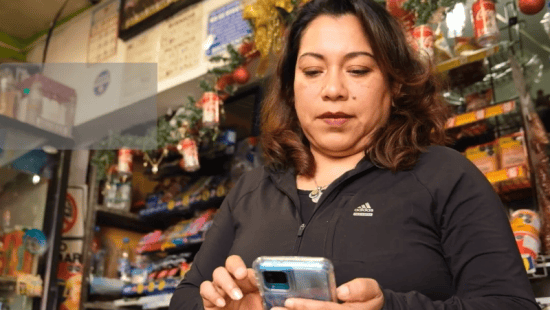
For Mexican Americans and other Latino communities, messaging platforms have an additional role. They make it possible to maintain close relationships with relatives in other cities, states and countries, often through private conversations and group chats.
Research published in 2022 by the Center for Media Engagement at the University of Texas at Austin examined WhatsApp use among Mexican American, Cuban American, and Indian American communities in the United States.
Among Mexican American participants, 65.6% said connecting with family and friends back home was an important use of WhatsApp. The study also found that 32.2% often or always discussed political issues on the platform, a higher share than among the Cuban American and Indian American groups included in the research.
The findings illustrate how personal communication and political discussion can coexist. WhatsApp may serve as a place to coordinate family events, share photos and exchange everyday information, while also becoming a channel for news, election discussions and commentary about government policies.
Because the research was conducted in 2022, the results should not be interpreted as a measurement of current WhatsApp habits. They nevertheless offer insight into how Mexican American participants used the platform at that time.
Politics is part of the conversation, not the whole story
The relationship between Latinos and political content online is more complicated than a simple preference for or against political discussion.
A 2025 academic study published in Political Research Quarterly examined online political engagement among more than 2,500 Latino respondents and compared their activity with that of white Americans. Researchers found that Latino social media political activity was comparable to that of white respondents.
That finding challenges the assumption that Latino users are less interested in political engagement online. Participation can take different forms, from sharing news and discussing public policy to communicating privately with family members about elections and government decisions.
At the same time, the Pew findings suggest that many people value online communities precisely because they offer something different from the constant political arguments that can dominate public social media feeds.
For Latino users, a neighborhood group may be useful for finding an apartment, locating a reliable contractor or asking about school enrollment. A cultural group may focus on recipes, music, traditions or celebrations. A family WhatsApp group may primarily serve to keep relatives informed, even when politics occasionally becomes a subject of debate.
These different purposes make it difficult to describe Latino online communities as uniformly political or apolitical. Their character depends on the people participating, the platform they use and the reason the group exists.
Digital communities reflect everyday life
Online communities have become an important part of how people maintain relationships and find information. For Latinos, they can also help preserve cultural connections across generations and geographic boundaries.
Political issues inevitably enter some of these conversations, particularly during election seasons or when government decisions directly affect families and communities. But the available research suggests that political discussion is only one part of a much broader digital experience.
The significance of these spaces lies not simply in whether users discuss politics, but in the relationships and shared interests that bring them together in the first place.