New research finds widespread pressure from medical care, housing and transportation costs, while many Hispanic adults lack emergency savings.
For many Latino households, the pressure of everyday expenses can leave little room to save for the future or handle an unexpected bill. A new Pew Research Center analysis of Americans’ financial challenges offers a measure of that strain: 60% of Hispanic adults said they had trouble affording at least one of four basic necessities in the past year, compared with 44% of U.S. adults overall and 36% of white adults.
Published Oct. 14, the analysis examines the cost of medical care, daily transportation, rent or mortgage payments, and food. Pew uses the term Hispanic; this article uses Latino and Hispanic interchangeably when referring to the population in the study.
The costs adding pressure to household budgets
Medical care was a challenge for 37% of Hispanic adults, compared with 28% of adults overall and 24% of white adults. For additional California context, read about why health care costs are rising even as people use less care.
Housing and transportation costs also weighed on households. About 33% of Hispanic adults said they had trouble paying rent or a mortgage, while 31% struggled with daily transportation costs. Among adults overall, the figures were 21% and 22%, respectively. Parriva has also explored whether California’s expanding housing supply is making homes more affordable.
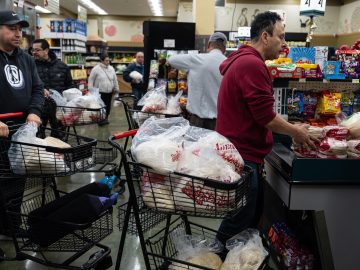
Food assistance was another measure of financial strain. One-third of Hispanic adults said they had obtained food from a food bank or pantry in the previous year, compared with 20% of adults overall and 14% of white adults. Parriva’s reporting on California food banks struggling to keep up as food prices stay high looks at the pressure facing families seeking food assistance.
These findings measure different experiences. Using a food pantry does not necessarily mean someone went hungry, just as difficulty paying a bill does not establish that a payment was missed.
The strain extends beyond paying for necessities. About 37% of Hispanic adults said they could not pay some of their bills or could make only partial payments in a typical month. That compared with 27% of adults overall and 20% of white adults.
Emergency savings were also limited. Two-thirds of Hispanic adults, or 66%, said they lacked enough emergency funds to cover three months of expenses. The figure was 53% among adults overall.
And 73% of Hispanic adults said they did not currently have enough income to lead the kind of life they wanted. Only 35% said they had been able to save for the future in the past year, compared with 45% of adults overall.
Many were also cutting back: 76% of Hispanic adults said they had reduced spending on extras such as eating out or streaming services.
Income helps explain some of the differences. Pew found that 71% of lower-income adults struggled to afford at least one of the four necessities, compared with 39% of middle-income adults and 13% of upper-income adults. The report cautions that income accounts for part of the differences across demographic groups, but its published comparisons do not establish how much income explains the gap between Hispanic and white adults.
Among adults who had trouble affording a necessity, 50% said they borrowed money from friends or family, and 31% took out a payday or other short-term loan. Pew did not provide separate figures for Hispanic adults on those questions.
A separate research from the UCLA Latino Policy and Politics Institute offers another piece of context for California workers. In 2025, Latinas earned 64 cents for every dollar earned by white men nationally, based on median hourly wages. In California, they earned 54 cents per dollar.
The wage findings and Pew’s survey measure different things. They do not establish that the wage gap caused the financial hardship reported by Hispanic adults, but they highlight a disparity relevant to understanding economic opportunity for Latinas.
Will affordability shape the midterms?
Economic concerns are also on voters’ minds as the Nov. 3 midterm elections approach.
In a separate Pew survey conducted July 6-12, 2026, 29% of registered voters named the economy as the issue they most wanted congressional candidates to discuss. Another 15% specifically mentioned cost of living or affordability, according to Pew’s analysis of voters’ priorities for the 2026 midterms.
But the surveys do not answer whether financial hardship will change how Latino voters cast their ballots. Pew’s affordability findings cover U.S. adults, not just registered or likely voters, and the voter-priority results are not specific to Latino voters.
For households struggling to cover essentials, the findings point to a challenge that goes beyond any single bill: meeting today’s expenses while trying to build enough savings to handle tomorrow’s. How that pressure translates into local experiences in Los Angeles County and into voting decisions requires more evidence.