Los Angeles has moved thousands of unhoused residents indoors through Mayor Karen Bass’ signature program. The harder question is what happens next—and whether the city is measuring success by placements or lasting housing.
Getting someone off a Los Angeles sidewalk and into a hotel room is a meaningful change.
But it is not necessarily the same thing as ending that person’s homelessness.
That difference is becoming increasingly important as Los Angeles evaluates Inside Safe, Mayor Karen Bass’ signature homelessness program, and voters prepare to choose the city’s next mayor.
Since its launch in December 2022, Inside Safe has been designed to move people from encampments into interim housing and ultimately permanent housing. The city’s Inside Safe program describes the strategy as a housing-led approach to getting people indoors and connecting them with services.
The harder question is what happens after people go inside.
Getting inside is not the same as getting housed
There are three different measurements that can easily get mixed together:
Placement: Did someone move from the street into interim housing?
Retention: Did that person remain housed?
Outcome: Did that person ultimately move into permanent housing and remain there?
Those are not the same thing.
Inside Safe has clearly produced placements. But independent reporting based on Los Angeles Homeless Services Authority data found that about 40% of people moved indoors through Inside Safe had returned to unsheltered homelessness by December 2025. The Los Angeles Times also reported that the program had cost the city more than $300 million.
That does not mean Inside Safe has done nothing.
It means moving someone indoors and permanently ending homelessness are different outcomes.
What the numbers show
The city has continued to point to people moved indoors and permanent-housing placements as evidence of progress.
There is a legitimate reason to count those results.
For someone sleeping outside, a hotel room can mean safety, a bathroom, protection from weather and a chance to reconnect with services. The city says Inside Safe teams continue to monitor previous operation sites, work with unhoused residents and connect people with housing and supportive services when resources are available.
But permanent housing is a different milestone.
Earlier reporting by CalMatters illustrates the gap. In October 2024, the publication reported that Inside Safe had moved 3,254 people into hotels, with nearly 23% subsequently moving into permanent housing. The percentage had improved substantially from the program’s early months, but many people still had not reached permanent housing.
More recent reporting suggests the retention problem remains significant.
That raises a better question than simply asking whether Inside Safe “works.”
What counts as success?
Los Angeles’ broader homelessness numbers complicate the picture
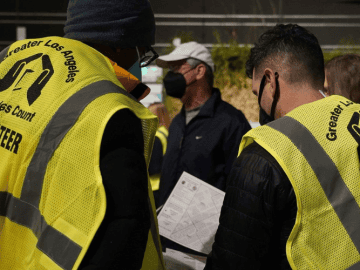
The latest Greater Los Angeles Homeless Count adds another piece of evidence.
LAHSA’s 2026 count found 45,194 people experiencing homelessness in the city, while the number of people experiencing homelessness without shelter increased 7.9% from the previous year.
That is important context.
But it does not prove that Inside Safe caused homelessness to increase.
Homelessness is affected by housing costs, rents, evictions, income, availability of permanent housing, behavioral-health needs and other factors.
So the evidence does not support the simple claim that Inside Safe caused the city’s 2026 increase.
It supports something narrower:
The number of people moved indoors does not, by itself, tell us how many people permanently exited homelessness.
Parriva’s 2026 Los Angeles homelessness analysis provides the broader context for understanding the city’s changing homelessness numbers and their impact on Los Angeles communities.
So how should Los Angeles measure Inside Safe?
A clearer evaluation would put at least three numbers side by side:
1. How many people entered interim housing?
This measures the program’s immediate reach.
2. How many remained housed?
This measures retention.
3. How many moved into permanent housing and remained there?
This measures the outcome most people ultimately care about.
That framework does not dismiss interim housing.
A temporary room can be enormously important to someone who has been sleeping outside.
But it also prevents a placement from automatically being treated as a permanent solution.
A program that moves 1,000 people indoors but permanently houses 100 has produced a different result from one that moves 700 indoors and permanently houses 300.
The placement number alone cannot tell us which program performed better.
Why this matters in the mayor’s race
Homelessness is one of the defining issues in Los Angeles’ 2026 mayoral contest.
Bass has made Inside Safe a central part of her record. Her administration points to people moved indoors and the program’s role in addressing encampments.
Critics argue that Los Angeles needs to focus much more heavily on permanent housing and long-term outcomes.
Parriva’s political coverage has examined the competing claims surrounding the Bass-Raman mayoral race and the city’s homelessness debate. The useful lesson for voters is the same here: separate a political claim from the underlying evidence.
Inside Safe should be evaluated the same way.
The question is not whether the program has produced any successes.
It clearly has.
The question is whether it is producing enough lasting housing outcomes to justify its cost and scale—and how those results compare with other approaches.
What the evidence cannot tell us
The available data cannot tell us that every person who returned to the street represents a failure of Inside Safe.
It cannot tell us that everyone who entered the program would have remained homeless without it.
And it cannot establish that another strategy would have produced better results without a credible comparison.
It would also be misleading to divide the program’s total placements by its permanent-housing placements and call the result a simple “success rate” when the underlying figures can represent different cohorts and time periods.
What the evidence can tell us is simpler:
Placement, retention and permanent housing are different things.
Los Angeles needs to know all three.
The room is important. The destination matters more.
For someone living on a sidewalk, getting a room can be a major victory.
It can provide safety, stability and a chance to begin again.
But if that person eventually returns to the street, the underlying housing problem remains.
That is why the most important Inside Safe number may not be how many people the city gets indoors.
It may be how many people stay housed.
For taxpayers, policymakers and voters, that is the measurement that deserves the closest attention.