Small businesses are supposed to anchor local economies. New UCLA research shows how immigration enforcement, falling customer traffic and financial pressures are testing whether the systems supporting them actually work.
From taco stands in South LA to fast food counters across the county, small businesses are often called the backbone of local economies. But when raids empty the streets, rents keep climbing, and credit stays out of reach, the question isn’t whether small businesses matter, it’s whether the system holds up its end of the bargain.
It’s a line politicians and economists repeat so often it barely registers as a claim anymore: strong small businesses, from restaurants to research startups, sustain economic growth, bolster supply chains, create jobs, and support the neighborhoods that attract workers and employers in the first place.
It’s also, by most measures, true. Small businesses make up nearly all U.S. businesses and employ close to half of the private-sector workforce. Every dollar spent at a local restaurant or shop tends to circulate closer to home than money spent at a national chain, paying a local landlord, a local supplier, a local worker. Economists call it the multiplier effect. City planners call it what makes a neighborhood worth walking through.
But that claim was built for ordinary times. The real test is what happens to it when the economy itself is under strain, and Los Angeles right now offers no shortage of evidence either way.
A Taco Stand Still Standing
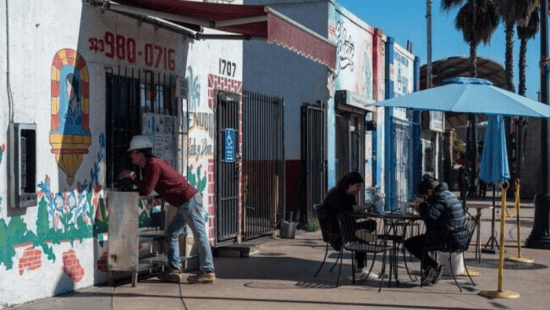
Rosa López Lorenzo, owner of Chapos Tacos in South Los Angeles, has lived the last several months on the sharper edge of that test. Immigration raids have kept customers off the streets. The cost of running the business keeps climbing. And still, she opens every day.
“Yo le lucho y le encuentro la manera,” she said. “The economy is bad, the raids have hurt businesses, people avoid going out, that’s hurt us, but that’s no reason to give up.”
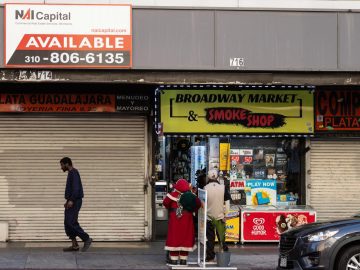
Her story isn’t an outlier. A study from the UCLA Latino Policy and Politics Institute found that 51 percent of business owners surveyed near enforcement activity reported employees missing work out of fear, and 68 percent said they had cut hours, closed temporarily, or operated with reduced staff as a direct result. If small businesses are supposed to be the stabilizing force in a local economy, the data suggests they’re often the first to absorb the shock instead, not the last.
The Capital Gap Nobody Talks About
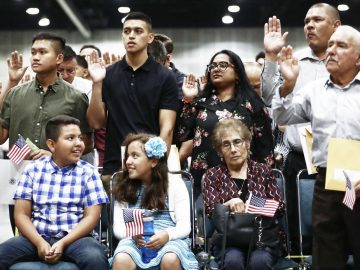
The strain isn’t distributed evenly. Latino-owned businesses in the U.S. grew 34 percent between 2007 and 2019, while white-owned businesses declined 7 percent over the same period, and their payrolls grew more than twice as fast. By that measure, the “small businesses sustain growth” argument holds up remarkably well.
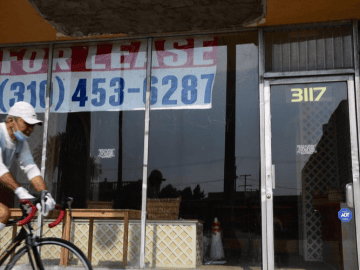
But growth in business formation hasn’t come with equal access to survival tools. Latino-owned businesses apply for bank loans at rates comparable to, or better than, white-owned businesses, yet are approved at significantly lower rates for loans above $50,000, the kind of capital that makes the difference between riding out a bad stretch and closing for good. The businesses doing the most to prove the claim true are often the ones with the least support to keep proving it.
Fast Food, Minimum Wage, and the Limits of Growth
Even outside crisis conditions, the “small businesses create jobs” half of the claim runs into friction fast. When California’s fast food minimum wage rose to $20 an hour in 2024, franchise owners like Behzad Salehi, who operates Blaze Pizza locations in Northridge and Encino, said he cut employee hours by 10 percent and raised prices just to absorb the cost. That’s a small business responding rationally to rising costs, and doing it by shrinking, not growing, its footprint in the local economy.
So, Is It True?
The honest answer is conditional. Small businesses do sustain economic growth, when they have access to capital, when enforcement policy doesn’t empty their customer base, when rising costs don’t outpace what they can absorb. Strip away those conditions, and what’s left isn’t proof that small businesses don’t matter. It’s proof that the systems meant to sustain them, credit access, immigration policy, labor cost support, aren’t holding up their end.
In other words, when small businesses struggle during a crisis, it isn’t the claim that’s being disproven. It’s the support system.