From California and Texas to Minnesota and Wisconsin, eight Latino candidates are pursuing potential political firsts as voters prepare for the November 3 midterm elections.
From California to Texas, Minnesota to Wisconsin, Latino candidates are seeking political breakthroughs as millions of Latino voters prepare to help shape the future of American politics.
The 2026 midterm elections could become another defining moment for Latino political representation in the United States. Across the country, eight Latino candidates are competing for major offices, seeking to break political barriers and bring new voices into Congress and state leadership.
Their campaigns come at a time when the Latino electorate has become increasingly important to the nation’s political future. With the economy, immigration, healthcare, education, and the cost of living dominating the national conversation, Latino voters could play a significant role in determining who controls Congress and who leads several states.
But beyond party politics, these elections raise another important question: Will the growing Latino population translate into greater political representation and influence?
In California, Xavier Becerra is seeking to make history as the state’s first elected Latino governor. The son of Mexican immigrants, Becerra previously served as California attorney general, a member of Congress and U.S. secretary of Health and Human Services. His candidacy represents a potentially historic milestone in a state where Latinos make up approximately 40 percent of the population.
In Texas, Gina Hinojosa is campaigning to become the state’s first Latina governor. A civil rights and labor attorney who has represented Austin in the state legislature, Hinojosa is challenging Republican incumbent Greg Abbott. Her campaign is taking place in a state where Democrats have not won a statewide election since 1994.
Texas is also home to another closely watched Latino candidacy. Tejano music star Bobby Pulido is seeking a seat in the U.S. House of Representatives, challenging Republican incumbent Monica De La Cruz in the 15th Congressional District. His campaign brings an unconventional political background to a district where Latino voters could play an important role in determining the outcome.
In Minnesota, Michele Tafoya is seeking a U.S. Senate seat. Her candidacy carries a potential historic milestone as she seeks to become the first Republican Latina elected to the Senate.
Other candidates are pursuing breakthroughs in states where Latino representation in statewide leadership and Congress remains limited.
In Nebraska, Denise Powell is running for the state’s 2nd Congressional District. If elected, she could become the first Latina to represent Nebraska in Congress.
In Nevada, Teresa Benitez Thompson is competing for the 2nd Congressional District. Her election could make her the first Latina to represent the state in the U.S. House.
Meanwhile, Colorado’s Amanda Gonzalez is seeking the office of secretary of state. Her election could establish another milestone for Latina representation in statewide executive leadership.
In Wisconsin, Milwaukee Common Council member JoCasta Zamarripa is pursuing the secretary of state position. She previously made history as the first Latina elected to the Wisconsin Legislature.
Together, these eight campaigns reflect the diversity of Latino political participation. They also demonstrate that Latino candidates are competing across different political parties, geographic regions, and ideological backgrounds.
The power of the Latino electorate
The significance of these races extends far beyond the candidates themselves.
According to the Pew Research Center, Democrats hold a 51 percent to 24 percent advantage over Republicans among Latino registered voters in the national congressional preference question. However, the numbers also reveal a more complicated electorate. Latino voters who supported Donald Trump in 2024 remain considerably more likely to support Republican congressional candidates, demonstrating that the community cannot be treated as a politically uniform constituency.
Pew also found that 77 percent of Latino registered voters supporting Democratic congressional candidates said it really mattered who won control of Congress, compared with 58 percent in 2022. Additionally, 53 percent said they were extremely motivated to vote, up from 41 percent four years earlier.
These figures suggest that Latino political engagement is growing among important segments of the electorate.
The economy remains a major concern. Rising living costs, housing affordability, healthcare expenses, employment and economic security are central to the decisions facing many Latino families. Immigration enforcement and the treatment of immigrant communities are also important issues, particularly as federal policies continue to shape conversations about belonging, opportunity and civil rights.
For candidates, winning Latino support requires more than speaking Spanish, emphasizing cultural heritage or appearing at community events. Voters are demanding answers to everyday challenges and tangible solutions to the problems affecting their families.
The stakes are particularly significant in states such as Texas, Nevada, California and Colorado, where Latino communities represent substantial portions of the electorate. Their participation can influence congressional contests, statewide leadership and the balance of political power.
Yet representation alone does not guarantee political change. Electing Latino officials is an important milestone, but voters will ultimately judge their representatives by their decisions, policies, and ability to deliver results.
Beyond historic firsts
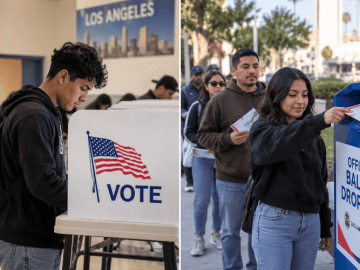
November 3 is therefore about more than eight individual campaigns. It is also an opportunity to examine how the Latino electorate is reshaping American democracy.
For generations, Latino communities have contributed to the country’s economy, culture and civic life while remaining underrepresented in many positions of political power. The candidates competing in these midterms represent different pathways into public service and different visions of leadership.
Their victories or defeats will not determine the future of Latino political influence by themselves. That influence will also depend on voter participation, community organizing, continued civic engagement, and the willingness of elected officials to respond to the needs of their constituents.
The Latino vote is no longer a political afterthought. It is an increasingly important part of the national electoral landscape.
On Election Day, the question will not simply be how many Latino candidates win. It will also be how millions of Latino voters use their collective voice to shape the country’s political direction.