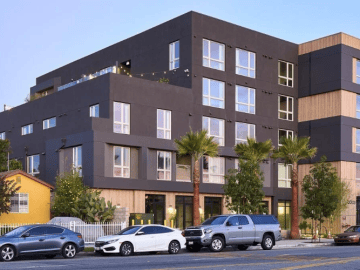
Los Angeles apartments average 818 square feet, leaving renters to balance rising housing costs with the space they need for work, family and everyday life.
In Los Angeles, getting a bigger apartment can mean giving something else up.
A shorter commute. A neighborhood where your family already lives. A school your children know. Or simply enough money left at the end of the month to cover everything else.
That tradeoff is getting harder to ignore.
The average apartment in Los Angeles County is about 818 square feet, according to RentCafe’s latest Los Angeles County rental data. Nationally, the average is about 911 square feet, according to RentCafe’s national rental-market data.
That’s a difference of roughly 93 square feet.
For someone living alone, that may not sound like much. For a family trying to fit children, work, meals and everyday life into the same home, those square feet can matter.
The difference becomes clearer when looking at individual apartment sizes.
In Los Angeles County, the average studio is about 517 square feet. A one-bedroom averages 713 square feet. Two-bedroom apartments average 1,021 square feet, while three-bedroom units average about 1,316 square feet.
Those are averages, not guarantees of what a renter will find.
But they show how quickly the amount of available space changes when a household needs another bedroom.
And in Los Angeles, getting that extra room usually means paying for more than a few additional walls.
It means paying more rent.
The latest RentCafe figures put the countywide average at $2,663 a month. A two-bedroom averages $3,101, while a three-bedroom averages $3,884.
That creates a difficult calculation for renters who need more space but cannot easily absorb a larger monthly payment.
For many Angelenos, the housing decision isn’t simply whether they can find an apartment.
It’s whether they can find one that fits their life.
A smaller apartment may allow someone to stay closer to work, family, schools or public transportation. A larger apartment may provide a separate bedroom for a child, a little privacy for parents or enough room for someone who works from home.
But the larger unit can also mean a rent increase that changes the household budget.
That is especially important for families.
A studio may work for one person. A one-bedroom can work for a couple. But when children enter the picture, the meaning of “enough space” changes.
So does the cost.
For households already sharing space with roommates or extended family, another bedroom can become less of a luxury and more of a practical need.
We have looked at that broader affordability problem before, including why California’s housing crisis can leave families struggling even as the state economy grows.
Los Angeles has spent years dealing with a shortage of housing, and building more homes is an important part of the conversation about supply.
But the number of units is only part of the story.
The size of those homes matters too.
A household can find a place to live and still struggle because the home doesn’t have enough room for the people living there.
That can mean children sharing rooms, parents working at the kitchen table or a living room serving as an office during the day.
These aren’t signs that every household is overcrowded. They’re examples of the kinds of compromises people can make when space is expensive.
And those compromises can shape where people live and how they organize their lives.
That is one reason our recent reporting on whether California’s new housing construction is actually becoming more affordable is key here.
More homes can help.
But the kind of homes being built is meaningful too.
The national apartment is moving in another direction
The contrast becomes more interesting when looking at new construction nationally.
RentCafe reported in August that the average size of a new U.S. apartment reached 910 square feet in 2025, up 13 square feet from the previous year. The analysis looks specifically at apartments completed between 2016 and 2025, so this is a different measure from the overall 911-square-foot national rental average.
RentCafe says several factors are helping push the national average higher, including more new apartments entering the market and larger floor plans in Southern markets.
Los Angeles remains a different kind of market.
What renters experience is simpler.
More space costs money.
That is why apartment size matters beyond a real-estate statistic.
Someone looking for a home may have to decide whether to pay more for another bedroom or stay in a smaller apartment.
They may move farther from work.
They may share with roommates.
They may move in with relatives.
They may stay in a home that no longer fits their needs because moving to something larger would mean a rent increase they cannot afford.
For some renters, even the rent itself is becoming a question of how long they can stay put. Our guide to California’s 2026 rent-increase rules and renter protections looks at another part of that equation: what happens when the monthly cost of staying in the same home changes.
The decisions are not unique to Los Angeles.
But in a region where housing costs are high and space is limited, they can become part of everyday life.
The housing question, then, is not only about whether there are enough homes.
It is also about whether the homes people can afford give them enough room to live.
For some renters, the question is no longer simply whether they can afford an apartment.
It is how much space they can afford to live in.