California’s new plug-in solar law could give renters another way to make some of their own electricity. Here’s what SB 868 changes and what it doesn’t.
If you rent your home, you’ve probably had this thought:
Why would I spend thousands of dollars putting solar on a roof I don’t own?
That’s one reason California’s new plug-in solar law could be worth paying attention to.
SB 868 creates a new path for certain small solar systems that can connect to a home’s electrical system without going through the traditional utility approval process.
For renters and apartment residents, that could open up an option that traditional rooftop solar often doesn’t.
And there’s another difference: you own the equipment.
If you move, you can potentially take it with you.
But before anyone pulls out a credit card, there’s a bigger question:
Will a small solar system save enough money to make it worth buying?
Let’s break it down.
So, what is plug-in solar?
The basic idea isn’t complicated.
Instead of putting a large solar system on your roof, you use smaller panels and equipment designed to send the electricity they produce into your home.
You may hear these systems called plug-in solar, portable solar or balcony solar.
The goal is simple:
Make some of your own electricity. Buy less from the utility.
Under SB 868, a qualifying system can produce no more than 1,200 watts of AC power per dwelling.
It also has to meet California and national electrical standards, carry the required safety certification and include protection that keeps it from sending electricity onto power lines during an outage.
Not every portable solar product you see online automatically qualifies.
What does the new law actually change?
SB 868 was signed Sept. 30 and takes effect Jan. 1, 2027.
For qualifying portable solar systems, the law removes certain utility interconnection requirements.
Put simply, you won’t have to go through the same utility approval process used for a traditional solar installation.
Your utility can still require a simple registration with information such as your address, equipment and system size.
The exemption currently runs through Jan. 1, 2030.
But renters need to pay attention to one important detail:
SB 868 changes utility rules. It doesn’t rewrite your lease.
You may still need your landlord’s permission before putting equipment on a balcony, railing, exterior wall or another part of the property.
Could it really lower your electric bill?
It could.
But let’s keep the expectations realistic.
An 800-watt system, under favorable conditions, could produce roughly 850 to 960 kilowatt-hours of electricity in a year.
If that electricity replaced power costing 30 cents per kilowatt-hour, that’s about $255 to $288 a year in electricity value.
At 36 cents per kilowatt-hour, it’s about $306 to $346.
Those numbers are examples, not guarantees.
Your actual results depend on how much sun the panels get, shade, direction, weather, your electricity rate and how much of the electricity your household uses while the panels are producing it.
Then there’s the question that matters most:
How much did you pay for the system?
A $1,000 system that saves $300 a year is a very different investment from a $3,000 system producing about the same amount of electricity.
That’s why the cheapest-looking panel isn’t necessarily the best deal.
For renters, there’s another advantage
This may be the part that gets the most attention from people who don’t own their homes.
Traditional rooftop solar is tied to the property.
A portable system is different.
You buy it. You own it. And if you move, you can potentially take it with you.
You aren’t necessarily spending money on a permanent improvement that stays behind when your lease ends.
If you move to another apartment or rental home, the equipment could potentially move with you — as long as the new location allows it and the system meets the applicable requirements.
But don’t read that as a blanket right to put solar wherever you want.
Check your lease. Talk to your landlord or property manager. Check building or HOA rules if they apply.
And make sure the new location gets enough sunlight to make the system worthwhile.
We have written before on the barriers that can keep Latino families from benefiting from California’s solar incentives. Why many Latino families are still left behind by California solar incentives
What happens when the power goes out?
A plug-in solar system isn’t automatically backup power.
During a utility outage, qualifying solar equipment is designed to disconnect from the grid. That’s a safety feature. It helps keep electricity from flowing onto power lines while utility crews are repairing them.
If you want electricity during an outage, you’ll generally need a battery and equipment designed to provide backup power.
Portable batteries around 1 kilowatt-hour can cost roughly $500 to $800. Larger 2-kilowatt-hour systems can cost around $1,000 to $1,500 or more, depending on the model and features.
Once you add a battery to a solar system, your total investment can quickly reach $1,000 to several thousand dollars.
But it can also provide something solar-only can’t: stored electricity when the grid isn’t working.
A properly designed backup system could keep important things such as a refrigerator, lights, phones or internet equipment running for a while.
Exactly how long depends on the battery, the refrigerator and what else you’re powering.
The CDC says refrigerated food generally stays safe for about four hours without power if the refrigerator remains closed.
For a family that has already spent money filling the refrigerator, an outage can mean more than sitting in the dark.
It can mean throwing away food and buying it again.
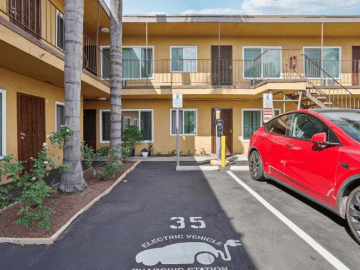
Can it help charge an EV?
Yes, but don’t think of it as a fast EV charger.
California says a Level 1 charger uses a regular 120-volt outlet and generally provides about 5 miles or less of driving range per hour. Level 2 chargers use 208 to 240 volts and provide much more power. California Energy Commission EV charging information
A small solar system can help offset the electricity your home uses to charge your car.
But an 800- or 1,200-watt system is small compared with many Level 2 chargers.
Think of it as helping reduce the cost of charging your EV, not replacing the charger.
Another fact we reported is the challenge California renters face when they don’t have a convenient place to charge an EV.
What about rebates?
California has programs that help some households pay for solar and energy storage.
But don’t assume SB 868 comes with a check from the state.
It doesn’t create a blanket rebate for plug-in solar.
Some programs help qualifying low-income households, homeowners or certain solar-and-storage projects. That doesn’t mean every portable system qualifies.
Before including a rebate in your budget, check the actual program rules and whether the equipment you’re considering is eligible.
Before you buy, ask yourself these questions
Does the system meet California’s requirements?
How much electricity can it realistically produce where I live?
What will the entire system cost?
Do I want a battery for backup power?
If I rent, am I allowed to use the space?
Can I take the equipment with me if I move?
What will my utility require after Jan. 1, 2027?
And finally:
How long will it take for the savings to pay back what I spent?
SB 868 could make a smaller form of solar easier for Californians to consider.
For renters, that’s potentially a big deal.
You don’t necessarily need to own a roof. You own the equipment. And if you move, your solar system can potentially move with you.
For families worried about power outages, adding the right battery and backup equipment could offer another benefit: keeping important appliances and devices running when the grid goes down.
But none of that makes the decision automatic.
A small system still costs money. It needs sunlight. A renter still needs to deal with property rules. And backup power requires the right equipment.
So don’t start with:
“Which solar system should I buy?”
Start with:
“What do I want this system to do?”
If the answer is lower my electric bill, provide backup power, or both, then run the numbers.
The technology may be getting easier. The smart purchase still comes down to the math.