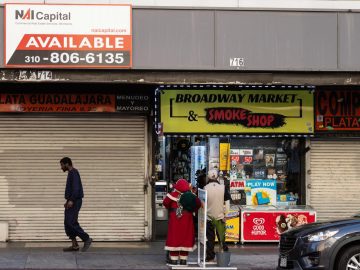
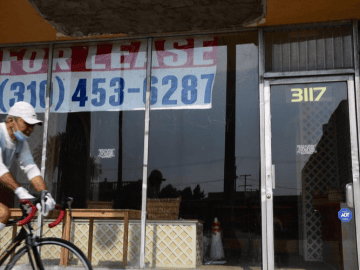
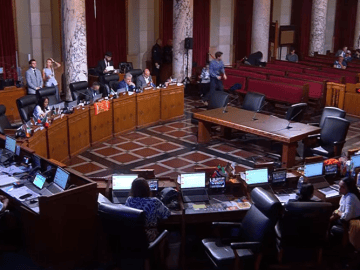
Los Angeles has launched Vacant to Vibrant in Downtown L.A. Here’s how the $500,000 program is supposed to help small businesses move into empty storefronts and what still needs to be answered.
A few days ago, Parriva looked at why so many DTLA storefronts remain empty even as people move back into downtown.
Now Los Angeles is trying something more direct: putting money behind businesses willing to fill some of those spaces.
The question is whether getting a business through the door is enough to keep it there.
On Oct. 2, Mayor Karen Bass launched the city’s first Vacant to Vibrant program in Downtown Los Angeles, with $500,000 in Community Development Block Grant funding. Downtown Works, the nonprofit arm of the Central City Association, is running the program.
For someone thinking about opening a business, the important question isn’t simply whether the city has launched a program.
The question is; Could this make it possible for me to open a storefront and what happens when the help runs out?
How Vacant to Vibrant works
The idea is pretty simple.
Property owners submit empty storefronts. Entrepreneurs apply. Downtown Works matches businesses with spaces based on the business idea, the space and what the business needs.
Once a match is made, participating businesses can receive rent support plus help with permits, build-out and other steps involved in getting the doors open.
CCA describes the process as:
Apply → Match → Activate → Sustain. Downtown Works / CCA Vacant to Vibrant
That last word, sustain, may be the most important one.
Getting a business into an empty storefront is one thing.
Keeping it there is another.
The city says the initial $500,000 will fund the Downtown launch, with additional funding being explored for possible expansion.
But there is still a basic question entrepreneurs need answered:
How much help can one business actually get?
The public program materials describe rent support, permitting help and build-out assistance. They do not currently spell out one standard dollar amount that every participating business receives.
So if you’re considering applying, there are still some numbers you need to know:
- How much of the rent will the program cover?
- How long will that support last?
- Who pays the deposit?
- What about utilities and insurance?
- How much help is available for build-out?
- How are businesses selected?
- What happens when the initial lease ends?
Those details are important.
A business owner can make a plan around temporary rent help. It’s a very different decision if the business has to absorb full market rent soon afterward.
The launch included a real example.
Artist Charlie Alston signed a lease for a new gallery in the Historic Core, bringing a storefront back into use after it had reportedly been closed for about a decade. The project involved Broadway Spring Center and Art/Space 114.
But it is not the same thing as saying L.A. has already completed a large pilot.
San Francisco launched its Vacant to Vibrant program in 2023.
Its first phase opened 18 downtown storefronts, and 11 of those businesses later signed long-term leases. The program has since expanded.
That’s important because San Francisco gives L.A. something it doesn’t have yet:
a track record.
But that track record belongs to San Francisco.
It does not tell us what will happen in Downtown L.A.
And even in San Francisco, opening a storefront and signing a lease are not the same thing as proving a business can keep going for years.
A ribbon cutting is easy to count.
A business that is still paying its bills a year later is more meaningful.
California has changed some of the rules, too
The timing is also worth watching.
California recently enacted AB 1679, which creates a framework for eligible temporary pop-up businesses in vacant commercial space, and AB 2418, which addresses private review of certain nonresidential permits when local review is excessively delayed. Governor Newsom’s legislation announcement
Those laws are not the L.A. Vacant to Vibrant program.
Think of them as separate pieces of the puzzle.
The local program is helping connect businesses with spaces and providing financial and technical support.
The state laws provide additional options for temporary activation and permitting.
How L.A. uses those tools will be key.
What this means if you’re thinking about opening a business
If you’ve been thinking about opening a storefront in Downtown L.A., Vacant to Vibrant is worth looking into.
But don’t start with the question, “How much money can I get?”
Start with the business.
Who is going to buy from you?
What problem are you solving?
How much do you need to sell each month?
What costs will you still have once the program’s help ends?
And can the business support the rent when you’re paying the full bill?
Our reporting on where L.A.’s Latino entrepreneurs go for business support also looks at the networks and organizations entrepreneurs turn to when a loan isn’t enough.
Because a storefront is not the business.
The customers are.
The numbers are.
And the ability to keep the doors open is.
L.A. is starting the clock
Los Angeles is adapting an idea San Francisco has already tested.
But L.A. is at the beginning of its own program.
That means the numbers that will matter most haven’t been written yet.
How many storefronts will actually open?
How many businesses will stay?
How many jobs will be created?
How much public money will each business require?
And how many businesses will still be there after the initial help is gone?
The storefront is only the beginning. The business is the test.