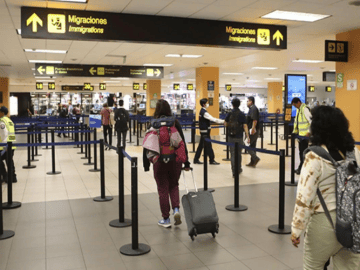
For Southern California, the border with Mexico is more than a line separating two countries.
It is part of the region’s economic infrastructure.
Workers cross it to reach jobs. Customers cross it to shop and eat. Patients travel for health care. Families move between communities. Manufacturers move components across the border as products are assembled on both sides.
That makes the California-Mexico border unusual: the same ports of entry that manage international movement also help sustain an economy that operates across national boundaries.
The scale of that relationship was visible in 2024, when nearly 200,000 daily entries were recorded through California’s ports of entry from Mexico, according to figures compiled by the Smart Border Coalition. During the first four months of that year, millions of people entered by vehicle or on foot.
Those numbers are now historical context rather than a measure of today’s exact traffic. But they illustrate the scale of a system that Southern California businesses have spent decades building around.
And newer evidence shows that dependence has not disappeared.
The San Diego-Tijuana region operates as a binational economy in ways that can be easy to miss when the border is discussed primarily as an immigration or security issue.
San Diego businesses rely on workers who live in Mexico and cross into California. Voice of San Diego reported in 2025 that about 60,000 workers live in Mexico and work in San Diego County. The region’s manufacturing economy is similarly intertwined, with products and components moving between San Diego and Tijuana during production.
That relationship extends into specialized industries.
Companies in the region have developed cross-border production networks in areas including medical devices, electronics and other manufacturing sectors. A California legislative hearing in 2025 highlighted the importance of that cross-border production to Southern California companies.
For those businesses, the border is not simply where a journey ends.
It is part of the production system.
The relationship is also visible on neighborhood streets.
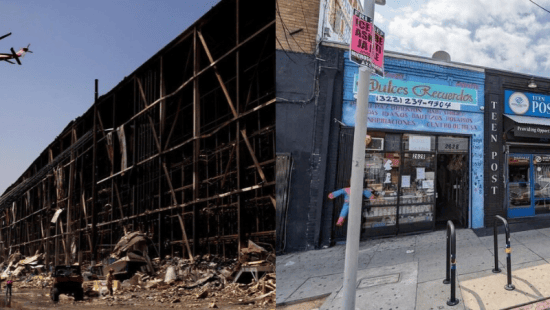
San Ysidro has hundreds of small businesses whose customer base includes people crossing from Mexico. UCLA’s Latino Policy & Politics Initiative counted 964 businesses in the community in 2023, with most employing fewer than 10 people. Retail represented nearly one-quarter of the establishments. (UCLA Latino Policy & Politics Institute)
That creates a business model that is difficult to replicate elsewhere.
A customer who crosses the border may buy lunch, visit a store, fill a prescription or make another purchase before returning home. Multiply that behavior across thousands of trips and the border becomes part of the local commercial ecosystem.
That is why border congestion can become an economic problem.
It was reported in 2024 that San Ysidro business owners were losing customers when long waits discouraged people from crossing. Research cited by the publication from the Atlantic Council also estimated that reducing border wait times by 10 minutes could produce significant additional economic activity.
The important point is not that every delay produces a precisely measurable loss.
It is that time at the border has an economic value.
The border is also a workplace
For cross-border workers, that value can be even more direct.
Someone who lives in Tijuana and works in San Diego is effectively building a daily commute around an international boundary.
The arrangement can make economic sense because housing and other living costs differ substantially between the two sides. But the benefit depends on the border remaining reasonably functional.
Every additional hour in a vehicle or pedestrian line is time that cannot be spent working, caring for family or doing something else.
That makes border efficiency a workforce issue as much as a transportation issue.
And it helps explain why cross-border workers remain part of the region’s economic infrastructure even as the nature of migration at the border has changed.
People are only part of the equation.
Manufacturers in the San Diego-Tijuana region use the border as part of their supply chains. Components can cross multiple times as products are assembled, tested and finished.
That means a delay does not necessarily affect only the truck sitting in line.
It can affect inventory, scheduling, labor and the timing of a finished product.
The broader California-Mexico trade relationship reinforces the scale. California has long identified Mexico as one of its most important international trading partners, while regional transportation agencies have invested in infrastructure designed specifically to improve the movement of people and goods across the border.
The border, in other words, behaves much like other economic infrastructure: when it functions, its importance can become almost invisible. When it does not, the consequences become easier to see.
California is building another crossing
That dependence is one reason the state and regional transportation agencies are investing in a new port of entry at Otay Mesa East.
The State Route 11/Otay Mesa East project is designed to create a new four-lane toll-road connection and a modern land port of entry between San Diego and Baja California. SANDAG says the project is intended to improve mobility and air quality while supporting economic growth and binational trade.
Construction is now underway on portions of the project. Caltrans lists the SR-11/Otay Mesa East Port of Entry as a current District 11 project, with construction continuing on the final segment of the future toll road and connecting ramps.
That investment represents a recognition that border capacity is transportation capacity.
It is also an economic investment.
The California-Mexico border is often discussed through individual issues: immigration enforcement, security, trade, congestion or infrastructure.
For the regional economy, those issues overlap.
A worker needs to cross to reach a job. A customer needs to cross to reach a business. A manufacturer needs to move components. A family needs to visit relatives. A company needs predictable transportation.
The same physical infrastructure serves all of them.
That does not mean every border policy or infrastructure decision has the same economic effect. Nor does it mean that reducing wait times alone can solve every problem facing the San Diego-Tijuana economy.
It does mean that border operations have consequences beyond the checkpoint itself.
The California-Mexico border has become embedded in how Southern California works.
What happens when that infrastructure becomes a bottleneck?
That is the larger economic question.
When crossings move efficiently, the border can facilitate a regional economy that stretches from San Diego to Tijuana and beyond.
When movement slows, the costs can appear in places that do not look like border costs at first: a missed shift, a customer who stays home, a delayed shipment, a worker who loses hours to commuting or a business that has fewer people walking through its doors.
New infrastructure such as Otay Mesa East is an attempt to increase the system’s capacity.
But the underlying economic reality is already here.
Southern California has built businesses, jobs, supply chains and communities around movement between California and Baja California.
The border is not simply where that economy stops.
It is part of the infrastructure that keeps the economy moving.