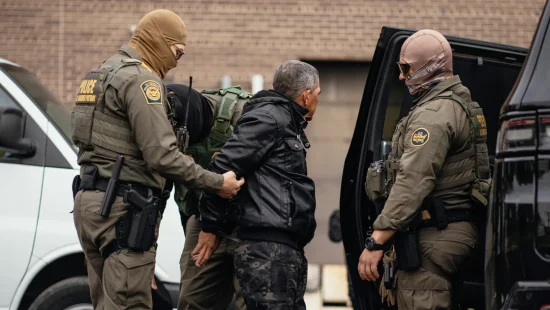
The Purépecha Plateau is on high alert after a violent day of armed attacks, forced disappearances, and roadblocks in at least five municipalities in the central-northwest region of Michoacán. This escalation of violence has forced the deployment of both state and federal security operations.
According to security sources, the current crisis is the result of a violent internal power struggle within the Jalisco New Generation Cartel (CJNG). The instability began after the arrests last April of Audias Flores Silva, alias “El Jardinero” (identified as the successor to Nemesio Oseguera Cervantes, “El Mencho”), and his financial operator, César Alejandro, alias “El Güero Conta.” Intelligence sources indicate that several criminal cells were excluded from the new territorial distribution agreements, triggering the current attacks.
Violence against the indigenous communities of Michoacán has shown a critical surge since the beginning of May, particularly targeting community security forces:
May 6 (Chilchota): Armed men stormed the community of Acachuén, killing two elderly people.
May 17 (Nahuatzen): An attack against the Sevina community guard resulted in the deaths of two kuarichas (indigenous guards).
May 17 (Paracho): Residents of the community of La Cantera reported the kidnapping of ten people by an armed group.
Due to Sunday’s attack, classes were suspended entirely in Sevina on Monday. Former community leaders suspect the attack was not due to a direct conflict, but rather to the community’s strategic geographic location, which serves as a key transit route to Pátzcuaro, Cherán, and Zamora.
The State Government’s Command, Control, Communications, Computing, and Citizen Contact Center (C5) confirmed traffic disruptions in the region due to blockades at strategic points. Among the affected roads are the Carapan-Zacapu highway, near the community of Acachuén; the Jacona-Los Reyes highway, near the community of La Cantera; the San Juan Tumbio-Carapan section, in Sevina; the Carapan-Cocuho highway, near the community of El Coyote; and the Patamban-San Isidro highway, approximately one kilometer past Patamban.
Intense clashes were also reported in the vicinity of the municipalities of Los Reyes and Charapan. In the latter case, the city council issued an urgent statement calling on the population—especially the residents of Cocucho—to remain calm while inter-institutional operations by all three levels of government continue.
Pavel Guzmán Macario, spokesperson for the Supreme Indigenous Council of Michoacán (CSIM), warned that in the last two years, Indigenous communities have suffered nearly 20 armed attacks by organized crime, severely impacting towns such as Sevina, Acachuén, Cherán, Santa Fe de la Laguna, and Ocumicho.
The spokesperson and local authorities harshly criticized the administration of Governor Alfredo Ramírez Bedolla, pointing to its deficient handling of the crisis.
Despite the governor’s commitment to establishing an Inter-institutional Operations Base in Sevina, the promise has yet to materialize.
The CSIM accuses the training and certification processes for community patrols of progressing at a snail’s pace. Nearly 40% of these security forces lack formal weaponry.
The state government only recognizes 50 community patrols belonging to self-governing villages, leaving the remaining 450 Indigenous communities in a legal limbo and unprotected.
Representatives from Acachuén denounced that, following the attack on May 6, the presence of the National Defense Secretariat (Sedena) lasted only three days. “When problems arise, they pretend not to see or hear,” the community leaders lamented, demanding immediate attention to a humanitarian and security crisis that threatens to spiral out of control.