The LAPD has undergone a dramatic demographic transformation. The harder question is whether that change has transformed how Los Angeles experiences policing.
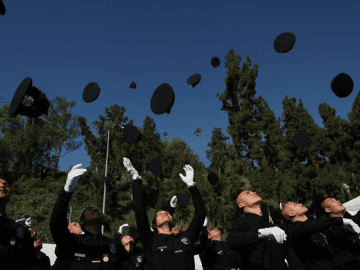
Latinos now make up more than half of the LAPD, and the department’s newest recruiting classes are even more heavily Latino. In the latest graduating class, 17 of 22 LAPD recruits were Hispanic. The recruits completed 904 hours of training over 24 weeks.
The demographic transformation is unmistakable.
The harder question is what that transformation has meant for the people being policed.
The available data do not provide a simple answer. But they show why representation and policing outcomes have to be looked at separately.
The department’s own demographic records show how much its composition has shifted.
In 2020, LAPD reported that roughly half of its sworn personnel were Hispanic, compared with about 30% who were White and 10% who were Black. The department has continued recruiting heavily from Los Angeles’ Latino population since then.
The latest official graduating class provides a snapshot of where that pipeline is heading: 17 Hispanic officers, two Caucasian officers, one Asian officer and one African-American officer among the 22 LAPD graduates.
That means the first part of the story is not really in dispute:
The LAPD looks substantially more like Los Angeles than it did a generation ago.
But demographic representation is not itself an outcome measure.
LAPD’s own 2022 Use of Force Year-End Review provides a useful baseline.
The department recorded 53 categorical use-of-force incidents in 2022, including 31 officer-involved shootings. That was a 16% decline from the 37 officer-involved shootings recorded in 2021.
But shootings represent only a small part of the department’s overall use of force.
The same LAPD report recorded 2,230 non-categorical use-of-force incidents involving 126,736 individual applications of force during 2022. The department also reported that 28% of those non-categorical incidents involved a person officers perceived to be experiencing a mental-health crisis, while 35% involved someone experiencing homelessness.
If the question is whether a more Latino LAPD has changed the experience of being policed, officer-involved shootings cannot provide the entire answer.
We have to dive into what happens across the much larger universe of police encounters.
The racial composition of people involved in officer-involved shootings can reveal a disparity.
It cannot, by itself, explain the disparity.
An officer-involved shooting can involve multiple factors: the location of the encounter, the reason officers were dispatched or initiated contact, whether someone was believed to be armed, perceived threats, resistance, the number of officers present, available alternatives and other circumstances.
LAPD’s own use-of-force framework recognizes that context matters when evaluating force, including the seriousness of the suspected offense, resistance, immediate threat, potential injury, escape, weapons, the number of people involved and environmental or exigent circumstances.
That is why a simple comparison, the racial makeup of officers versus the racial makeup of people subjected to force, cannot establish causation.
Race tells us who was involved.
It does not, by itself, tell us why the encounter unfolded as it did.
The 2024 LAPD archive shows why incident-level evidence matters
LAPD maintains an incident-level archive of its 2024 officer-involved shootings and other critical incidents.
The archive identifies the date, LAPD division, location, person involved, incident number and whether video is available. It also distinguishes shootings in which officers hit someone from shootings in which there were no hits.
That is important because it allows the question to move beyond a single annual percentage.
The incidents occurred across multiple LAPD divisions, including Newton, Southeast, Mission, Foothill, 77th Street, Central, Rampart, Northeast, Harbor, Topanga and others.
The next level of analysis is therefore not simply:
What percentage of people shot were Latino?
It is:
Where did those encounters happen, why did officers make contact, what happened immediately before force was used, and how did those circumstances vary across communities?
That is a much harder question and a more useful one.
A more representative police department may matter for legitimacy, trust, recruitment and relationships with the communities it serves.
But demographic representation alone cannot demonstrate that policing has become less discriminatory, less forceful or more effective.
The seperations is important because an institution can change demographically without every institutional practice changing at the same rate.
LAPD itself recognizes the need to separately review and analyze use-of-force incidents. Its Critical Incident Review Division is responsible for reviewing categorical and non-categorical force, maintaining use-of-force databases and producing the department’s annual statistical reviews.
That structure reflects a basic principle of evidence:
Who works for an institution and what the institution does are related questions, but they are not the same measurement.
The missing part of the story happens before the shooting
Police shootings are highly visible.
Most police encounters are not shootings.
That makes traffic stops, pedestrian stops, searches, arrests, detention and lower levels of force important parts of any serious examination of racial disparities in policing.
California’s statewide data provide useful context.
The California Racial and Identity Profiling Advisory Board’s 2026 report analyzed 5,065,428 stops conducted by 533 law-enforcement agencies during 2024, along with approximately 13,000 civilian complaints. The report found continued disparities in the number and nature of stops involving people perceived as Black, Native American and Hispanic/Latine.
The report is statewide—not an LAPD-specific explanation of Los Angeles shootings.
But the data demonstrate why the experience of policing cannot be reduced to the most extreme encounters.
Los Angeles’ own data on pretextual traffic stops provide another window into what happens before a use-of-force incident.
The underlying issue is straightforward: when officers stop someone for a minor traffic violation as part of an investigation into suspected serious crime, the decision to initiate that encounter becomes part of the policing experience.
That makes stop data relevant to the larger question of institutional change.
It also creates another measurement challenge.
Differences in stop rates do not automatically establish discriminatory intent. Officers may encounter different populations because of geography, calls for service, suspected offenses and other factors. At the same time, disparities can be important evidence requiring further examination.
The distinction is the same one that applies to officer-involved shootings:
A disparity is evidence of a difference. It is not, by itself, proof of its cause.
What has actually changed?
One thing can be established with considerable confidence:
The racial and ethnic composition of the LAPD has changed substantially.
The department’s official records show a force that became majority Hispanic by 2020, while its newest graduating class is even more heavily Hispanic.
What cannot be established from those demographic numbers alone is whether the change has transformed the experience of being policed.
The use-of-force data show why.
The department recorded 31 officer-involved shootings in 2022 alongside thousands of other force incidents and more than 126,000 individual force applications.
California’s broader stop data show continuing racial differences in police encounters.
And LAPD’s incident-level records make it possible to examine the circumstances surrounding individual shootings rather than relying only on annual percentages.
Those pieces point toward a more difficult and more measurable question.
Not simply whether the LAPD looks more like Los Angeles.
But whether the way Los Angeles experiences policing has changed with it.
We have pointed out other ways LAPD policy intersects with Los Angeles communities, including the department’s handling of ICE detention requests, its role in federal immigration enforcement, and the city’s debate over LAPD leadership and sanctuary-city policy.
The faces of the LAPD have changed. The harder question is whether the experience of being policed has changed with them.
That question cannot be answered by demographics alone.
It requires examining who gets stopped, who gets searched, who gets detained, who experiences force and what happens during those encounters.