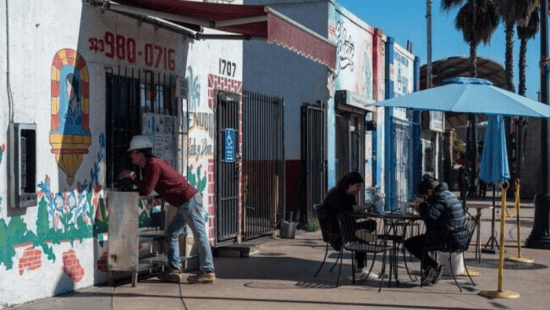
California has spent years expanding access to higher education for undocumented students. But falling enrollment and growing uncertainty over immigration status are raising questions about whether those students still see college as a path to a secure future.
California has spent years building a pathway to higher education for undocumented students.
Through the California Dream Act and other state policies, eligible undocumented students can attend California’s public colleges and universities and apply for state financial aid. The goal has been straightforward: immigration status should not prevent a qualified student from pursuing an education.
But that pathway may be losing some of its appeal.
Last academic year, 35,949 applications for state financial aid came from undocumented students, according to the California Student Aid Commission. That was down from nearly 50,000 five years earlier.
Researchers have also found a sharp decline in enrollment among low-income undocumented students at California’s two major public university systems. Between 2016 to 17 and 2022 to 23, the number of newly enrolled low-income undocumented students at the University of California and California State University systems fell by roughly half.
The numbers raise an important question: Why are fewer undocumented students pursuing college when California has worked to make higher education more accessible to them?
The answer appears to involve more than one factor.
The COVID-19 pandemic disrupted education for millions of students and disproportionately affected families already facing economic challenges. At the same time, immigration enforcement and uncertainty surrounding federal immigration policy have created a different kind of obstacle for undocumented students.
For some, the uncertainty is not about getting into college.
It is about what happens after graduation.
A pathway with an uncertain destination
California can help an undocumented student pay for college. But the state cannot determine whether that student will have federal permission to work after earning a degree.
That distinction has become increasingly important as the future of Deferred Action for Childhood Arrivals, or DACA, remains uncertain.
Created during the Obama administration, DACA provides eligible young immigrants with protection from deportation and employment authorization. But the program is effectively closed to first time applicants. Although U.S. Citizenship and Immigration Services continues to accept initial requests, it cannot approve them or grant the accompanying work authorization under the current court order.
For students deciding whether to spend four or more years earning a degree, that uncertainty can change the calculation.
A college education is an investment of time and money. Students may also be asking whether they will be able to work legally in the careers for which they are preparing.
That does not mean undocumented students have stopped pursuing higher education.
Thousands continue to enroll every year, and California remains one of the states with the most extensive educational opportunities for undocumented students.
But the declining numbers suggest that access alone may not be enough.
California is not the problem
The decline should not be interpreted as evidence that California has abandoned undocumented students.
In many ways, the state has gone in the opposite direction.
California allows eligible undocumented students to qualify for state financial aid through the California Dream Act. The state’s public higher education systems have also developed programs and resources specifically designed to support undocumented students.
The challenge is that California’s ability to help ends at a certain point.
Immigration status is governed primarily by federal law.
That creates an unusual policy gap. California can make college more affordable and accessible, but it cannot guarantee that an undocumented graduate will receive federal authorization to work in the United States.
For students and their families, that distinction can make the value of a college degree more complicated.
The pandemic changed the equation
Researchers studying the decline in undocumented student enrollment have pointed to multiple factors.
The pandemic disrupted college plans, employment and household finances. Students who might otherwise have enrolled were forced to reconsider their education as families dealt with economic uncertainty.
But the pandemic was not the only issue.
Immigration policy has also shaped the environment in which undocumented students make educational decisions.
For young immigrants and their families, changes in enforcement policy can create uncertainty about safety, employment and long term stability. Those concerns can influence whether a student chooses to enroll, where they enroll and whether they believe a four year degree is worth the investment.
The effect can be difficult to measure because students who decide not to attend college do not necessarily leave behind a clear record explaining why.
That makes the enrollment numbers important, but incomplete.
They tell us that fewer students are entering the pipeline.
They do not necessarily tell us what is happening inside the minds of the students who are staying away.
The question California cannot answer
That may be the most important issue facing the state’s higher education system.
California can tell an undocumented student:
You can apply.
You can attend.
You may qualify for state financial aid.
You can earn a degree.
But it cannot necessarily answer the question that comes next:
What happens after graduation?
That answer depends heavily on federal immigration policy.
For a student considering college, the uncertainty can be consequential.
If a student believes that a degree will lead to a career, higher income and greater stability, college can look like a worthwhile investment.
But it is a question that deserves closer examination as the numbers continue to fall.