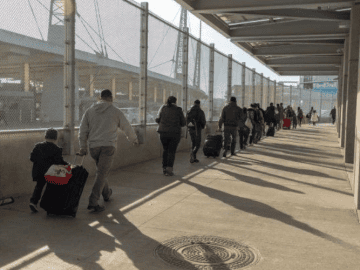
Smugglers are using drones and phone instructions along the Tijuana-San Diego border, authorities say. The practice raises questions about migrant safety and how much control criminal networks exercise over crossings.
Along the Tijuana–San Diego border, smugglers are using drones to watch U.S. Border Patrol agents and phones to tell migrants when and where to move, according to a Border Patrol spokesperson.
The technology gives criminal networks another way to coordinate crossings into California. For migrants, it can mean following instructions from people who are watching enforcement activity remotely.
Gerardo Gutiérrez, a spokesperson for the Border Patrol’s San Diego Sector, described the practice in November 15 reporting by Mexico’s El Universal. He attributed the surveillance to the Sinaloa Cartel, the Jalisco New Generation Cartel and groups linked to the Arellano Félix organization.
His account raises a question beyond the technology itself: What does this kind of surveillance mean for the people being directed across the border?
How smugglers use drones
Drones allow smugglers to observe enforcement activity from the air without placing someone near Border Patrol agents.
According to Gutiérrez, criminal groups now primarily use the aircraft to monitor agents’ movements, although drones have previously carried small quantities of drugs.
Smugglers then communicate with migrants by telephone, telling them when to advance and where they are expected to be picked up, he said.
The practice adds to the digital tools used in human smuggling. Parriva previously examined how online guides and digital information can influence dangerous border crossings.
But authorities have not publicly established how many San Diego-area crossings involve drones or how frequently smugglers use them to direct migrants.
Mexico and the United States have already responded
The surveillance threat is supported by official government reporting.
In September, Mexican and American authorities conducted a coordinated counter-drone operation called Águila Alta.
Mexico’s Defense Secretariat said commercially available drones were being used by criminal groups to monitor authorities during human and drug smuggling.
The operation’s deployment phase ran from September 7 through September 21.
Mexican authorities subsequently reported disabling five drones. One was first detected on the U.S. side before entering Mexico, where Mexican personnel disabled it.
Authorities also reported detaining one suspected operator.
Separately, U.S. Northern Command announced September 4 that its forces had countered more than 300 unauthorized drones along the southern border during 2026.
That number covers the broader border mission, not just San Diego.
The operations demonstrate an official response to drone surveillance. They do not establish how many migrant crossings were prevented.
What does this mean for migrants?
When smugglers coordinate a crossing remotely, migrants may depend on instructions they cannot independently verify.
Someone watching Border Patrol activity could decide when a person should move, wait or continue toward a pickup location.
That arrangement gives smugglers significant influence over decisions made during an already hazardous journey.
However, the reporting reviewed does not establish whether drone-assisted crossings are more dangerous than other smuggling methods or how often migrants are abandoned or harmed.
The concern is not simply that smugglers have better technology. It is that people may be relying on information controlled by criminal networks.
Smugglers are also using the Pacific coast
Gutiérrez described migrants arriving along the San Diego coast aboard personal watercraft and speedboats.
He said some pay between $18,000 and $20,000 for maritime crossings and suggested tighter land-border enforcement has pushed more smuggling toward the ocean.
Those estimates and the claimed increase have not been independently verified.
Maritime smuggling is nevertheless documented. Parriva previously reported on two vessels carrying 45 migrants intercepted near Ensenada.
Travel by sea presents different dangers, including unsafe vessel conditions, weather and limited access to emergency assistance.
What should readers understand?
Three distinctions are important.
First, authorities have documented criminal drone surveillance along the border, but the number of drone-assisted migrant crossings remains unknown.
Second, a drone interception is not necessarily a prevented human-smuggling attempt.
Third, the maritime price estimates and claims of increasing sea crossings require independent evidence.
For migrants and families, these distinctions help separate documented enforcement activity from claims about the risks and scale of smuggling.
The larger story is about how technology allows criminal networks to coordinate people’s movements remotely—and how much remains unknown about the consequences for those making the journey.